

Reading List: Textile Arts
February 18, 2026
By Cori Edmonds-Hutchinson, Discovery Lead, Frick Art Research Library

Among the decorative objects in the permanent holdings of The Frick Collection are a number of rare and notable textiles, including Mughal Indian rugs, Flemish tapestries, and Persian carpets—in addition to the French-woven wall hangings, silk brocades, draperies, upholstery, passementerie, and other fabrics adorning our historic galleries. Elsewhere, pieces such as the sixteenth-century Persian carpet on view in the Living Hall are displayed as both functional objects and works of art.
Perhaps more readily than with other media, the materials, patterns, and uses of textiles are intimately informed by geography, social structure, economy, and personal narrative. It is a feat of modern art history and specialized conservation that textiles have come to be shown in fine art contexts—often fragmented, particularly in the case of centuries-old rugs, and redolent of former domestic use, as with quilts. Despite their fragility, textiles are increasingly celebrated for their skill, influence, and haptic transmission of knowledge and experience.
As the winter season continues to call attention to fiber and knitwear, bundle up with a reading list from the Frick Art Research Library that threads together various textile arts traditions. Browse these books and many others by planning a visit to our reading room!
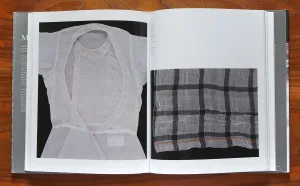
1. Muslin
By Sonia Ashmore (2012)
Across time and geography, trace the history of one particular fabric: muslin. Once a cloth worn in the high Mughal court and profitably traded by India, plain-weave cotton muslin is now regarded humbly, commonly used in the West to make models of final garments. The types, patterns, samples, and reproductions of muslin garments offered by the book—which is also replete with detailed maps—may complicate your perception of this seemingly simple fabric.
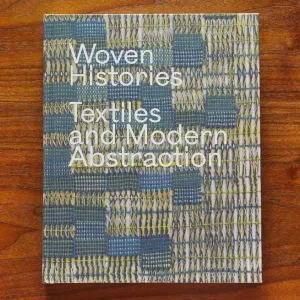
2. Woven Histories: Textiles and Modern Abstraction
Edited by Lynne Cooke (2023)
Enjoy an intertwined history of modernism and textiles, from ceremonial garments to basketry. This volume, published in conjunction with an exhibition organized by the National Gallery of Art, explores the relationship between abstraction and textiles through rich visual illustrations and accompanying essays and reflections. Even the physical form of the book—its cover, endpapers, and typeface—evokes the medium it so vividly describes.
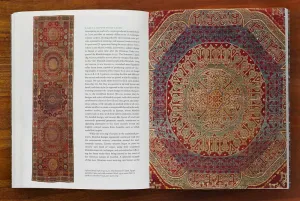
3. How to Read Islamic Carpets
By Walter B. Denny (2014)
Discover sixty examples of Islamic carpets from the collection of The Metropolitan Museum of Art in this engaging introduction to the forms and creation of Islamic textiles. The publication presents research on the production, uses, provenance, and representations of these enchanting carpets. Both utilitarian and decorative examples are represented from across the “Rug Belt,” spanning North Africa, the Middle East, Central Asia, and northern India.
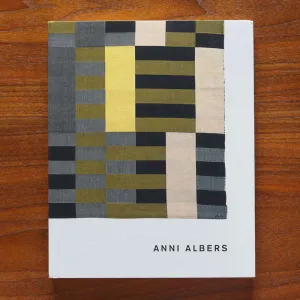
4. Anni Albers
By Ann Coxon, Briony Fer, and Maria Müller-Schareck (2018)
Appreciate the fiber details of German twentieth-century artist Anni Albers in this focused companion to a retrospective exhibition held at the Kunstsammlung Nordrhein-Westfalen and Tate Modern. Albers, a painter turned weaver, contributed to and experimented with abstract modernism via the Bauhaus School. The publication includes contributions by textile scholars, curators, and Nicholas Fox Weber, Executive Director of the Josef and Anni Albers Foundation, among others, along with a detailed glossary with personal definitions of terms used by Albers to describe her practice.
5. The Quilts of Gee’s Bend
By John Beardsley (2002)
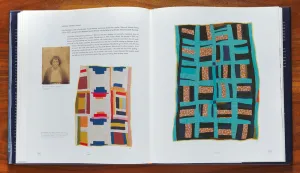
Meet the acclaimed quiltmakers from the regional movement named after the rural hamlet in Boykin, Alabama, known as Gee’s Bend in this catalogue accompanying a traveling display of quilts from the William Arnett Collection of the Tinwood Alliance. Discover how the artists’ works are oriented aesthetically to land, legacy, lineage, and labor. At the heart of the book, photographic portraits of quiltmakers with introductions from themselves and their families are paired with full-page reproductions of associated quilts.
6. Many Hands Make a Quilt: Short Histories of Radical Quilting
By Jess Bailey (2024)
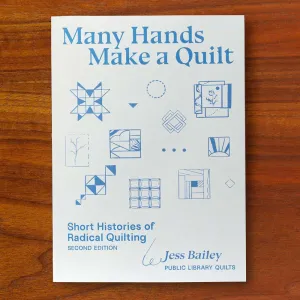
Presented in a short-form zine format with hand-drawn illustrations, this book by Jess Bailey, of the arts education project Public Library Quilts, compiles examples of quilts as material symbols of historical social movements. Bailey includes individual artists working within communal traditions, such as Faith Ringgold, as well as collectives like the Fairton Collective and Navajo Quilting Project, highlighting the community-oriented nature of quiltmaking. Though brief, the text is a rich compendium and features a useful list of further reading.
7. Threads of Power: Lace from the Textilmuseum St. Gallen
Edited by Emma Cormack and Michele Majer (2022)
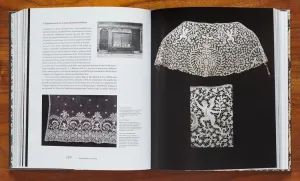
For both lace enthusiasts and novices, this accompaniment to an exhibition at Bard Graduate Center—which showcased more than 150 objects from the Textilmuseum St. Gallen in Switzerland—provides illuminating background on the delicate craft of early modern to present-day European lacemaking. The growth of the industry of lace over time is described in detail, evolving from handheld tools to mechanized production.
8. May Morris: Arts & Crafts Designer
By Jenny Lister, Anna Mason, and Jan Marsh (2017)
Get acquainted with turn-of-the-century English artist May Morris: the youngest daughter of esteemed textile designer William Morris, an active needlecraft artist in her own right, a cofounder of the Women’s Guild of Arts, and a leading member of the Arts and Crafts movement alongside her father. This exhibition catalogue highlights in particular May Morris’s textile design and embroidery in the collections of the Victoria and Albert Museum and William Morris Gallery. The book includes detailed entries, with full-color plates, on selected jewelry, metalwork, and works on paper, all informed by pattern and textiles.

All photos by Joseph Coscia Jr., The Frick Collection