Between 1916 and 1918, Henry Clay Frick purchased several important pieces of porcelain to decorate his New York mansion. Made at Sèvres, the preeminent eighteenth-century French porcelain manufactory, the objects — including vases, potpourris, jugs and basins, plates, a tea service, and a table—were displayed throughout Frick’s residence.
From about 1515 until his death, Andrea del Sarto (1486–1530) ran the most successful and productive workshop in Florence, not only leaving his native city richly decorated with his art but also greatly influencing the art produced in the remainder of the century. By 1700, however, Andrea’s reputation had declined, not to be revived until the publication of monographs by Sydney Freedberg and John Shearman in 1963 and 1965, respectively.
Depicting quotidian life in the country, urban scenes, and imagined views of timeless Arcadian realms, this selection of rarely exhibited landscape drawings from the Frick’s small but superb collection of works on paper reveals thematic continuities across four centuries. The presentation featured the Frick’s newly acquired View of Dieppe Harbor of 1873 by Antoine Vollon, the generous gift of Dr. Carol Forman Tabler.
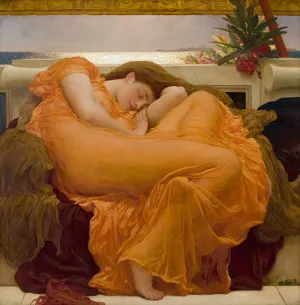
At the end of his career, the British artist Frederic Leighton painted the now-iconic image of a sleeping woman in a vivid orange gown. This nineteenth-century masterpiece embodies the modern philosophy of “art for art’s sake,” the belief that the value of art lies in its aesthetic qualities rather than in its subject matter. The sensuously draped figure — freed from any narrative context — is integrated into a harmonious ensemble of rhythmic lines and radiant color.
Henry Clay Frick had a deep appreciation for Spanish painting, particularly the work of El Greco, the extraordinary Greek artist who, after a brief period in Italy, spent most of his life in Toledo, Spain. Frick traveled to Spain twice and acquired three works by the artist between 1905 and 1913.
A masterpiece of comic fiction, Cervantes’s Don Quixote (fully titled The Ingenious Gentleman Don Quixote of La Mancha) enjoyed great popularity from the moment it was published, in two volumes, in 1605 and 1615. Reprints and translations spread across Europe, captivating the continental imagination with the escapades of the knight Don Quixote and his companion, Sancho Panza. The novel’s most celebrated episodes inspired a multitude of paintings, prints, and interiors.
From November 5, 2014, through February 1, 2015, the Frick presented ten masterpieces of painting from the Scottish National Gallery. The museum, one of the finest in the world, is distinguished for its holdings of works by the greatest masters of Western art and for its comprehensive collection of Scottish art. The exhibition featured paintings from the fifteenth to the nineteenth centuries that invite illuminating comparisons to the Frick's permanent collection.
PLAN YOUR VISIT
Timed tickets are recommended. Members visit free, with no reservations!