

90th Anniversary: The Story of Our Logo
December 9, 2025
By Noah Purdy and Vincent Tolentino, Senior and Assistant Editors for External Affairs
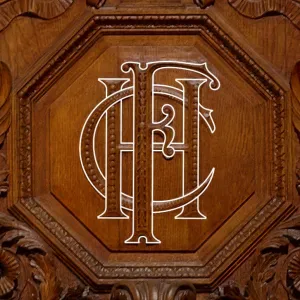
The Frick Collection’s logo appears everywhere: on our website, on tote bags, caps, buttons, books, signs, flags, and more. Look up the next time you visit the museum and you’ll even see it carved in wood above our front doors. You may be able to make out the three letters in the logo, or you may not—either way, you might wonder where they come from and what they mean.
In honor of our 90th anniversary, we’re happy to demystify this visual flourish.

“I do not think this monogram can be misread.”
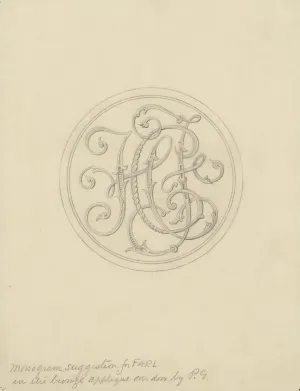
So wrote Porter Garnett—playwright, critic, and graphic artist—in a letter to the Frick’s first director, Frederick Mortimer Clapp. Clapp and a new Board of Trustees oversaw the transformation of the Frick family mansion into a museum, as well as the construction of an adjacent building for the Frick Art Research Library. Both the museum’s and library’s new entrances featured decorative spaces above the doors with blank medallions in the center, which inspired the idea for a new “seal or insignia.”
Garnett was engaged to design a monogram for the library’s entrance on East 71st Street. Simultaneously, the Office of John Russell Pope—the architect who designed the museum’s renovation and the new library building—created a monogram for the museum’s East 70th Street entrance.
Garnett’s assessment may have been optimistic. Both monograms are in fact composed of the three letters HCF, interlaced and enhanced by embellishments. The initials honor The Frick Collection’s founder, Henry Clay Frick, who bequeathed his Fifth Avenue home and art collection to become a museum following his death. It is presumed that the library and museum monograms both refer to him, though his daughter, Helen Clay Frick, a Trustee of the museum and the founder of the Frick Art Research Library, shares his initials.
In 1934, plans for the two monograms were submitted to Clapp and to Helen Clay Frick. Garnett’s library sketch (above) features whimsically curved letters with leaf- and vine-like ornamentation, “carried out in a manner harmonious with the architecture,” as he wrote. It was planned to be cast in bronze.
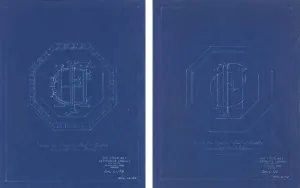
For the museum overdoor, two versions were submitted (above)—one more ornate and one more spare, but both with more linear, geometric lettering than the library version. Clapp described these in his notes as “Louis XIV monograms,” referring to the stately, classical lettering style associated with the French king.
Helen Clay Frick preferred the less ornate version of the Louis XIV monogram (above, right), writing to Clapp, “In my humble opinion, [the second] is vastly the superior of the two!” She signed her note with quiet authority: “HCF.” Helen approved the final design in June 1934.
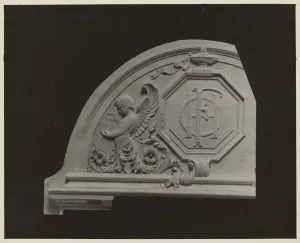
The library and museum monograms were produced and installed in time for the December 16, 1935, opening of The Frick Collection. Throughout the following decades, the museum monogram came to be synonymous with the institution, appearing as a true logo on publications, tickets, press releases, lecture programs, merchandise, and webpages.
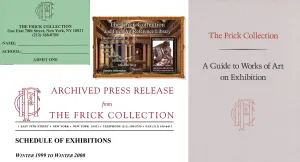
In recent years, the monogram even took on an orange glow with the move to Frick Madison (2021–24), our temporary home during the institution’s recently completed renovation project.

In preparation for the grand reopening of the Frick’s Fifth Avenue buildings in April 2025, our branding got a refresh in collaboration with Abbott Miller and Yoon-Young Chai from the design firm Pentagram. Along with an updated signature “Frick red” color, the monogram was subtly altered to enhance its scalability, with the addition of outline and stencil variations (below). The monogram now functions as a grace note within the Frick’s branding, an avatar that, like a stamp on letterhead, evokes the personal identity behind the institution’s history.

Today, the logo is ubiquitous, whether you visit the Frick’s galleries or reading room, browse the Museum Shop, or explore our website and social media channels. Its meaning may not be immediately apparent, but its elegance and impact remain clear. Forever etched in wood above our doors, the monogram commemorates Henry and Helen Clay Frick, whose onetime home has welcomed visitors and art lovers—for ninety years and counting.