

Mr. and Mrs. Andrews
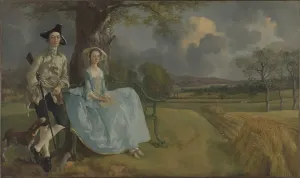
Thomas Gainsborough (1727–88)
Mr. and Mrs. Andrews, ca. 1750
Oil on canvas
27 1/2 x 47 in. (69.8 x 119.4 cm)
The National Gallery, London; Bought with contributions from The Pilgrim Trust, the Art Fund, Associated Television Ltd., and Mr. and Mrs. W. W. Spooner, 1960
Image © The National Gallery, London
One of Gainsborough's best-known works, this painting has been called a "triple portrait" for its depiction of Robert Andrews (1725–1806), his wife, Frances (ca. 1732–1780), and their land with such precision that scholars claim to be able to identify the still-standing oak tree under which they sit at Auberies, near Sudbury. Conversation pieces such as this were already going out of style when Gainsborough painted this composition, which has been called "radical" for the way most of it is devoted to the land. Robert may have requested this expansive view, which also showcases his modern farming techniques, such as the field ploughed in regular furrows. Robert's hunting attire, complete with bags of powder and shot, underscores his status as a landowner (that is, having land on which to hunt), while Frances's hooped dress, straw hat, and pink satin mules show her at the height of fashion. The unfinished passage in her lap may have been intended to be a pheasant, left incomplete as a joke between the artist and sitters regarding Robert's shooting skills or perhaps left to anticipate a child.
Transcript
Speaker: Aimee Ng
After his youthful apprenticeship and early work in London, Gainsborough moved back to his hometown of Sudbury, in Suffolk, around age twenty-one. By the time he created the three small-scale group portraits called “conversation pieces” in this room, this type of portrait was already going out of fashion, and it was largely associated by the London elite with an outdated, provincial style. These were also referred to as “family portraits,” since it was often families pictured together, and it is not clear why the three men in the triple portrait, who come from different social classes, chose to be depicted as a group.
The portrait of the couple, Mr. and Mrs. Andrews, is one of Gainsborough’s most famous paintings. It has been described as a “triple portrait,” portraying Robert Andrews and his wife, Frances, as well as the farmland they owned near Sudbury. Gainsborough went to the same school as Robert, though they were not of the same social class, and the artist was not among the landowners, or landed gentry. Here, Robert wears hunting attire, emphasizing that, beyond the farmland he owns, he also has land to hunt on. The portrait has been called “radical” by modern scholars for Gainsborough’s devotion of so much of the composition to land rather than figures; perhaps it was Robert who wanted it this way, to show off his modern farming techniques as well as the bounties of their productive land. It gave Gainsborough a chance to indulge in his passion for landscape painting. Mrs. Andrews is dressed in a fine, fashionable outfit, down to her pink satin mules, though there is unfinished business in her lap. This blank space may have been left as a joke between the artist and sitter, anticipating a pheasant that Andrews had yet to shoot, or perhaps it anticipates a child.