

Audio
Introduction: Fashion and Portaiture
Audio Introduction
Transcript
Speaker: Aimee Ng
Welcome to the audio guide for the special exhibition Gainsborough: The Fashion of Portraiture. I’m Aimee Ng, Peter Jay Sharp Chief Curator at the Frick, and it is my pleasure to guide you through the show.
Thomas Gainsborough was one of the leading artists of eighteenth-century Britain—which is sometimes referred to as “Georgian” Britain after the four King Georges who ruled from 1714 through 1830. For thousands of years, artists have made portraits to record the appearance of the people around them, and in Georgian Britain, portraits did that and much more. Among other things, they shaped and invented identities, declared social rank, represented alliances, asserted power, and conveyed political views. People traded portraits with each other and gave them as gifts; they displayed them at public exhibitions; and critics wrote about portraits in daily newspapers. Portraits were the most popular form of painting in Gainsborough’s time. Gainsborough, who grew up in the countryside, loved making landscape paintings, but it was portraiture that paid his bills. The twenty-five paintings in this exhibition, which represent some of the highest achievements of Gainsborough’s nearly fifty-year career, are selected from about seven hundred extant portraits by the artist.
This exhibition explores the place of portraits in Gainsborough’s world and their relationship to fashion, which touched nearly every level of British society. What you wore in a portrait, how you were painted, and by whom, could go in and out of style just as clothing did. The trappings and trade of fashion filled Gainsborough’s world—in magazines and tailor shops, at the opera and on promenades—and his portraits were at the heart of it. As a concept, fashion was understood a little differently in Gainsborough’s time. Beyond how people dressed, fashion was also associated with time, making and manufacture, and explicitly to social class. A “person of fashion” was someone who held a social rank below the nobility and above the “vulgar.” One of the most fashionable painters of his day, Gainsborough explored the power of portraiture to shape his sitters’ identities, to show off his signature painting style, and, sometimes, to subvert the rules of British social class.
Thomas Gainsborough (1727–88)
Mr. and Mrs. Andrews, ca. 1750
Oil on canvas
27 1/2 x 47 in. (69.8 x 119.4 cm)
The National Gallery, London; Bought with contributions from The Pilgrim Trust, the Art Fund, Associated Television Ltd., and Mr. and Mrs. W. W. Spooner, 1960
Image © The National Gallery, London
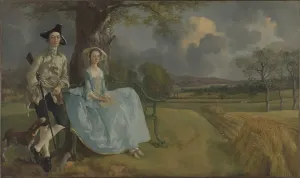
One of Gainsborough's best-known works, this painting has been called a "triple portrait" for its depiction of Robert Andrews (1725–1806), his wife, Frances (ca. 1732–1780), and their land with such precision that scholars claim to be able to identify the still-standing oak tree under which they sit at Auberies, near Sudbury. Conversation pieces such as this were already going out of style when Gainsborough painted this composition, which has been called "radical" for the way most of it is devoted to the land. Robert may have requested this expansive view, which also showcases his modern farming techniques, such as the field ploughed in regular furrows. Robert's hunting attire, complete with bags of powder and shot, underscores his status as a landowner (that is, having land on which to hunt), while Frances's hooped dress, straw hat, and pink satin mules show her at the height of fashion. The unfinished passage in her lap may have been intended to be a pheasant, left incomplete as a joke between the artist and sitters regarding Robert's shooting skills or perhaps left to anticipate a child.
Transcript
Speaker: Aimee Ng
After his youthful apprenticeship and early work in London, Gainsborough moved back to his hometown of Sudbury, in Suffolk, around age twenty-one. By the time he created the three small-scale group portraits called “conversation pieces” in this room, this type of portrait was already going out of fashion, and it was largely associated by the London elite with an outdated, provincial style. These were also referred to as “family portraits,” since it was often families pictured together, and it is not clear why the three men in the triple portrait, who come from different social classes, chose to be depicted as a group.
The portrait of the couple, Mr. and Mrs. Andrews, is one of Gainsborough’s most famous paintings. It has been described as a “triple portrait,” portraying Robert Andrews and his wife, Frances, as well as the farmland they owned near Sudbury. Gainsborough went to the same school as Robert, though they were not of the same social class, and the artist was not among the landowners, or landed gentry. Here, Robert wears hunting attire, emphasizing that, beyond the farmland he owns, he also has land to hunt on. The portrait has been called “radical” by modern scholars for Gainsborough’s devotion of so much of the composition to land rather than figures; perhaps it was Robert who wanted it this way, to show off his modern farming techniques as well as the bounties of their productive land. It gave Gainsborough a chance to indulge in his passion for landscape painting. Mrs. Andrews is dressed in a fine, fashionable outfit, down to her pink satin mules, though there is unfinished business in her lap. This blank space may have been left as a joke between the artist and sitter, anticipating a pheasant that Andrews had yet to shoot, or perhaps it anticipates a child.
Thomas Gainsborough (1727–88)
Mary, Countess Howe, 1763–64
Oil on canvas
94 15/16 × 60 3/4 in. (243.2 × 154.3 cm)
English Heritage, Kenwood House, London; The Iveagh Bequest
Image © Historic England/Bridgeman Images
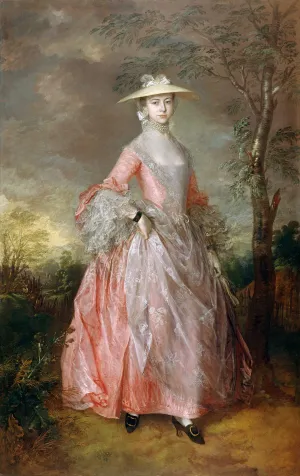
One of Gainsborough's first full-length female portraits, this painting exemplifies the new monumentality and sophistication the artist achieved in Bath, where society figures came from throughout Britain to "take the cure" from the city's thermal springs. Gainsborough pictures Lady Mary Howe (1732–1800)—in 1788, she and her husband would become Earl and Countess Howe—at the height of fashion, from her Leghorn hat (named after the Italian city known for woven straw, Livorno, anglicized "Leghorn") to her heeled shoes fastened with buckles. Her attire, a "nightgown" (loose-fitting dress) of pink silk, is suited to walking, and her decorative lace apron folds back on itself, suggesting movement, as well as showing the artist's ability to render layers of translucency. The black bands at her wrists accentuate the paleness of her skin while her shield-shaped earrings and strings of pearls signal her wealth.
Transcript
Speaker: Aimee Ng
In the early 1750s, leaving the fashion for conversation pieces behind, Gainsborough hoped to grow his business by moving from his hometown to the larger port city of Ipswich. He continued to visit larger cities like London, where his encounters with art and clients inspired him to set his sights on bigger markets. After a sojourn in Bath, in Somerset, he decided to relocate his family there in 1759. Social elites traveled from around the country to “take the cure” in Bath’s healing waters—both drinking it and bathing in it—with many seeking relief from illnesses like gout. Bath had a vibrant social season of balls and concerts for which visitors would bedeck themselves in the newest styles of clothing and accessories. Gainsborough set up his studio and showroom in the heart of the city’s social scene, and, conveniently, his sister set up a millinery shop right next door, selling hats, dresses, and many other elements of fashion. Anyone shopping for clothes could be inspired to have their portrait painted, and vice versa.
In one of Gainsborough’s first female full-length portraits, Mary, Countess Howe is dressed in the height of fashion, from her straw hat (called “Leghorn,” after the Italian city known for its woven straw, Livorno, which was anglicized as“Leghorn”) to her heeled shoes fastened with buckles. The portrait exemplifies the new monumentality and sophistication Gainsborough achieved in Bath, as well as the elevated social status of his new clients. Her pink silk “nightgown”—which was the name for a loose-fitting dress as opposed to sleepwear—was suited to walking, which appears to be what she is doing in the portrait. Walks outside were not just for exercise. People went walking to see and especially to be seen, and Countess Howe wears her finest earrings and five strings of pearls for the occasion.
Thomas Gainsborough (1727–88)
Lords John and Bernard Stuart, after Anthony van Dyck, ca. 1765
Oil on canvas
92 1/2 × 57 1/2 in. (235 × 146.1 cm)
Saint Louis Art Museum; Gift of Mrs. Jackson Johnson in memory of Mr. Jackson Johnson
Image Saint Louis Art Museum
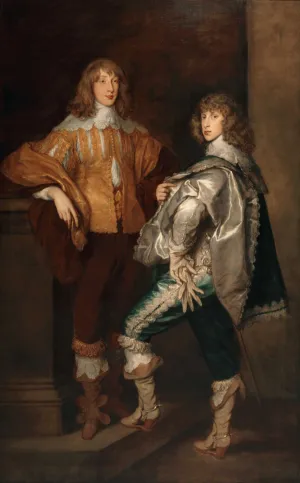
Unlike contemporaries who traveled to Europe to study art, Gainsborough remained in his home country, studying Old Master paintings in prints and in English collections. He emulated—and even collected—paintings by Anthony van Dyck above all others. Some thirty portraits by Gainsborough, dating from the 1760s through to his last years, feature various interpretations of "Van Dyck dress" exemplified in this careful copy after Van Dyck's Lord John Stuart and His Brother, Lord Bernard Stuart of about 1638 (then belonging to the 3rd Earl of Darnley). In this largest and most accomplished of Gainsborough's copies after Old Masters, he closely observed Van Dyck's original while interpreting it in his own style, with swift strokes suited to the depiction of the figures' sensational attire. When Gainsborough painted it is uncertain. He appears to have made it for himself, as it remained in his studio at his death, after which it was purchased by the 4th Earl of Darnley, uniting it with Van Dyck's original.
Transcript
Speaker: Aimee Ng
Unlike contemporaries who traveled to Europe to study art, Gainsborough remained in his home country, studying Old Master paintings in prints and in English collections. Above all, he was inspired by (and even collected) paintings by Anthony van Dyck, who painted for the English court of Charles I in the first half of the seventeenth century. Some thirty portraits by Gainsborough feature various interpretations of “Van Dyck dress,” which Gainsborough studied closely in copies, like this highly accomplished copy after Van Dyck’s Lord John Stuart and His Brother, Lord Bernard Stuart (which then belonged to the Earl of Darnley, was one of Gainsborough’s patrons).
Van Dyck–style dress was popular in British portraiture in part because it connected eighteenth-century sitters to a respectable historic past, suggesting a long lineage connected to the court of Charles I immortalized by Van Dyck. Georgian sitters kept their modern hairstyles, however, such as The Hon. Frances Duncombe, displayed next to this copy of Van Dyck. Her bright blue dress with its standing dog-tooth collar is inspired by Van Dyck style, but her hair is arranged in a tall, powdered pouf, which was the height of fashion in the mid-1770s. Though other artists suggested that Van Dyck dress had gone out of style by the 1770s, Gainsborough continued to probe its possibilities until the end of his life. One of the last paintings he made before his death, if not the very last, is the portrait in the middle of the gallery of Bernard Howard, later 12th Duke of Norfolk, standing elegantly in his black Van Dyck suit.
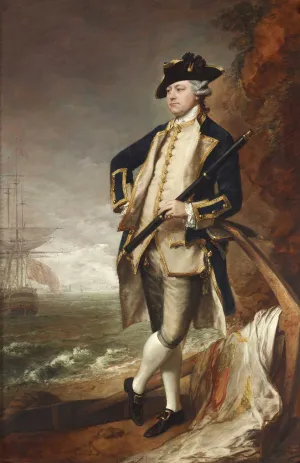
Thomas Gainsborough (1727–88)
Captain Augustus John Hervey, Later 3rd Earl of Bristol, ca. 1768
Oil on canvas
91 5/16 x 60 1/16 in. (232 x 152.5 cm)
National Trust Collections, Ickworth; The Bristol Collection (acquired through the H. M. Government and transferred to The National Trust in 1956)
Image © National Trust Images
Born to a noble family, Augustus John Hervey (1724–1779) entered the navy at age eleven as a captain's servant and eventually rose to become Lord of the Admiralty. Gainsborough conveys Hervey's profession and rank through meticulous rendering of his naval uniform, with details such as the fob hanging from the waist, the sword peeking out from his coat, and the pinky ring. The fort pictured in the distance and what is presumably the Spanish ensign draped over the anchor evoke Hervey's role in the 1762 conquest over the Spanish at Fort Moro, Havana, Cuba, during the Seven Years' War. Hervey suffered from gout and like many contemporaries traveled to Bath for relief. Setting up his studio immediately adjacent to Bath's Pump Room—the center of social activity and source for the city's healing waters—Gainsborough capitalized on the crowds who came to "take the cure" and stayed to have their portraits painted.
Transcript
Speaker: Aimee Ng
As seen in the nearby portrait of a child, John Heathcote, boys and girls were dressed the same until boys were breeched—made to wear breeches—around age seven. In general, men in Georgian Britain had more options than women did to represent their identities in portraits. While women had near endless options of dress and accessories that were constantly going in and out of style, men had the option of being shown at work, such as the auctioneer James Christie, pictured nearby with the paintings it was his job to sell, and of wearing uniform, as in the full-length portrait of Captain Augustus Hervey. Captain Hervey stands proudly in his naval uniform with a scene in the distance evoking the defeat of the Spanish at Fort Moro, Havana, Cuba, during the Seven Years’ War.
Hervey entered the navy at age eleven as a captain’s servant and eventually became Lord of the Admiralty, retiring when he inherited the title of Earl of Bristol. His family had a reputation for outlandish behavior, inspiring the contemporary quip, “God made men, women, and Herveys,” and Captain Hervey was part of a highly public scandal around his estranged wife, Elizabeth Chudleigh, who was charged with bigamy after marrying the Duke of Kingston, making her both a countess and duchess at the same time.
In this stately full-length portrait, Gainsborough conveys Hervey with dignity and emphasizes his profession, rank, and wealth through the setting, uniform, and details like the fob at his waist hanging with his seal (which he would impress into wax on his letters), and what appears to be a diamond pinky ring. Like many contemporaries, Hervey suffered from gout and traveled to Bath for relief, where he met Gainsborough. Hervey commissioned a number of portraits of himself to give as gifts, often to female lovers. Gainsborough’s is the largest of Hervey’s portraits and was made for what was then the Hervey family house, Ickworth, today a National Trust property.
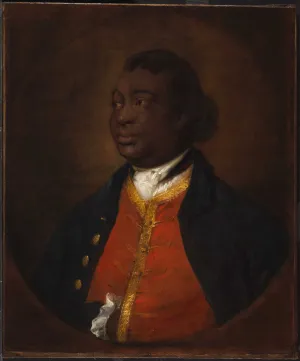
Thomas Gainsborough (1727–88)
Ignatius Sancho, 1768
Oil on canvas
29 × 24 1/2 in. (73.7 × 62.2 cm)
National Gallery of Canada, Ottawa; Purchased 1907
Image National Gallery of Canada
Born on a slaving ship, musician and writer Ignatius Sancho (ca. 1729–1780) was the first known Afro-Briton to vote in parliamentary elections and receive an obituary in the British press. As a child, he was made to work for three sisters who gave him the derogatory name (after the character Sancho Panza in Don Quixote) that he would use thereafter. Upon a chance meeting, he impressed John, 2nd Duke of Montagu, with his intellect and eventually was hired as valet to the husband of the Duchess of Montagu. It was in the company of the Duke and Duchess of Montagu that Sancho sat for this portrait in Bath. In his only portrait of a Black sitter, Gainsborough omits any trace of Sancho's status as a servant, such as picturing him wearing the Montagu livery, which he would have worn when working. Instead, he presents Sancho dressed and posed as a gentleman, with one hand tucked into his waistcoat. The cost of the portrait would have been beyond Sancho's means. It may have been a gift from the Montagus or from Gainsborough himself, who had musical friends in common with Sancho and was known to exchange paintings for music lessons, instruments, and musical compositions.
Transcript
Speaker: Aimee Ng
Gainsborough soon became the most fashionable society portraitist in Bath, and his clients included members of the nobility, like Mary, Duchess of Montagu, in whose portrait (displayed nearby) Gainsborough sensitively captures the beauty of older age. On the other end of the social spectrum is the portrait of the duchess’s servant, Ignatius Sancho. Born on a slaving ship and given the name “Sancho” by three sisters he was made to work for as a child (after the comic character in Don Quixote), Sancho worked as valet to the duchess’s husband, the Duke of Montagu. It was in the company of the Duke and Duchess of Montagu that Sancho sat for this portrait in Bath. In his only portrait of a Black sitter, Gainsborough omits any trace of Sancho’s status as a servant, such as picturing him wearing the Montagu livery, or uniform, which he would have worn when working. Instead, he presents Sancho dressed and posed as a gentleman, with one hand tucked into his waistcoat.
In doing so Gainsborough highlights another side of Sancho’s identity: though he earned his livelihood as a servant, Sancho was an accomplished composer, musician, writer, and abolitionist. He was also the first known Afro-Briton to vote in parliamentary elections and to receive an obituary in the British press. Sancho would not likely have been able to afford a portrait on his valet’s salary. The portrait may have been given as a gift, either from his employers, the Duke and Duchess of Montagu, or from Gainsborough himself, who had musical friends in common with Sancho and was known to trade paintings for musical instruments, lessons, and other things. This is believed to be the only independent portrait of a servant by a major artist of this period, and it remained with Sancho’s family for decades, until Sancho’s daughter gave it to a family friend.
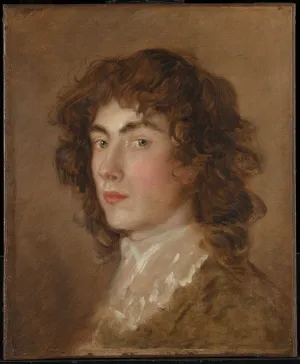
Thomas Gainsborough (1727–88)
Gainsborough Dupont, ca. 1770–72
Oil on canvas
17 15/16 x 14 3/4 in. (45.5 x 37.5 cm)
Tate, London; Bequeathed by Lady d'Abernon, 1954
Image Tate
Gainsborough did not employ a team of assistants like some of his fellow artists. To achieve the signature style of his paintings, he had the help of a single long-term assistant, Gainsborough Dupont (1754–1797), the son of his sister. Gainsborough portrayed his nephew as many as eight times, perhaps inspired by his attractive features or simply because he was a convenient model. Dupont collaborated with his uncle for about two decades as model, assistant, and studio aide. He cultivated a style of painting close to Gainsborough's and, after his uncle's death, achieved limited renown. The unusual size of this canvas and its sketchiness suggest its experimental nature. The turn of the head, sidelong gaze, falling lace collar, and long, full hair reflect Gainsborough's study of Van Dyck and echoes especially the figure of Lord Bernard Stuart in his copy after Van Dyck's portrait. This close connection to Van Dyck's prototype—while showcasing Gainsborough's distinctive paint handling—suggests a date in the early 1770s. An anecdote describes Gainsborough placing a "last head" on his easel at the time of his death. It is thought to have been this painting.
Transcript
Speaker: Aimee Ng
Gainsborough did not employ a team of assistants like other artists. His only long-term assistant was his nephew, Gainsborough Dupont, shown here in a sketchy canvas with shaggy hair and a lace collar clearly inspired by Van Dyck portraits, like the one Gainsborough copied of the Stuart Brothers, shown nearby. Gainsborough painted his nephew probably about eight times, perhaps inspired by his evidently attractive features, or maybe simply because he was a convenient model. The unusual size of the canvas and its sketchiness suggest an experimental nature, and it remained in the artist’s possession until the end of his life. In fact, an anecdote recounts that Gainsborough had placed this painting on his easel at the time of his death.
Gainsborough thought about his own legacy and image. In the weeks before he passed at age 61, he wrote a note to his survivors forbidding anyone to take a likeness of him after his death, allowing one exception: He permitted his late self-portrait—displayed nearby—which he had meant to give his friend Carl Friedrich Abel, to be engraved as a print by one particular engraver. It is unclear why he selected this from among his various self-portraits. Perhaps it was because it had been meant for his dear friend; perhaps, both in its likeness and in its characteristic, loose brushwork, it was both a portrait of the man and of his signature style.

Thomas Gainsborough (1727–88)
Carl Friedrich Abel, ca. 1777
Oil on canvas
88 3/4 x 59 1/2 in. (225.4 x 151.1 cm)
The Huntington Library, Art Museum, and Botanical Gardens, San Marino
Image © Courtesy of the Huntington Art Museum
Said to have lived with his walls covered in Gainsborough's drawings, the German Carl Friedrich Abel (1725–1787) served as chamber musician (with his compatriot Johann Christian Bach) to Queen Charlotte, who once owned this portrait. For this likeness of the composer at work, which may have been intended for Abel and Bach's concert hall in Hanover Square, Gainsborough pictures his friend as if struck by inspiration as he composes for the viola da gamba (precursor to the cello), resting against his leg. The tempo notation allegro ("cheerful") is legible on the score. Abel's other hand rests on a gold snuffbox, possibly a gift from Frederick William of Prussia. Abel was described as "a tall, big, portly person, with a waistcoat under which might easily have been buttoned twin brothers." Gainsborough portrays him elegantly in sumptuous attire—from his bagwig to his brown coat lined in blue satin to leather shoes fastened with buckles—giving no hint of his financial troubles. The composer's snoozing Pomeranian adds an informality to the scene, which was praised at the Royal Academy as "the finest modern portrait" critics had seen.
Transcript
Speaker: Aimee Ng
Gainsborough finally made the move to the capital city, London, in 1774. By now, he was one of the most sought-after society portraitists in the nation, and he sometimes struggled to keep up with the demands of what he referred to, in frustration, as that “curs’d face business.” But he also painted portraits for his friends as gifts or exchanged portraits for something musical, like an instrument or lessons.
He painted this full-length, for example, of his dear friend, the German composer and musician Carl Friedrich Abel, possibly to hang in the concert hall that Abel performed at with Johann Christian Bach. Both Germans were chamber musicians to Queen Charlotte, who also once owned this portrait. It is a flattering image of Abel, who was otherwise described as a portly person, in the midst of composing for his viola da gamba, the instrument resting at his leg. His fine clothing and the gold snuffbox on the table give no hint that Abel was in financial straits.
When Gainsborough showed this portrait at the Royal Academy, critics hailed it as “the finest modern portrait” they had seen, a painting that both caught your eye from a distance and rewarded close looking at its details. Gainsborough imbues the portrait with a sense of relaxed informality, especially through the snoozing dog, which was Abel’s pet Pomeranian. Though pet portraiture was not a particularly fashionable or lucrative business, Gainsborough made an independent portrait of Abel’s Pomeranian with a pup (displayed nearby), which he reportedly gave to Abel in exchange for music lessons. Gainsborough gave as much personality and character to the dogs as he did their owner. Gainsborough painted his last self-portrait for Abel, displayed in this gallery; but Abel died before he could give it to him.

Thomas Gainsborough (1727–88)
Margaret Gainsborough, ca. 1778
Oil on canvas
30 15/16 x 25 1/8 in. (76.8 x 63.8 cm)
The Courtauld Gallery, London; Samuel Courtauld Trust
Image © The Courtauld/Bridgeman Images
Gainsborough married Margaret Burr (1728–1798), the illegitimate daughter of the 3rd Duke of Beaufort, in 1746. The £200 annuity she received from her father's estate helped support the couple's young family early in Gainsborough's career, though being born out of wedlock did nothing to elevate her husband's modest social standing. Gainsborough painted an unusually high number—about thirty—of family portraits that include their daughters, siblings, nephews, and nieces. Reportedly, he painted his wife annually to mark their wedding anniversary. Encircled by a black lace mantle, Margaret was about fifty when she sat for this portrait that, in its intimacy and sympathetic depiction, gives a sense of the artist's affection for his wife after three decades of marriage, not all of them easy. Gainsborough's family portraits would have hung in his showrooms and may have served to present options from which potential clients could choose.
Transcript
Speaker: Aimee Ng
Gainsborough and his wife were teenagers when they married in 1746. Their first child died as a toddler. His wife, Margaret, was the illegitimate daughter of the 3rd Duke of Beaufort, and an annual inheritance from her father’s estate helped support their young family as Gainsborough struggled financially. Her illegitimate birth, even if to a duke, did not help to elevate their social standing, though, reportedly, once accused of dressing above her station, she declared that she was “a prince’s daughter.” Along with disparaging remarks Gainsborough made about his “gentlemen” clients being only good for their money, such anecdotes suggest a tension in the Gainsboroughs’ lives around the status they strived to attain, his subordinate relationship to his clients, and the unrecognized nobility into which Margaret had been born. His many portraits of his family, like this one, suggest that he and his wife saw themselves as people of fashion; he pictured them no differently than paying clientele.
Encircled in a black lace mantel, Margaret was about fifty years old when she sat for this portrait. In its intimacy and sympathetic depiction, it gives a sense of the artist’s affection for his wife after three decades of marriage, not all of them easy. He would not have made money from family portraits, but he may have hung them in his showrooms to show examples of his work and offer clients options for their own portraits.

Thomas Gainsborough (1727–88)
Grace Dalrymple Elliott, 1778
Oil on canvas
92 1/4 × 60 1/2 in. (234.3 × 153.7 cm)
The Metropolitan Museum of Art, New York; Bequest of William K. Vanderbilt, 1920
Image © Metropolitan Museum of Art/ArtResource
Raised in a convent in France after her parents' separation, Grace Dalrymple Elliott (ca. 1754–1823) married Dr. John Elliot at age seventeen but soon earned a reputation for having scandalous affairs with prominent men. Her highly public liaison with the married Lord Valentia led to her husband's 1776 divorce suit and settlement, after which, as was conventional, she continued to use the name "Mrs. Elliott" (spelled with two t's). Here, in the towering hairstyle of the 1770s and a vibrant yellow dress that combines Van Dyck style with elements of masquerade, Elliott gathers her skirts and turns in profile as if returning from a walk into a classicizing architectural space. Her figure lives up to her nickname, "Dally the Tall," a reference to her height. When Gainsborough exhibited this portrait, British newspapers teemed with reports about her relationship with George, 4th Earl of Cholmondeley, who hung this portrait at Houghton Hall. Quoting a poem by Alexander Pope, art critics alluded to her "errors" but, overwhelmed by her beauty, were inclined to "forget them all."
Transcript
Speaker: Aimee Ng
Every summer, crowds piled into London’s Royal Academy to see the latest works on exhibit by the fledgling British School of artists. Art criticism flourished in daily newspapers, with critics praising and criticizing the works on view. Most of these were portraits, and people recognized the faces of actors, aristocrats, and other society figures looking down from their frames, even though the names of the paintings’ sitters were almost always withheld in the printed exhibition catalogues. This elegant full-length, for example, was exhibited as “Portrait of a Lady,” but viewers recognized immediately that it depicted the scandalous Grace Dalrymple Elliott, infamous for her affairs with prominent men. The gossip columns were full of talk about her recent divorce and relationship with George, 4th Earl of Cholmondeley, when Gainsborough exhibited this portrait. He pictures her demurely, turning her face into profile, and dresses her in a somewhat fantastical yellow dress that combines Van Dyck style with elements of masquerade wear, the skirts of which she pulls toward her chest in a gesture of modesty. The critics went wild. While they took every opportunity to mention her scandalous reputation, they found Gainsborough’s portrayal of her ravishing and were willing to forgive all her sins.
This was not the case four years later, when Gainsborough painted a second portrait of Grace, a bust-length portrait of her looking straight out to the viewer, which is shown nearby. The critics were vicious. Maybe it was because she had just given birth to a child—rumored to have been fathered by the Prince of Wales—or maybe it was the frankness with which he presented her here, having shed the modest pose and fantastical dress for a direct, intimate gaze out and her own contemporary clothing that hugged the contours of her breasts. “A wanton countenance,” one critic wrote, “and such hair; good God!”
Critics protested what they deemed to be inappropriate social mixing on the exhibition walls: that a painting of a courtesan hung on the same wall as a royal, both dressed and posed similarly. Fashion in portraits could be dangerous in this way. It could blur the lines of the British social class system, turning a servant into a gentleman and a courtesan into a duchess.
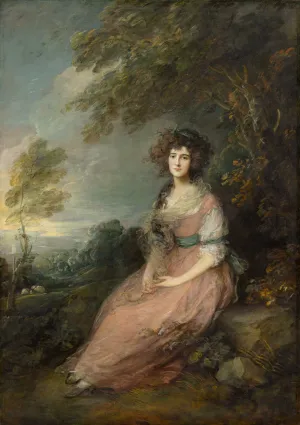
Thomas Gainsborough (1727–88)
Mrs. Sheridan, probably 1783, altered between 1785 and 1787
Oil on canvas
86 1/2 x 60 1/2 in. (219.7 x 153.7 cm)
National Gallery of Art, Washington; Andrew W. Mellon Collection
Image Courtesy National Gallery of Art
A celebrity since childhood, Elizabeth Linley (1754–1792) performed with the Linley family of musicians (her brother's portrait is also in the exhibition). Her beauty and voice attracted immense public attention, but her career came to an end when she married the playwright Richard Brinsley Sheridan, who forbade her to perform anywhere but for private parties hosted by nobles. Gainsborough portrayed Elizabeth several times. A portrait of her as a shepherdess was thought to be lost when technical examination revealed it to be beneath this portrait. Gainsborough had altered the composition, as he sometimes did, years later. Initially depicting her in a bergère hat and with a basket, shepherd's crook, and a lamb or other snouted animal, the artist later painted these elements out, suggesting that the fashion for the pastoral portrait had passed.
Transcript
Speaker: Aimee Ng
Fashion and portraiture are somewhat at odds with each other. Portraits are meant to capture a moment for posterity, freeze a moment in time, while fashion, by definition, is fleeting; everything that comes into style will inevitably go out. The President of the Royal Academy of Arts, Sir Joshua Reynolds, encouraged painters to depict subjects in classical or “timeless” dress. Gainsborough, however, preferred painting his subjects wearing their own modern clothing, even if it meant that they would come back to him years later to have their portraits updated with the latest styles, which they did. This was the case for his portrait of Mrs. Sheridan seated in a landscape. A portrait of Mrs. Sheridan dressed as a shepherdess was thought to be lost when conservators x-rayed this painting to find it hidden under what you see today. Gainsborough originally painted her with a large hat, basket, and a sheep or other snouted animal. Years later, he painted these details out, suggesting that the pastoral style of portraiture was no longer in fashion.
Mrs. Sheridan, born Elizabeth Linley, was a celebrity since she was a child, along with her family, the Linley family of musicians (Gainsborough’s portrait of her brother Samuel Linley is on display in an adjacent gallery). Her voice and beauty brought her fame and attention—not all of it welcome, and her troubling male suitors were the subject of a contemporary play. Her marriage to the celebrated playwright Richard Brinsley Sheridan effectively ended her career as her husband forbade Elizabeth to perform anywhere but for private parties hosted by nobles.
The portrait next to Mrs. Sheridan of Mrs. Moody and her two young sons was also augmented by Gainsborough years after he initially painted it. Originally, Mrs. Moody was pictured alone, standing in the landscape, grasping her pearl necklace in a fashionable full-length portrait. She died shortly after, leaving two very young boys. Her husband brought the painting back to Gainsborough, who agreed to add the sons to the portrait. What had been a fashionable portrait of a beautiful society figure was transformed into a memorial that united a young mother with her sons. Portraits certainly had a superficial function in Georgian life, asserting status and modishness, but they were also about life and death, capturing lives of loved one for posterity, when life itself was as fleeting as fashion.