

Grace Dalrymple Elliott
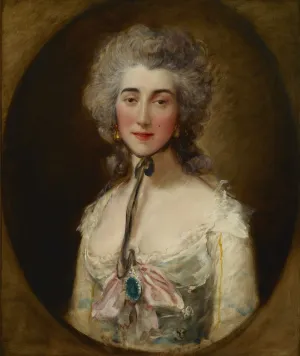
Thomas Gainsborough (1727–88)
Grace Dalrymple Elliott, 1782
Oil on canvas
30 1/8 × 25 in. (76.5 × 63.5 cm)
The Frick Collection, New York
Gainsborough's second portrait of Elliott (see the earlier full-length) offers a more intimate image than the first and attracted more vicious criticism. Whereas the earlier portrait showed her in modest profile, here she faces the viewer directly with her shoulders nearly square, and the bust-length composition brings her close. No longer in fanciful Van Dyck–inspired dress, she wears contemporary attire, with her neckline following the contours of her breasts and a nearly invisible fichu, or kerchief, at her chest. A black ribbon at her chin, cascading to meet a blue jewel, contrasts with her white skin, as do her dark eyebrows and beauty spot—possibly a patch (a piece of velvet affixed to the skin)—and heavily rouged cheeks. Additional scandal accompanied this portrait's exhibition in 1782, fueling the gossip columns. Elliott had just given birth to a child, reportedly fathered by the Prince of Wales but raised in the household of the Earl of Cholmondeley. Reviewers of the exhibition disparaged the portrait as "not a good moral likeness," with her eyes being "too characteristic of her vocation"—that is, her role as a courtesan, or "demi-rep," suggesting the social boundaries of Georgian portraiture.