

Mrs. Sheridan
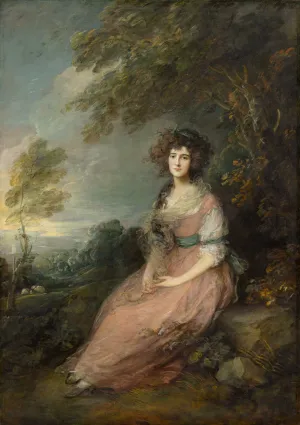
Thomas Gainsborough (1727–88)
Mrs. Sheridan, probably 1783, altered between 1785 and 1787
Oil on canvas
86 1/2 x 60 1/2 in. (219.7 x 153.7 cm)
National Gallery of Art, Washington; Andrew W. Mellon Collection
Image Courtesy National Gallery of Art
A celebrity since childhood, Elizabeth Linley (1754–1792) performed with the Linley family of musicians (her brother's portrait is also in the exhibition). Her beauty and voice attracted immense public attention, but her career came to an end when she married the playwright Richard Brinsley Sheridan, who forbade her to perform anywhere but for private parties hosted by nobles. Gainsborough portrayed Elizabeth several times. A portrait of her as a shepherdess was thought to be lost when technical examination revealed it to be beneath this portrait. Gainsborough had altered the composition, as he sometimes did, years later. Initially depicting her in a bergère hat and with a basket, shepherd's crook, and a lamb or other snouted animal, the artist later painted these elements out, suggesting that the fashion for the pastoral portrait had passed.
Transcript
Speaker: Aimee Ng
Fashion and portraiture are somewhat at odds with each other. Portraits are meant to capture a moment for posterity, freeze a moment in time, while fashion, by definition, is fleeting; everything that comes into style will inevitably go out. The President of the Royal Academy of Arts, Sir Joshua Reynolds, encouraged painters to depict subjects in classical or “timeless” dress. Gainsborough, however, preferred painting his subjects wearing their own modern clothing, even if it meant that they would come back to him years later to have their portraits updated with the latest styles, which they did. This was the case for his portrait of Mrs. Sheridan seated in a landscape. A portrait of Mrs. Sheridan dressed as a shepherdess was thought to be lost when conservators x-rayed this painting to find it hidden under what you see today. Gainsborough originally painted her with a large hat, basket, and a sheep or other snouted animal. Years later, he painted these details out, suggesting that the pastoral style of portraiture was no longer in fashion.
Mrs. Sheridan, born Elizabeth Linley, was a celebrity since she was a child, along with her family, the Linley family of musicians (Gainsborough’s portrait of her brother Samuel Linley is on display in an adjacent gallery). Her voice and beauty brought her fame and attention—not all of it welcome, and her troubling male suitors were the subject of a contemporary play. Her marriage to the celebrated playwright Richard Brinsley Sheridan effectively ended her career as her husband forbade Elizabeth to perform anywhere but for private parties hosted by nobles.
The portrait next to Mrs. Sheridan of Mrs. Moody and her two young sons was also augmented by Gainsborough years after he initially painted it. Originally, Mrs. Moody was pictured alone, standing in the landscape, grasping her pearl necklace in a fashionable full-length portrait. She died shortly after, leaving two very young boys. Her husband brought the painting back to Gainsborough, who agreed to add the sons to the portrait. What had been a fashionable portrait of a beautiful society figure was transformed into a memorial that united a young mother with her sons. Portraits certainly had a superficial function in Georgian life, asserting status and modishness, but they were also about life and death, capturing lives of loved one for posterity, when life itself was as fleeting as fashion.