

Mary, Countess Howe
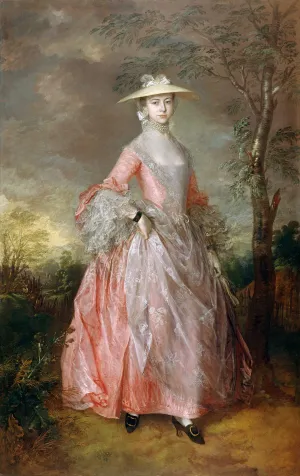
Thomas Gainsborough (1727–88)
Mary, Countess Howe, 1763–64
Oil on canvas
94 15/16 × 60 3/4 in. (243.2 × 154.3 cm)
English Heritage, Kenwood House, London; The Iveagh Bequest
Image © Historic England/Bridgeman Images
One of Gainsborough's first full-length female portraits, this painting exemplifies the new monumentality and sophistication the artist achieved in Bath, where society figures came from throughout Britain to "take the cure" from the city's thermal springs. Gainsborough pictures Lady Mary Howe (1732–1800)—in 1788, she and her husband would become Earl and Countess Howe—at the height of fashion, from her Leghorn hat (named after the Italian city known for woven straw, Livorno, anglicized "Leghorn") to her heeled shoes fastened with buckles. Her attire, a "nightgown" (loose-fitting dress) of pink silk, is suited to walking, and her decorative lace apron folds back on itself, suggesting movement, as well as showing the artist's ability to render layers of translucency. The black bands at her wrists accentuate the paleness of her skin while her shield-shaped earrings and strings of pearls signal her wealth.
Transcript
Speaker: Aimee Ng
In the early 1750s, leaving the fashion for conversation pieces behind, Gainsborough hoped to grow his business by moving from his hometown to the larger port city of Ipswich. He continued to visit larger cities like London, where his encounters with art and clients inspired him to set his sights on bigger markets. After a sojourn in Bath, in Somerset, he decided to relocate his family there in 1759. Social elites traveled from around the country to “take the cure” in Bath’s healing waters—both drinking it and bathing in it—with many seeking relief from illnesses like gout. Bath had a vibrant social season of balls and concerts for which visitors would bedeck themselves in the newest styles of clothing and accessories. Gainsborough set up his studio and showroom in the heart of the city’s social scene, and, conveniently, his sister set up a millinery shop right next door, selling hats, dresses, and many other elements of fashion. Anyone shopping for clothes could be inspired to have their portrait painted, and vice versa.
In one of Gainsborough’s first female full-length portraits, Mary, Countess Howe is dressed in the height of fashion, from her straw hat (called “Leghorn,” after the Italian city known for its woven straw, Livorno, which was anglicized as“Leghorn”) to her heeled shoes fastened with buckles. The portrait exemplifies the new monumentality and sophistication Gainsborough achieved in Bath, as well as the elevated social status of his new clients. Her pink silk “nightgown”—which was the name for a loose-fitting dress as opposed to sleepwear—was suited to walking, which appears to be what she is doing in the portrait. Walks outside were not just for exercise. People went walking to see and especially to be seen, and Countess Howe wears her finest earrings and five strings of pearls for the occasion.