

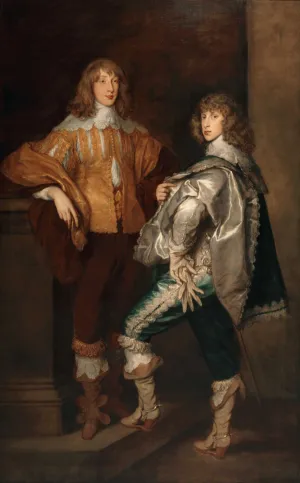
Lords John and Bernard Stuart, after Anthony van Dyck
Thomas Gainsborough (1727–88)
Lords John and Bernard Stuart, after Anthony van Dyck, ca. 1765
Oil on canvas
92 1/2 × 57 1/2 in. (235 × 146.1 cm)
Saint Louis Art Museum; Gift of Mrs. Jackson Johnson in memory of Mr. Jackson Johnson
Image Saint Louis Art Museum
Unlike contemporaries who traveled to Europe to study art, Gainsborough remained in his home country, studying Old Master paintings in prints and in English collections. He emulated—and even collected—paintings by Anthony van Dyck above all others. Some thirty portraits by Gainsborough, dating from the 1760s through to his last years, feature various interpretations of "Van Dyck dress" exemplified in this careful copy after Van Dyck's Lord John Stuart and His Brother, Lord Bernard Stuart of about 1638 (then belonging to the 3rd Earl of Darnley). In this largest and most accomplished of Gainsborough's copies after Old Masters, he closely observed Van Dyck's original while interpreting it in his own style, with swift strokes suited to the depiction of the figures' sensational attire. When Gainsborough painted it is uncertain. He appears to have made it for himself, as it remained in his studio at his death, after which it was purchased by the 4th Earl of Darnley, uniting it with Van Dyck's original.
Transcript
Speaker: Aimee Ng
Unlike contemporaries who traveled to Europe to study art, Gainsborough remained in his home country, studying Old Master paintings in prints and in English collections. Above all, he was inspired by (and even collected) paintings by Anthony van Dyck, who painted for the English court of Charles I in the first half of the seventeenth century. Some thirty portraits by Gainsborough feature various interpretations of “Van Dyck dress,” which Gainsborough studied closely in copies, like this highly accomplished copy after Van Dyck’s Lord John Stuart and His Brother, Lord Bernard Stuart (which then belonged to the Earl of Darnley, was one of Gainsborough’s patrons).
Van Dyck–style dress was popular in British portraiture in part because it connected eighteenth-century sitters to a respectable historic past, suggesting a long lineage connected to the court of Charles I immortalized by Van Dyck. Georgian sitters kept their modern hairstyles, however, such as The Hon. Frances Duncombe, displayed next to this copy of Van Dyck. Her bright blue dress with its standing dog-tooth collar is inspired by Van Dyck style, but her hair is arranged in a tall, powdered pouf, which was the height of fashion in the mid-1770s. Though other artists suggested that Van Dyck dress had gone out of style by the 1770s, Gainsborough continued to probe its possibilities until the end of his life. One of the last paintings he made before his death, if not the very last, is the portrait in the middle of the gallery of Bernard Howard, later 12th Duke of Norfolk, standing elegantly in his black Van Dyck suit.