

Captain Augustus John Hervey, Later 3rd Earl of Bristol
Thomas Gainsborough (1727–88)
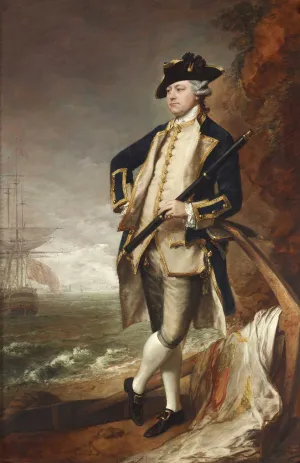
Captain Augustus John Hervey, Later 3rd Earl of Bristol, ca. 1768
Oil on canvas
91 5/16 x 60 1/16 in. (232 x 152.5 cm)
National Trust Collections, Ickworth; The Bristol Collection (acquired through the H. M. Government and transferred to The National Trust in 1956)
Image © National Trust Images
Born to a noble family, Augustus John Hervey (1724–1779) entered the navy at age eleven as a captain's servant and eventually rose to become Lord of the Admiralty. Gainsborough conveys Hervey's profession and rank through meticulous rendering of his naval uniform, with details such as the fob hanging from the waist, the sword peeking out from his coat, and the pinky ring. The fort pictured in the distance and what is presumably the Spanish ensign draped over the anchor evoke Hervey's role in the 1762 conquest over the Spanish at Fort Moro, Havana, Cuba, during the Seven Years' War. Hervey suffered from gout and like many contemporaries traveled to Bath for relief. Setting up his studio immediately adjacent to Bath's Pump Room—the center of social activity and source for the city's healing waters—Gainsborough capitalized on the crowds who came to "take the cure" and stayed to have their portraits painted.
Transcript
Speaker: Aimee Ng
As seen in the nearby portrait of a child, John Heathcote, boys and girls were dressed the same until boys were breeched—made to wear breeches—around age seven. In general, men in Georgian Britain had more options than women did to represent their identities in portraits. While women had near endless options of dress and accessories that were constantly going in and out of style, men had the option of being shown at work, such as the auctioneer James Christie, pictured nearby with the paintings it was his job to sell, and of wearing uniform, as in the full-length portrait of Captain Augustus Hervey. Captain Hervey stands proudly in his naval uniform with a scene in the distance evoking the defeat of the Spanish at Fort Moro, Havana, Cuba, during the Seven Years’ War.
Hervey entered the navy at age eleven as a captain’s servant and eventually became Lord of the Admiralty, retiring when he inherited the title of Earl of Bristol. His family had a reputation for outlandish behavior, inspiring the contemporary quip, “God made men, women, and Herveys,” and Captain Hervey was part of a highly public scandal around his estranged wife, Elizabeth Chudleigh, who was charged with bigamy after marrying the Duke of Kingston, making her both a countess and duchess at the same time.
In this stately full-length portrait, Gainsborough conveys Hervey with dignity and emphasizes his profession, rank, and wealth through the setting, uniform, and details like the fob at his waist hanging with his seal (which he would impress into wax on his letters), and what appears to be a diamond pinky ring. Like many contemporaries, Hervey suffered from gout and traveled to Bath for relief, where he met Gainsborough. Hervey commissioned a number of portraits of himself to give as gifts, often to female lovers. Gainsborough’s is the largest of Hervey’s portraits and was made for what was then the Hervey family house, Ickworth, today a National Trust property.