

Ignatius Sancho
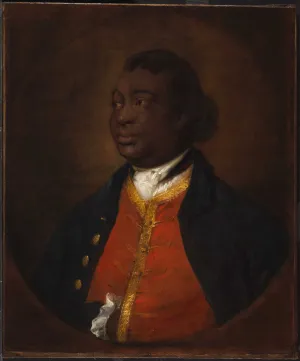
Thomas Gainsborough (1727–88)
Ignatius Sancho, 1768
Oil on canvas
29 × 24 1/2 in. (73.7 × 62.2 cm)
National Gallery of Canada, Ottawa; Purchased 1907
Image National Gallery of Canada
Born on a slaving ship, musician and writer Ignatius Sancho (ca. 1729–1780) was the first known Afro-Briton to vote in parliamentary elections and receive an obituary in the British press. As a child, he was made to work for three sisters who gave him the derogatory name (after the character Sancho Panza in Don Quixote) that he would use thereafter. Upon a chance meeting, he impressed John, 2nd Duke of Montagu, with his intellect and eventually was hired as valet to the husband of the Duchess of Montagu. It was in the company of the Duke and Duchess of Montagu that Sancho sat for this portrait in Bath. In his only portrait of a Black sitter, Gainsborough omits any trace of Sancho's status as a servant, such as picturing him wearing the Montagu livery, which he would have worn when working. Instead, he presents Sancho dressed and posed as a gentleman, with one hand tucked into his waistcoat. The cost of the portrait would have been beyond Sancho's means. It may have been a gift from the Montagus or from Gainsborough himself, who had musical friends in common with Sancho and was known to exchange paintings for music lessons, instruments, and musical compositions.
Transcript
Speaker: Aimee Ng
Gainsborough soon became the most fashionable society portraitist in Bath, and his clients included members of the nobility, like Mary, Duchess of Montagu, in whose portrait (displayed nearby) Gainsborough sensitively captures the beauty of older age. On the other end of the social spectrum is the portrait of the duchess’s servant, Ignatius Sancho. Born on a slaving ship and given the name “Sancho” by three sisters he was made to work for as a child (after the comic character in Don Quixote), Sancho worked as valet to the duchess’s husband, the Duke of Montagu. It was in the company of the Duke and Duchess of Montagu that Sancho sat for this portrait in Bath. In his only portrait of a Black sitter, Gainsborough omits any trace of Sancho’s status as a servant, such as picturing him wearing the Montagu livery, or uniform, which he would have worn when working. Instead, he presents Sancho dressed and posed as a gentleman, with one hand tucked into his waistcoat.
In doing so Gainsborough highlights another side of Sancho’s identity: though he earned his livelihood as a servant, Sancho was an accomplished composer, musician, writer, and abolitionist. He was also the first known Afro-Briton to vote in parliamentary elections and to receive an obituary in the British press. Sancho would not likely have been able to afford a portrait on his valet’s salary. The portrait may have been given as a gift, either from his employers, the Duke and Duchess of Montagu, or from Gainsborough himself, who had musical friends in common with Sancho and was known to trade paintings for musical instruments, lessons, and other things. This is believed to be the only independent portrait of a servant by a major artist of this period, and it remained with Sancho’s family for decades, until Sancho’s daughter gave it to a family friend.