

Gainsborough: The Fashion of Portraiture
Gainsborough: The Fashion of Portraiture
Frick to Present New York’s First Exhibition on the English Artist’s Portraiture
February 12 through May 25, 2026
Updated 01/22/26: This exhibition has been extended through May 25, 2026.
New York (January 15, 2026) — Beginning February 12, 2026, The Frick Collection will present its first special exhibition dedicated to the English artist Thomas Gainsborough, and the first devoted to his portraiture ever held in New York. Displaying more than two dozen paintings, the show will explore the richly interwoven relationship between Gainsborough’s portraits and fashion in the eighteenth century. The works included represent some of the greatest achievements from every stage of this period-defining artist’s career, drawn from the Frick’s holdings and from collections across North America and the United Kingdom.
The trappings and trade of fashion filled Gainsborough’s world—in magazines and tailor shops, at the opera and on promenades—and his portraits were at the heart of it all. This exhibition invites visitors to consider not only the clothing the artist depicted in his paintings, but also the role of his canvases as both records of and players in the larger conception of fashion: encompassing everything from class, wealth, labor, and craft to formality, intimacy, and time. Recent technical investigations also shed light on Gainsborough’s artistic process, including connections to materials—textiles, dyes, cosmetics, jewelry—that fueled the fashion industry.
Gainsborough: The Fashion of Portraiture is organized by Aimee Ng, the museum’s Peter Jay Sharp Chief Curator. Stated Ng, “The spectacular and at times, to modern eyes, absurd fashions in portraits by Thomas Gainsborough continue to fascinate viewers today. The appeal of these demonstrations of taste, status, and wealth persists in tension with increased recognition, over the last few decades, of the injustices that made such extravagance possible. This exhibition necessarily deals with clothing and personal attire, while exploring how fashion was understood in Gainsborough’s time, how it touched every level of society, and how portraiture itself was as much a construction and invention as a sitter’s style.”
THEMATIC THREADS
Gainsborough: The Fashion of Portraiture explores numerous themes threading through the artist’s career, as well as the expansive layers of meaning that fashion held in his time.
Three early works in the show represent the painter’s innovations in the so-called “conversation piece”—including the exceptional loan of Mr. and Mrs. Andrews—which allowed Gainsborough to practice his beloved landscape painting while satisfying the fashionable conventions of what he called the “curs’d Face Business.”
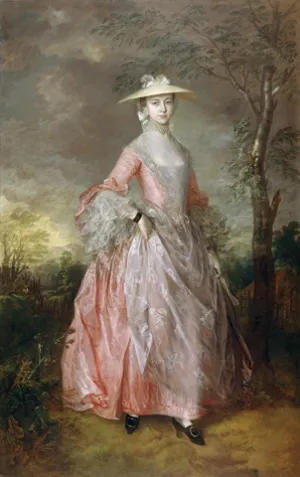
Other works exemplify society portraits’ power to depict subjects not only as fashionable, but as people “of fashion,” which carried deeper meanings of reputation and honorability. In Mary, Countess Howe, Gainsborough meticulously documents every element of a new aristocrat’s attire, while men’s trappings often more readily communicated profession and status, such as a Royal Navy captain’s gold-trimmed uniform.
The exhibition also considers how portraiture both reinforced and challenged social hierarchies, especially for sitters on the margins of the Georgian era’s fashionable class. Among the dukes and duchesses we find portraits of Gainsborough himself and his family members; actors, musicians, and an eccentric inventor; the unrecognized Catholic wife of the Prince of Wales; and even a dog and her puppy.
In one salient pairing, visitors will encounter portraits of Mary, Duchess of Montagu (ca. 1768, Duke of Buccleuch, Bowhill House), and her servant, Ignatius Sancho (1768, National Gallery of Canada). The latter, born into enslavement, became a celebrated composer and one of the most famous Afro-Britons of his time; in his likeness, the artist dresses him in the coat and waistcoat of a gentleman, not in the livery he donned in the Montagu household.
Visitors will also learn about Gainsborough’s use of “Van Dyck dress,” which evokes the Old Master painter from a century earlier. While a copy after Van Dyck is included alongside Bernard Howard, Later 12th Duke of Norfolk (1788, His Grace, the Duke of Norfolk, Arundel Castle, Sussex)—whose billowing black costume emulates his noble ancestors—the style also elevated those without such a legacy, notably the scandal-ridden Grace Dalrymple Elliott.
Finally, portraits could even mark time, from shifting trends to the social “seasons” in London and Bath to youth and aging. Technical examinations reveal Gainsborough’s fascinating practice of reworking pictures, whether to commemorate an unexpected death—as in Mrs. Samuel Moody and Her Sons, Samuel and Thomas (ca. 1799, reworked ca. 1784, Dulwich Picture Gallery, London)—or to update styles like that of Mrs. Sheridan, whose initial portrayal as a shepherdess was reworked years later, when the pastoral look no longer suited her.
PUBLIC PROGRAMMING
The exhibition will be complemented by a robust schedule of public programs, from lectures this winter and spring by Ng and other speakers, a conversation between Ng and fashion designer Isaac Mizrahi in connection with their Frick Diptych volume (see below), a symposium on art and fashion, a pair of seminars, and art-making programs both online and in person. Details for these events and more will be shared at frick.org/programs.
The Frick’s 2025–26 concert season also features musical programming inspired by the exhibition: On April 19, early-music ensemble Ruckus, flutist Emi Ferguson, violinist Rachel Ellen Wong, and countertenor Reginald Mobley will present a program dedicated to the music of Ignatius Sancho, whose portrait is included in the show. On May 3, ensemble-in-residence Sonnambula will explore the celebrated Bach-Abel concerts in eighteenth-century London, highlighting Gainsborough’s circle of musical friends. (Both concerts are sold out, but rush tickets may be made available to e-newsletter subscribers the week of each event.)
ACCOMPANYING PUBLICATIONS
The exhibition is further complemented by a richly illustrated catalogue authored by Ng, with a contribution by Kari Rayner, Associate Conservator of Paintings, J. Paul Getty Museum.
Along with entries for each work, the catalogue features essays on portraiture and self-fashioning in Gainsborough’s era, on materials and techniques that linked clothing and paintings, and on the roles of class and time in eighteenth-century style. The book also touches on the longstanding appeal of Gainsborough’s art, particularly its popularity a century after his death among American collectors such as the Fricks, Vanderbilts, and Huntingtons.
The 200-page exhibition catalogue is funded by Dr. Tai-Heng Cheng and published by Rizzoli Electa in association with The Frick Collection (hardcover $50; softcover $35; members 20% off in-store, 10% online). The book will be available for purchase in the Frick’s Museum Shop, online at shop.frick.org, or by contacting shop@frick.org or 212.547.6849.
Additionally, the exhibition inspired a new volume in the acclaimed Frick Diptych series, whose entries illuminate a single masterpiece from the permanent collection by pairing essays from a curator and a contemporary artist, musician, or other cultural luminary. This volume centers on Gainsborough’s Hon. Frances Duncombe (ca. 1776), with a contribution by fashion designer Isaac Mizrahi alongside an illuminating art historical essay by Ng.
The 80-page hardcover diptych ($29.95; members 20% off in-store, 10% online) will be published in April 2026 by the Frick in association with D Giles Limited. The book will be available for purchase in the Museum Shop and may be pre-ordered at shop.frick.org or by contacting shop@frick.org or 212.547.6849.
EXHIBITION SUPPORT
Leadership support for Gainsborough: The Fashion of Portraiture is provided by an anonymous donor in honor of Ian Wardropper and by the Horace W. Goldsmith Foundation.
Major support is provided by Michael and Jane Horvitz, Dr. Tai-Heng Cheng, Barbara and Bradford Evans, Kathleen Feldstein, Mrs. Natalie Jackson and The Brandt Jackson Foundation, James K. Kloppenburg, Dr. Arlene P. McKay, The Eric & Jane Nord Family Fund for Exhibition Programming, The Helen Clay Frick Foundation, David and Kate Bradford, the Dr. Lee MacCormick Edwards Charitable Foundation, Anita Saggurti, and Katie von Strasser – InspiratumColligere.
Additional support is provided by Margot and Jerry Bogert, Edward Lee Cave, Mr. and Mrs. Hubert L. Goldschmidt, The Honorable and Mrs. Earle Mack, Jennifer Schnabl, Connie Simmons and James D. Krugman, the Malcolm Hewitt Wiener Foundation, Bradley Isham Collins† and Amy Fine Collins, Bosilika An, Denise Mularoni Decker, Siri and Bob Marshall, The Cowles Charitable Trust, Henry J. Campos, Bailey Foote, Alexander Mason Hankin, Brittany Beyer Harwin and Zachary Harwin, Kevin MacKinnon, Laurence Ross Milstein, The Rothman and Rycroft Family, and Otto Naumann and Heidi D. Shafranek.
This exhibition is also supported by an indemnity from the Federal Council on the Arts and the Humanities.
This catalogue is funded by Dr. Tai-Heng Cheng.
Image: Thomas Gainsborough (1727–1788), Mary, Countess Howe, 1763–64, oil on canvas, 94 15/16 × 60 3/4 in. (243.2 × 154.3 cm), English Heritage, Kenwood House, London © Historic England / Bridgeman Images