Past

JMW Turner oil painting of port of Cologne with ship arriving
Turner’s Modern and Ancient Ports: Passages through Time
to

Joseph Mallord William Turner, Britain’s greatest land- and seascape painter of the nineteenth century, explored the theme of the port throughout his career. This exhibition centered around the Frick’s Harbor of Dieppe and Cologne, uniting them with a closely related yet unfinished work from Tate, London, that depicts the harbor of Brest, in Brittany. The trio was accompanied by more than thirty of Turner’s oil paintings, watercolors, sketchbooks, and prints.

Detail of Gouthiere gilt-bronze pot-pourri vase with head of a swan
Pierre Gouthière: Virtuoso Gilder at the French Court
to

The Frick Collection presented the first exhibition on Pierre Gouthière (1732–1813), the great French bronze chaser and gilder who worked for Louis XV and Louis XVI. The exhibition shed new light on the artist’s production, life, and workshop through the presentation of twenty-two objects from public and private collections. Attributed with certainty to Gouthière, these works include clocks, vases, firedogs, wall lights, and mounts for Chinese porcelain and hardstone vases. The exhibition was organized by Charlotte Vignon, Curator of Decorative Arts, The Frick Collection. Based on new art historical and technical research, the exhibition and catalogue promise to transform our understanding of one of the greatest artists of eighteenth-century France.

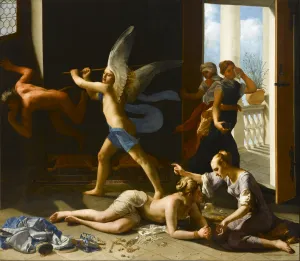
painting with six figures including an angel surrounded by naked and clothed figures
Cagnacci’s “Repentant Magdalene”: An Italian Baroque Masterpiece from the Norton Simon Museum
to

Guido Cagnacci was one of the most eccentric painters of seventeenth-century Italy, infamous for the unconventionality of both his art and his lifestyle. Born in Romagna in 1601, he lived and worked in his native region as well as in Venice, concluding his career in imperial Vienna. His works, mostly religious in subject, are known for their unabashed, often unsettling eroticism, and his biography is no less intriguing.

painting of soldiers standing and seated against wall, circa 1711
Watteau’s Soldiers: Scenes of Military Life in Eighteenth-Century France
to

It would be difficult to think of an artist further removed from the muck and misery of war than Jean-Antoine Watteau (1684–1721), who is known as a painter of amorous aristocrats and melancholy actors. And yet, early in his career, Watteau painted a number of scenes of military life. They were produced during one of the darkest chapters of France’s history, the War of the Spanish Succession (1701–14), but the martial glory on which most military painters trained their gaze held no interest for Watteau.

photo of white porcelain dish decorated with large red dragon and cup-like objects
Porcelain, No Simple Matter: Arlene Shechet and the Arnhold Collection
to

A collaboration with New York−based sculptor Arlene Shechet, this exhibition explored the complex history of making, collecting, and displaying porcelain. About one hundred eighteenth-century pieces produced by the Royal Meissen Manufactory, many from the promised gift of Henry H. Arnhold, were juxtaposed with sixteen of Shechet’s own works.

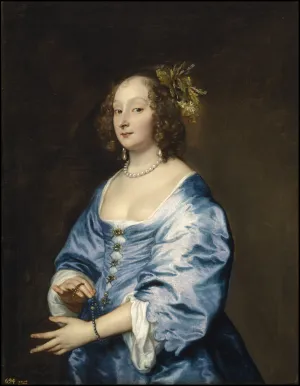
Half length oil portrait of a woman with a blue dress wearing pearls, set against a brown background
Van Dyck: The Anatomy of Portraiture
to

Anthony van Dyck (1599–1641), one of the most celebrated and influential portraitists of all time, enjoyed an international career that took him from his native Flanders to Italy, France, and, ultimately, the court of Charles I in London. Van Dyck’s supremely elegant manner and convincing evocation of a sitter’s inner life — whether real or imagined — made him the favorite portraitist of many of the most powerful and interesting figures of the seventeenth century.

Red chalk profile portrait study of Julius Caesar
Andrea del Sarto: The Renaissance Workshop in Action
to

From about 1515 until his death, Andrea del Sarto (1486–1530) ran the most successful and productive workshop in Florence, not only leaving his native city richly decorated with his art but also greatly influencing the art produced in the remainder of the century. By 1700, however, Andrea’s reputation had declined, not to be revived until the publication of monographs by Sydney Freedberg and John Shearman in 1963 and 1965, respectively.

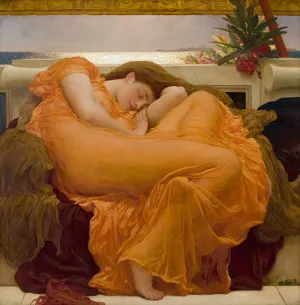
Oil painting of sleeping woman in orange dress curled up on bench
Leighton’s Flaming June
to

At the end of his career, the British artist Frederic Leighton painted the now-iconic image of a sleeping woman in a vivid orange gown. This nineteenth-century masterpiece embodies the modern philosophy of “art for art’s sake,” the belief that the value of art lies in its aesthetic qualities rather than in its subject matter. The sensuously draped figure — freed from any narrative context — is integrated into a harmonious ensemble of rhythmic lines and radiant color.

watercolor landscape of shoreline with sailboats and buildings in the background
Landscape Drawings in The Frick Collection
to

Depicting quotidian life in the country, urban scenes, and imagined views of timeless Arcadian realms, this selection of rarely exhibited landscape drawings from the Frick’s small but superb collection of works on paper reveals thematic continuities across four centuries. The presentation featured the Frick’s newly acquired View of Dieppe Harbor of 1873 by Antoine Vollon, the generous gift of Dr. Carol Forman Tabler.

Green and purple porcelain ship on bronze base
From Sèvres to Fifth Avenue: French Porcelain at The Frick Collection
to

Between 1916 and 1918, Henry Clay Frick purchased several important pieces of porcelain to decorate his New York mansion. Made at Sèvres, the preeminent eighteenth-century French porcelain manufactory, the objects — including vases, potpourris, jugs and basins, plates, a tea service, and a table—were displayed throughout Frick’s residence.