Past

Close-up of tapestry with three shepherdesses dancing
Coypel’s Don Quixote Tapestries: Illustrating a Spanish Novel in Eighteenth-Century France
to

A masterpiece of comic fiction, Cervantes’s Don Quixote (fully titled The Ingenious Gentleman Don Quixote of La Mancha) enjoyed great popularity from the moment it was published, in two volumes, in 1605 and 1615. Reprints and translations spread across Europe, captivating the continental imagination with the escapades of the knight Don Quixote and his companion, Sancho Panza. The novel’s most celebrated episodes inspired a multitude of paintings, prints, and interiors.

Oil painting of virgin and child in garden
Masterpieces from the Scottish National Gallery
to

From November 5, 2014, through February 1, 2015, the Frick presented ten masterpieces of painting from the Scottish National Gallery. The museum, one of the finest in the world, is distinguished for its holdings of works by the greatest masters of Western art and for its comprehensive collection of Scottish art. The exhibition featured paintings from the fifteenth to the nineteenth centuries that invite illuminating comparisons to the Frick's permanent collection.

Oil painting of Jesus Christ banishing people from a temple.
El Greco at The Frick Collection
to

Henry Clay Frick had a deep appreciation for Spanish painting, particularly the work of El Greco, the extraordinary Greek artist who, after a brief period in Italy, spent most of his life in Toledo, Spain. Frick traveled to Spain twice and acquired three works by the artist between 1905 and 1913.

oil painting of man, from waist up, in black and gold armor with helmet on table
Men in Armor: El Greco and Pulzone Face to Face
to

From 1570 to 1576, El Greco (1541–1614) worked in Rome, where he endeavored to establish himself as a portrait painter. The artist’s magnificent Vincenzo Anastagi ― a full-length standing portrait representing the largest of only three examples of his work in this genre to survive from the period ― offers a vital expression of his ambition and invention.

Painting of a half-length woman wearing a round headdress, big blue sleeves, and holding a white fan
The Poetry of Parmigianino’s “Schiava Turca”
to

Born in Parma and known as Parmigianino after his native city, Francesco Mazzola (1503–1540) lived only thirty-seven years, yet his eloquent, innovative art inspired his contemporaries to name him “Raphael reborn” and praise him as one of the greatest painters of his age. During his short life, Parmigianino was especially esteemed for his portraits. Today his Schiava Turca, an exquisite depiction of a young woman, is an icon in the city of Parma and admired as an expression of ideal female beauty in the tradition of Leonardo’s Mona Lisa.

Marble bust of a woman glancing over right shoulder with long, curly hair pulled back and leaves adorning her garment
Enlightenment and Beauty: Sculptures by Houdon and Clodion
to

Jean-Antoine Houdon (1741–1828) and Claude Michel, called Clodion (1738–1814), were two of the foremost sculptors in France during the late eighteenth century, and the Frick housed an important group of their works. In 1915 founder Henry Clay Frick acquired Clodion’s terracotta Zephyrus and Flora and, the following year, Houdon’s marble bust of the Comtesse du Cayla. Other works that were subsequently added to the collection were shown together for the first time, highlighting the artists’ expressive ranges, as well as their defining contributions to the sculpture of Enlightenment-era France. MORE »

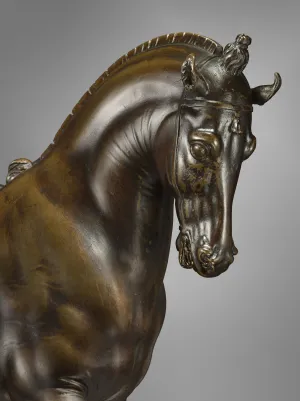
Close up of bronze sculpture of a horse.
Renaissance and Baroque Bronzes from the Hill Collection
to

The Frick Collection was the only venue for the first public exhibition of this private collection devoted to the bronze figurative statuette. The nearly forty sculptures included in the show were of exceptional quality and span the fifteenth through the eighteenth century, exemplifying the genre from its beginnings in Renaissance Italy to its dissemination across the artistic centers of Europe. The Hill Collection is distinguished by rare, autograph masterpieces by Italian sculptors such as Andrea Riccio, Giambologna, and Giuseppe Piamontini. MORE »

Young woman with large pearl earring
Vermeer, Rembrandt, and Hals: Masterpieces of Dutch Painting from the Mauritshuis
to

The Frick Collection was the final American venue of a global tour of paintings from the Royal Picture Gallery Mauritshuis in The Hague, the Netherlands.

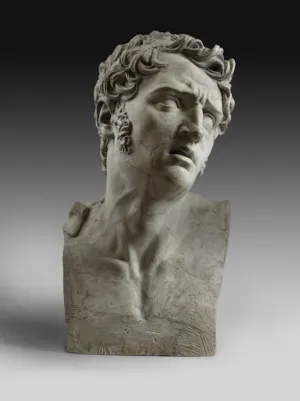
plaster sculpted bust of man, with brow furrowed and head turned
David d'Angers: Making the Modern Monument
to

Lauded by Victor Hugo as the Michelangelo of Paris, French sculptor Pierre-Jean David d’Angers (1788–1856) produced many of the most iconic portraits and ambitious public monuments of the Romantic era. An experimental writer, outspoken Republican, and teacher to some of the greatest sculptors of the nineteenth century, David d’Angers cultivated friendships with an array of contemporary artists, writers, scientists, and politicians — from Honoré de Balzac and Niccolò Paganini to Johann Wolfgang von Goethe and Eugène Delacroix. This exhibition included forty-eight works by David on paper and in wax, terracotta, marble, bronze, and plaster, as well as rare nineteenth-century reproductions of his work in photographs and engravings.

Color print of female clown seated on red bench with legs apart
The Impressionist Line from Degas to Toulouse-Lautrec: Drawings and Prints from the Clark
to

This exhibition presented a selection of nineteenth-century French drawings and prints from the Sterling and Francine Clark Art Institute in Williamstown, Massachusetts. Sheets by Millet, Courbet, Degas, Manet, Pissarro, Gauguin, Toulouse-Lautrec, and other masters are on view. Ranging widely in subject matter and technique and spanning the entire second half of the nineteenth century, these works represent the diverse interests of Realist, Impressionist, and Post-Impressionist artists in a rapidly changing world.