

Faith and Symbols
The works of art in this exhibition were created by the foremost European artists and artisans of their time. They were intended to be used by the Franciscan friars during liturgical ceremonies at the Holy Sepulcher and in other churches of the Holy Land. Many of them have been in continuous use since their creation, typically in solemn ceremonies.
The works of art made for the Custody are visually linked to the site for which they were created and to the events recounted by the Gospels. The Church of the Holy Sepulcher was first built at the time of Emperor Constantine (r. 306–37) to mark the site where Jesus Christ was crucified and the tomb in which he was buried and from which he resurrected. Most objects created for the church depict episodes from the Passion of Christ, culminating in the Resurrection. For Catholics, the symbol of Jerusalem, featured on most of these works, is the Jerusalem Cross, which symbolizes the five wounds that Christ bore at the time of the Crucifixion.

Palestinian craftsmen
Model of the Church of the Holy Sepulcher, 18th century
Olive and pistachio wood, mother-of-pearl, camel bone
13 9/16 × 19 5/16 × 21 1/4 in. (34.5 × 49 × 54 cm)
Terra Sancta Museum, Jerusalem
© The Frick Collection
Throughout the early modern period, Palestinian craftsmen based in Bethlehem created detailed models of the holy sites of Christianity, among them, the Church of the Nativity in Bethlehem and that of the Holy Sepulcher in Jerusalem. These luxurious objects were made with precious local materials, such as exotic woods, mother-of-pearl from shells from the Red Sea, and camel bone and were intended as gifts from the Custody for important donors. The representations of these churches, accurate even in their interiors (the models can be opened, like a dollhouse), also served to show what these buildings looked like to a European audience for whom travel to the Holy Land would have been difficult before the nineteenth century.
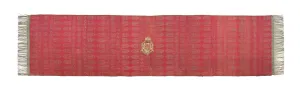
Spain or Middle East
Humeral Veil, late 16th or early 17th century
Silk, gold and silver thread
109 1/16 × 25 13/16 in., 2.8 lb. (277 × 65.5 cm, 1.27 kg)
Terra Sancta Museum, Jerusalem
© The Frick Collection
Between 1187 and 1917, Jerusalem was under Muslim rule, first under the Egyptian Mamluks and later under the Turkish Ottomans. This object reflects the encounter between Islam and Christianity. A Muslim textile for clothing or furnishing was transformed into a Christian object, a humeral veil, a long scarf worn over the shoulders by the priest and falling to the sides. When carrying the Holy Sacrament, the priest uses the humeral veil to hold the monstrance. This veil is decorated with the arms of King Philip II of Spain (r. 1556–98).

Robert Landry (act. in Paris 1618–35)
Reliquary of the True Cross, 1628–29
Gilt silver, glass
20 1/16 × 13 3/16 × 8 7/16 in. (51 × 33.5 × 21.5 cm))
Terra Sancta Museum, Jerusalem
© The Frick Collection
The interior of the Church of the Holy Sepulcher includes the Hill of Calvary, the site where Jesus Christ was crucified. Since Empress Helena (246/48–330) rediscovered the relics of the Passion of Christ, fragments of the wooden cross on which Christ was killed have been the most precious relics in Christianity. Traditionally, such reliquaries are made in the shape of a cross and include minuscule wooden fragments at their center. Created in Paris in the seventeenth century, this object is usually displayed in the Church of the Holy Sepulcher on two feast days: May 6 (the feast of the Finding of the Holy Cross) and September 14 (the feast of the Exaltation of the Cross).
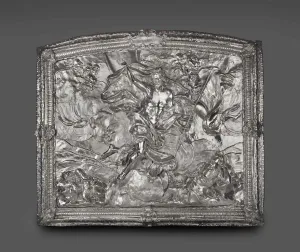
Naples
The Resurrection, 1736
Silver
67 5/16 × 78 9/16 × 10 5/8 in. (171 × 199.5 × 27 cm)
Terra Sancta Museum, Jerusalem
© The Frick Collection
The tomb in which Christ was buried and from which he resurrected three days later is at the heart of the Church of the Holy Sepulcher. This monumental relief depicts the defining moment for Christians: Jesus triumphantly emerging from his tomb, as the Roman soldiers guarding it sleep. The tomb at the Holy Sepulcher is a very small space, smaller than this room. This relief may have been intended to be placed inside the tomb, as its size almost matches one of the walls of the structure. However, this would have been impossible because of the very small door into the tomb. The anonymous Neapolitan sculptor who created this relief may have based it on designs by the Italian painter Francesco Solimena (1657–1747).
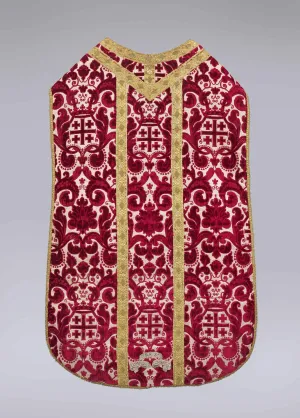
Milan or Genoa
Chasuble from the Red “Jerusalem Cross” Set of Pontifical Vestments, ca. 1600
Silk velvet, gold and silver thread
45 11/16 × 28 3/8 in., 2.98 lb. (116 × 72 cm, 1.35 kg)
Terra Sancta Museum, Jerusalem
© The Frick Collection
A chasuble is worn by priests during the celebration of Mass. Its color depends on the liturgical time of the year. A red chasuble would have been used for feasts such as Pentecost. The decoration of the chasuble includes the Jerusalem Cross, made of five crosses that symbolize the wounds suffered by Jesus Christ during his Passion. Together with other vestments, this chasuble was sent in the early seventeenth century to Jerusalem from the Commissariat of the Holy Land in Lombardy, in Milan. The gift may have been in commemoration of the Jubilee Year of 1600.

Milan or Genoa
Chasuble from the Dark Purple “Arma Christi” Set of Pontifical Vestments, ca. 1600
Silk velvet, gold and silver thread
45 11/16 × 28 3/8 in., 2.98 lb. (116 × 72 cm, 1.35 kg)
Terra Sancta Museum, Jerusalem
© The Frick Collection
Probably intended to commemorate the Jubilee Year of 1600, this chasuble and other liturgical vestments were sent from the Commissariat of the Holy Land in Lombardy, in Milan, to the Holy Sepulcher. The chasuble is decorated with the Arma Christi (Weapons of Christ), instruments and objects that were associated with the Passion, among them, the crown of thorns, a ladder with a lance and a sponge, a column, and whips, each representing a different episode. They are interspersed with the symbol of Jerusalem, the five crosses. The dark color of this chasuble indicates that it would have been used for ceremonies on Good Friday, the day commemorating the death of Christ on the Cross.