

Checklist

Palestinian craftsmen
Model of the Church of the Holy Sepulcher, 18th century
Olive and pistachio wood, mother-of-pearl, camel bone
13 9/16 × 19 5/16 × 21 1/4 in. (34.5 × 49 × 54 cm)
Terra Sancta Museum, Jerusalem
© The Frick Collection
Throughout the early modern period, Palestinian craftsmen based in Bethlehem created detailed models of the holy sites of Christianity, among them, the Church of the Nativity in Bethlehem and that of the Holy Sepulcher in Jerusalem. These luxurious objects were made with precious local materials, such as exotic woods, mother-of-pearl from shells from the Red Sea, and camel bone and were intended as gifts from the Custody for important donors. The representations of these churches, accurate even in their interiors (the models can be opened, like a dollhouse), also served to show what these buildings looked like to a European audience for whom travel to the Holy Land would have been difficult before the nineteenth century.
Spain or Middle East
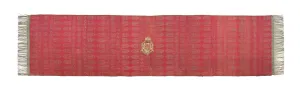
Humeral Veil, late 16th or early 17th century
Silk, gold and silver thread
109 1/16 × 25 13/16 in., 2.8 lb. (277 × 65.5 cm, 1.27 kg)
Terra Sancta Museum, Jerusalem
© The Frick Collection
Between 1187 and 1917, Jerusalem was under Muslim rule, first under the Egyptian Mamluks and later under the Turkish Ottomans. This object reflects the encounter between Islam and Christianity. A Muslim textile for clothing or furnishing was transformed into a Christian object, a humeral veil, a long scarf worn over the shoulders by the priest and falling to the sides. When carrying the Holy Sacrament, the priest uses the humeral veil to hold the monstrance. This veil is decorated with the arms of King Philip II of Spain (r. 1556–98).

Robert Landry (act. in Paris 1618–35)
Reliquary of the True Cross, 1628–29
Gilt silver, glass
20 1/16 × 13 3/16 × 8 7/16 in. (51 × 33.5 × 21.5 cm))
Terra Sancta Museum, Jerusalem
© The Frick Collection
The interior of the Church of the Holy Sepulcher includes the Hill of Calvary, the site where Jesus Christ was crucified. Since Empress Helena (246/48–330) rediscovered the relics of the Passion of Christ, fragments of the wooden cross on which Christ was killed have been the most precious relics in Christianity. Traditionally, such reliquaries are made in the shape of a cross and include minuscule wooden fragments at their center. Created in Paris in the seventeenth century, this object is usually displayed in the Church of the Holy Sepulcher on two feast days: May 6 (the feast of the Finding of the Holy Cross) and September 14 (the feast of the Exaltation of the Cross).
Naples
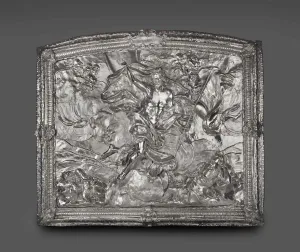
The Resurrection, 1736
Silver
67 5/16 × 78 9/16 × 10 5/8 in. (171 × 199.5 × 27 cm)
Terra Sancta Museum, Jerusalem
© The Frick Collection
The tomb in which Christ was buried and from which he resurrected three days later is at the heart of the Church of the Holy Sepulcher. This monumental relief depicts the defining moment for Christians: Jesus triumphantly emerging from his tomb, as the Roman soldiers guarding it sleep. The tomb at the Holy Sepulcher is a very small space, smaller than this room. This relief may have been intended to be placed inside the tomb, as its size almost matches one of the walls of the structure. However, this would have been impossible because of the very small door into the tomb. The anonymous Neapolitan sculptor who created this relief may have based it on designs by the Italian painter Francesco Solimena (1657–1747).
Milan or Genoa
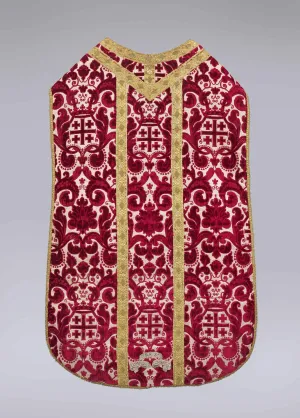
Chasuble from the Red “Jerusalem Cross” Set of Pontifical Vestments, ca. 1600
Silk velvet, gold and silver thread
45 11/16 × 28 3/8 in., 2.98 lb. (116 × 72 cm, 1.35 kg)
Terra Sancta Museum, Jerusalem
© The Frick Collection
A chasuble is worn by priests during the celebration of Mass. Its color depends on the liturgical time of the year. A red chasuble would have been used for feasts such as Pentecost. The decoration of the chasuble includes the Jerusalem Cross, made of five crosses that symbolize the wounds suffered by Jesus Christ during his Passion. Together with other vestments, this chasuble was sent in the early seventeenth century to Jerusalem from the Commissariat of the Holy Land in Lombardy, in Milan. The gift may have been in commemoration of the Jubilee Year of 1600.

Milan or Genoa
Chasuble from the Dark Purple “Arma Christi” Set of Pontifical Vestments, ca. 1600
Silk velvet, gold and silver thread
45 11/16 × 28 3/8 in., 2.98 lb. (116 × 72 cm, 1.35 kg)
Terra Sancta Museum, Jerusalem
© The Frick Collection
Probably intended to commemorate the Jubilee Year of 1600, this chasuble and other liturgical vestments were sent from the Commissariat of the Holy Land in Lombardy, in Milan, to the Holy Sepulcher. The chasuble is decorated with the Arma Christi (Weapons of Christ), instruments and objects that were associated with the Passion, among them, the crown of thorns, a ladder with a lance and a sponge, a column, and whips, each representing a different episode. They are interspersed with the symbol of Jerusalem, the five crosses. The dark color of this chasuble indicates that it would have been used for ceremonies on Good Friday, the day commemorating the death of Christ on the Cross.

Claude Caignet (act. as of 1609)
Large Sanctuary Lamp, 1617–18
Gilt silver
H.: 29 3/4 (75 cm), diam.: 10 1/4 in. (26 cm)
Terra Sancta Museum, Jerusalem
© The Frick Collection
Part of Mass Setting

Attributed to Claude Caignet (act. as of 1609)
Large Processional Cross, ca. 1620
Gilt silver
107 7/8 × 20 1/4 × 6 5/16 in. (274 × 51.5 × 16 cm)
Terra Sancta Museum, Jerusalem
© The Frick Collection
Part of Mass Setting

Claude Caignet (act. as of 1609) and an anonymous Parisian goldsmith
Six Altar Candlesticks, 1620–45
Gilt silver
Candlestick Pair A: A) h. 17 5/16 in. (44 cm); base diam. 6 1/8 in. (15.5 cm); drip pans diam. 4 1/2 in. (11.5 cm) B) h. 17 1/8 in. (43.5 cm); base diam. 6 1/8 in. (15.5 cm); drip pans diam. 4 1/2 in. (11.5 cm); Candlestick Pair B: A) h. 17 5/16 in. (44 cm); base diam. 6 1/2 in. (16.5 cm); drip pans diam. 5 11/16 in. (14.5 cm) B) h. 17 5/16 in. (44 cm); base diam. 6 11/16 in. (17 cm); drip pans diam. 5 1/2 in. (14 cm); Candlestick Pair C: A) h.15 3/8 in. (39 cm); base diam. 5 5/16 in. (13.5 cm); drip pans diam. 4 1/8 in. (10.5 cm) B) h.14 3/4 in. (37.5 cm); base diam. 5 5/16 in. (13.5 cm); drip pans diam. 4 1/8 in. (10.5 cm)
Terra Sancta Museum, Jerusalem
© The Frick Collection
Part of Mass Setting

Alexandre Paynet (or Penet) (act. 1615–56)
Red Pontifical Vestments: Three Copes, 1619
Silk, gold and silver threads
Cope 1: 59 1/16 × 118 1/8 in., 14.15 lb. (150 × 300 cm, 6.42 kg); cope 2: 60 1/4 × 118 1/8 in., 16.05 lb. (153 × 300 cm, 7.28 kg); cope 3: 59 13/16 × 118 1/8 in., 13.65 lb. (152 × 300 cm, 6.19 kg)
Terra Sancta Museum, Jerusalem
© The Frick Collection
Related to An Antependium and Two Dalmatics
Part of Mass Setting
Alexandre Paynet (or Penet) (act. 1615–56)
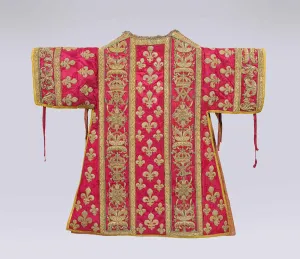
Red Pontifical Vestments: Two Dalmatics, 1619
Silk, gold and silver threads
Dalmatic 1: 42 1/2 × 48 1/16 in., 8.73 lb. (108 × 122 cm, 3.96 kg); Dalmatic 2: 42 1/2 × 47 5/8 in., 7.8 lb. (108 × 121 cm, 3.54 kg)
Terra Sancta Museum, Jerusalem
© The Frick Collection
Related to An Antependium and Three Copes
Part of Mass Setting
Alexandre Paynet (or Penet) (act. 1615–56)
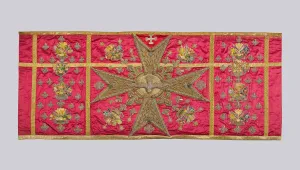
Red Pontifical Vestments: An Antependium, 1619
Silk, gold and silver threads
38 × 82 11/16 in., 8.05 lb. (96.5 × 210 cm, 3.65 kg)
Terra Sancta Museum, Jerusalem
© The Frick Collection
Related to Two Dalmatics and Three Copes
Part of Mass Setting
Claude Caignet (act. as of 1609)
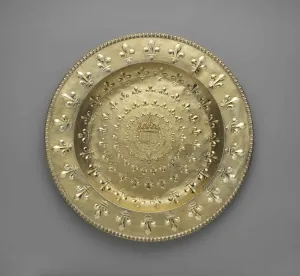
Two Ceremonial Basins, 1620–24
Gilt silver
Diam.: 15 3/8 in. (39 cm); depth: 1 3/16 in. (3 cm)
Terra Sancta Museum, Jerusalem
© The Frick Collection
According to a longstanding tradition, a credenza laden with ceremonial dishes is placed in the choir of churches during Pontifical Mass (a solemn Mass celebrated by a high-ranking prelate, like a bishop or the Custos). The two large basins, decorated with the arms of France and Navarre and with fleurs-de-lys, were sent to Jerusalem in 1635 as a gift from Louis XIII (r. 1610–43).

Nicolas Dolin (act. 1648–84)
Crozier, 1654–55
Gilt silver, glass, semi-precious stones
80 1/8 × 6 11/16 × 4 1/8 in. (203.5 × 17 × 10.5 cm)
Terra Sancta Museum, Jerusalem
© The Frick Collection
A crozier (or pastoral staff) is used by a bishop (and by the Custos) during offices to symbolize his pastoral responsibilities. This one, created in Paris by the goldsmith Nicolas Dolin, was a gift from Louis XIV (r. 1643–1715) to the Custody of the Holy Land. It is decorated with the lilies (fleurs-de-lys) of France and two statuettes of St. Louis, King of France, and his nephew, the Franciscan Bishop St. Louis of Toulouse, both ancestors of the king.

Nicolas Dolin (act. 1648–84)
Chalice, 1661–63
Gilt silver, glass, semi-precious stone
H.: 12 3/16 in. (31 cm), base diam.: 7 1/16 (18 cm), cup diam.: 4 5/16 in. (11 cm)
Terra Santa Museum, Jerusalem
© The Frick Collection
This chalice is decorated, on its base, with the arms of France and Navarre and with a relief of St. Louis (Louis IX) holding the crown of thorns and three nails. The king had acquired some of the Passion relics and brought them to Paris. On the stem are small statuettes of Christ, St. Francis of Assisi, and St. Anthony of Padua. Along the upper part are reliefs of the Flagellation, the Crucifixion, and the Resurrection. The paten is decorated with a relief of the Assumption of the Virgin. This magnificent chalice and paten, a gift from Louis XIV, arrived in Jerusalem on May 4, 1665.
Nicolas Dolin (act. 1648–84)
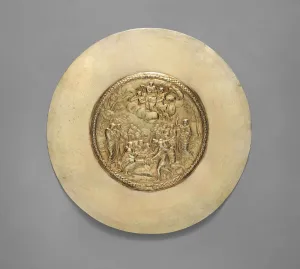
Paten, 1661–63
Gilt silver, glass, semi-precious stone
Diam.: 7 5/8 in. (19.3 cm)
Terra Santa Museum, Jerusalem
© The Frick Collection
Related to Chalice
This chalice is decorated, on its base, with the arms of France and Navarre and with a relief of St. Louis (Louis IX) holding the crown of thorns and three nails. The king had acquired some of the Passion relics and brought them to Paris. On the stem are small statuettes of Christ, St. Francis of Assisi, and St. Anthony of Padua. Along the upper part are reliefs of the Flagellation, the Crucifixion, and the Resurrection. The paten is decorated with a relief of the Assumption of the Virgin. This magnificent chalice and paten, a gift from Louis XIV, arrived in Jerusalem on May 4, 1665.

Jean Hubé (act. 1636–87)
Ciborium, 1668–69
Gilt silver
Cup: 15 9/16 × 6 9/16 × 5 7/8 in. (39.5 × 16.7 × 15 cm); Lid: h. 5 1/2 in. (14 cm), diam. 5 7/8 in. (15 cm) ; Cross on lid: h. 3 5/16 in. (8.4 cm)
Terra Sancta Museum, Jerusalem
© The Frick Collection
A ciborium (or pyx) is a container for the consecrated Host. The relief scenes on this object refer to the Passion of Christ and the Eucharist and are linked to the use of the vessel. On the base are the Agony in the Garden, the Washing of the Feet, and Christ before His Judges. On the cup are the Last Supper, the Crucifixion, and the Supper at Emmaus. The domed cover depicts scenes of the Meeting of Abraham and Melchizedek, the Paschal Lamb, and the Fall of Manna. The figure of the resurrected Christ stands at the top. The ciborium is probably a gift from Charles Olier (1635–1685), marquis de Nointel, who, as French ambassador to Constantinople, visited Jerusalem in March 1674.

France
Set of Pontifical Vestments: Cope, 1741
Silk, gold and silver threads
55 1/8 × 120 1/2 in., 11.71 lb. (140 × 306 cm, 5.31 kg)
Terra Sancta Museum, Jerusalem
© The Frick Collection
Related to Chasuble and Dalmatic
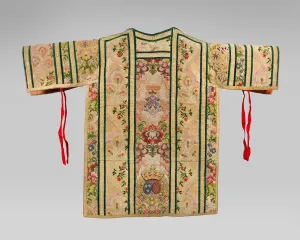
This set of vestments was delivered to Jerusalem in April 1741 from the Commissariat of the Holy Land in Paris. They were a gift from the Kingdom of France, under the reign of Louis XV (r. 1715–74). The fabric used for the paraments represents the finest in French weaving from around 1735–40 and was most likely made in Lyon. While a chasuble is worn by priests during Mass, a cope is used during solemn celebrations and processions. A dalmatic, identifiable by its sleeves, is usually worn by deacons.
France
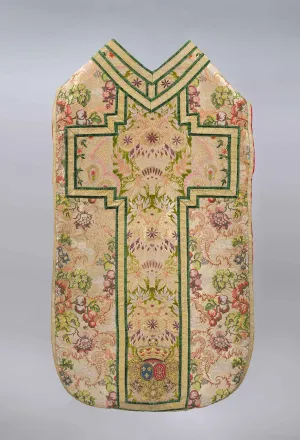
Set of Pontifical Vestments: Chasuble, 1741
Silk, gold and silver threads
49 3/16 × 27 3/16 in., 4.83 lb. (125 × 69 cm, 2.19 kg)
Terra Sancta Museum, Jerusalem
© The Frick Collection
This set of vestments was delivered to Jerusalem in April 1741 from the Commissariat of the Holy Land in Paris. They were a gift from the Kingdom of France, under the reign of Louis XV (r. 1715–74). The fabric used for the paraments represents the finest in French weaving from around 1735–40 and was most likely made in Lyon. While a chasuble is worn by priests during Mass, a cope is used during solemn celebrations and processions. A dalmatic, identifiable by its sleeves, is usually worn by deacons.
France
Set of Pontifical Vestments: Dalmatic, 1741
Silk, gold and silver threads
38 9/16 × 52 3/8 in., 6.26 lb. (98 × 133 cm, 2.84 kg)
Terra Sancta Museum, Jerusalem
© The Frick Collection
This set of vestments was delivered to Jerusalem in April 1741 from the Commissariat of the Holy Land in Paris. They were a gift from the Kingdom of France, under the reign of Louis XV (r. 1715–74). The fabric used for the paraments represents the finest in French weaving from around 1735–40 and was most likely made in Lyon. While a chasuble is worn by priests during Mass, a cope is used during solemn celebrations and processions. A dalmatic, identifiable by its sleeves, is usually worn by deacons.
Daniel I. Schäffler (1659–1727)
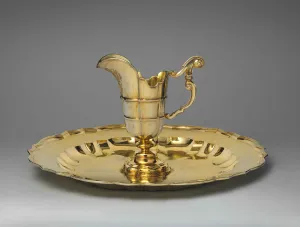
Ewer and Basin, ca. 1721–25
Gilt silver
Ewer: 10 1/4 × 4 3/4 × 10 1/16 in. (26 × 12 × 25.5 cm)
Basin: Diam.: 20 7/8 in. (53 cm); depth: 2 in. (5 cm)
Terra Sancta Museum, Jerusalem
© The Frick Collection
In August 1730, a shipment reached Jerusalem from the Commissariat of the Holy Land in Vienna. This included a series of significant gifts—among them, this ewer and basin—from the emperor Charles VI to be used in the churches of the Holy Sepulcher and of the Nativity in Bethlehem. Objects of this kind are used for the washing of the hands of the Custos during Mass, usually before the consecration of the Eucharist. Goldsmiths, such as Daniel Schäffler, produced objects like these for both religious and secular purposes. Originally from Dresden, Schäffler worked in Augsburg where he specialized in the creation of ceremonial pieces and toilette services.

Michael Gotthardt Unterhuber (1657/58–1743)
Dish, 1732
Gilt silver
17 15/16 × 21 1/4 × 1 3/8 in. (45.5 × 54 × 3.5 cm)
Terra Sancta Museum, Jerusalem
© The Frick Collection
This large dish, one of a pair, is engraved with the imperial coat of arms, surrounded by the chain of the Order of the Golden Fleece. It was a gift to the Custody from Emperor Charles VI, who, in 1736, sent another pair of similar dishes. Dishes such as this have no practical purpose. They are displayed on a credenza during pontifical ceremonies. The engraved decoration around the rim is similar to decoration that was painted, around the same time, on porcelain pieces produced by the Du Paquier Manufactory in Vienna.

Vienna
Chalice, 1737
Gilt silver, enamal, semi-precious stones
12 13/16 × 7 1/16 × 4 5/16 in. (32.5 × 18 × 11 cm)
Terra Sancta Museum, Jerusalem
© The Frick Collection
This splendid chalice is decorated with enamel plaques that depict episodes from the Passion of Christ. On the base are the Flagellation, the Crowning with Thorns, and the Bearing of the Cross; and on the chalice are the Agony in the Garden, the Last Supper, and the Crucifixion. The angels in relief hold some of the instruments of the Passion (whip, crown of thorns, and spear). Under the supervision of Brother Hugo Babler, the Commissariat in Vienna sent impressive gifts to Jerusalem in the 1730s, at the time of Emperor Charles VI.
Master IK
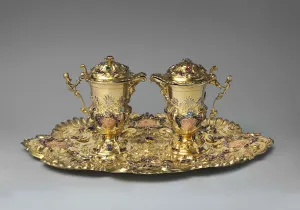
Tray and Cruets, 1740
Gold, gilt silver, precious and semi-precious stone
Tray: 13 3/8 × 16 5/16 × 1 in. (34 × 41.5 × 2.5 cm)
Cruets: Each 6 1/8 × 3 3/8 × 5 1/2 × 2 9/16 in. (15.5 × 8.5 × 14 × 6.5 cm)
Terra Sancta Museum, Jerusalem
© The Frick Collection
Cruets are small containers for water and wine that are poured by the priest into the chalice during Mass. The decoration of this magnificent set is linked to its use. Wheat and grapes are shown surrounding four biblical scenes (relating to water and wine) in relief in pink gold: Rebecca at the Well, the Wedding Feast at Cana, the Samaritan Woman at the Well, and the Last Supper. On the bodies of the cruets are reliefs displaying the four virtues: Faith, Hope, Charity, and Meekness. A gift as luxurious as this most likely came from the emperor. Signed with the initials IK, the piece must have been made by an important Viennese goldsmith.
Attributed to Johann Caspar Kriedemann (act. 1734–59)
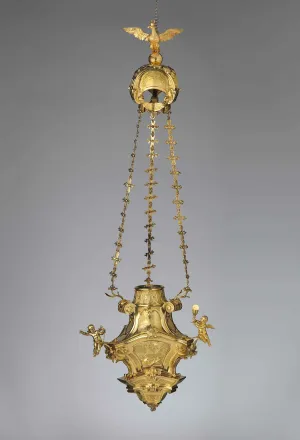
Sanctuary Lamp, 1758–59
Gold, gilt silver
34 13/16 × 12 3/16 × 11 7/16 in. (88.5 × 31 × 29 cm)
Terra Sancta Museum, Jerusalem
© The Frick Collection
On August 1, 1730, Emperor Charles VI (r. 1711–40) gifted a gold sanctuary lamp to the Holy Sepulcher. On the night of April 2 (eve of Palm Sunday), 1757, the Greek clergy at the Holy Sepulcher attacked the Franciscan friars and ransacked and smashed much of the Latin Treasure; the lamp of Charles VI was heavily damaged. This lamp may have been made in Vienna with the gold of the previous lamp. It was a gift from Empress Maria Theresa (r. 1740–80), in honor of her parents, Charles VI and Elisabeth Christine of Brunswick-Wolfenbüttel. The lamp is decorated with reliefs showing three episodes from the life of Christ: the Nativity, the Resurrection, and the Ascension. It arrived in Jerusalem on May 5, 1759.
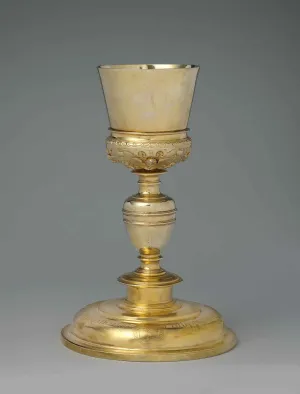
Juan Rodríguez de Babia (ca. 1525–1594)
Chalice, 1587
Gilt silver
H.: 10 1/4 in. (26 cm), base diam.: 6 3/8 in. (16.2 cm), diam.: 3 7/8 in. (9.8 cm)
Terra Sancta Museum, Jerusalem
© The Frick Collection
This chalice is one of the earliest surviving pieces in the Latin Treasure. It was a Spanish tradition for the king to present three chalices to churches or religious communities on the Feast of the Epiphany. These chalices were blessed during Mass to commemorate the gifts of the Magi to the baby Jesus. A gift to the Custody from Philip II (r. 1556–98), this chalice is inscribed with the name of Don García de Loaysa y Girón, royal chaplain and tutor of the future Philip III (r. 1598–1621).

Castile
Pair of Holy Oil Vessels, before 1640
Silver
Each: H.: 4 3/4 in. (12.1 cm), diam.: 2 3/8 in. (6 cm)
Terra Sancta Museum, Jerusalem
© The Frick Collection
Small vessels like these were meant to contain the chrism (oil blessed on Holy Thursday and used for the sacraments of baptism and confirmation) and the oil for the catechumens (used for exorcisms). Both are decorated with the royal arms of Spain and the crosses of Jerusalem.
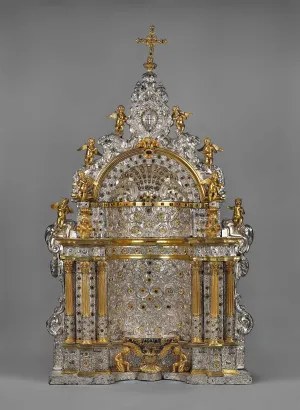
Pietro (ca. 1609–1705), Eutichio (d. 1682), and Sebastiano (d. 1701) Juvarra
Throne of Eucharistic Exposition, 1665
Silver, gilt silver, gilt copper, glass, precious and semi-precious stones
73 1/4 × 43 1/2 × 15 15/16 in. (186 × 110.5 × 40.5 cm)
Terra Sancta Museum, Jerusalem
© The Frick Collection
Part of Altar Setting

Southern Italy (Naples or Sicily) or Spain
Antependium, ca. 1675–1700
Silk, linen, gold and silver thread
39 3/8 × 90 15/16 in., 7.08 lb. (100 × 231 cm, 3.21 kg)
Terra Sancta Museum, Jerusalem
© The Frick Collection
During Mass, the front of an altar is usually decorated with an antependium (or palliotto) made of metal, wood, or fabric. This example is richly embroidered with floral and plant motifs. Although it could have been made in Spain, it was more likely created in Southern Italy, as a gift from the Spanish Crown.

Pietro (ca. 1609–1705), Eutichio (d. 1682), and Sebastiano (d. 1701) Juvarra
Six Candlesticks, ca. 1673
Silver, gilt silver, gilt copper, glass, precious and semi-precious stones
Candlestick A: 43 5/16 × 13 9/16 × 11 13/16 in. (110 × 34.5 × 30 cm); Candlestick B: 43 11/16 × 13 × 12 3/16 in. (111 × 33 × 31 cm); Candlestick C: 43 7/8 × 13 3/16 × 12 3/16 in. (111.5 × 33.5 × 31 cm); Candlestick D: 43 5/16 × 13 3/8 × 12 3/16 in. (110 × 34 × 31 cm); Candlestick E: 42 1/8 × 12 13/16 × 12 3/16 in. (107 × 32.5 × 31 cm); Candlestick F: 40 9/16 × 13 3/16 × 12 3/16 in. (103 × 33.5 × 31 cm)
Terra Sancta Museum, Jerusalem
© The Frick Collection
Related to Four Vases
Part of Altar Setting
A Throne of Eucharistic Exposition is a structure that usually includes an apse in which a monstrance can be placed to display the Holy Sacrament. This example, which arrived in Jerusalem in April 1666, was a gift from Philip IV of Spain (r. 1621–65) but was paid for from the coffers of the Kingdom of Sicily (at the time, Sicily belonged to Spain). It was made by a prominent goldsmith from Messina, Pietro Juvarra, in collaboration with his sons, Eutichio and Sebastiano. The candlesticks and decorative vases with flowers were also produced in Messina by the Juvarra workshop. Embellished with towers and lions—symbols of Castile and Leon (principal regions of Spain)—they are gifts from Philip IV’s son, Charles II (r. 1665–1700), and are used to decorate an altar during a pontifical Mass.
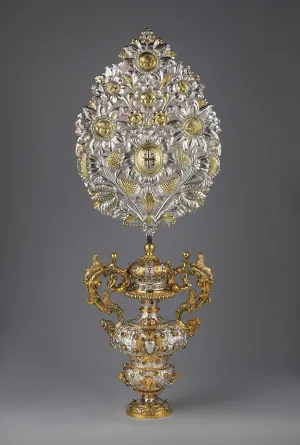
Pietro (ca. 1609–1705), Eutichio (d. 1682), and Sebastiano (d. 1701) Juvarra
Four Vases, ca. 1673
Silver, gilt silver, gilt copper, glass, precious and semi-precious stones
Vases A and B: 42 1/8 × 16 1/8 × 9 5/8 in. (107 × 41 × 24.5 cm); Vase C: 42 1/8 × 14 3/8 × 9 5/8 in. (107 × 36.5 × 24.5 cm); Vase D: 42 1/8 × 14 3/4 × 9 5/8 in. (107 × 37.5 × 24.5 cm)
Terra Sancta Museum, Jerusalem
© The Frick Collection
Related to Six Candlesticks
Part of Altar Setting
A Throne of Eucharistic Exposition is a structure that usually includes an apse in which a monstrance can be placed to display the Holy Sacrament. This example, which arrived in Jerusalem in April 1666, was a gift from Philip IV of Spain (r. 1621–65) but was paid for from the coffers of the Kingdom of Sicily (at the time, Sicily belonged to Spain). It was made by a prominent goldsmith from Messina, Pietro Juvarra, in collaboration with his sons, Eutichio and Sebastiano. The candlesticks and decorative vases with flowers were also produced in Messina by the Juvarra workshop. Embellished with towers and lions—symbols of Castile and Leon (principal regions of Spain)—they are gifts from Philip IV’s son, Charles II (r. 1665–1700), and are used to decorate an altar during a pontifical Mass.
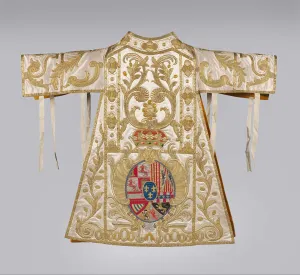
Spain
Dalmatic from the White Pontifical Vestments of Spain, 1758–60
Silk, gold and silver threads
42 1/2 × 51 3/16 in., 6.57 lb. (108 × 130 cm, 2.98 kg)
Terra Sancta Museum, Jerusalem
© The Frick Collection
A pontifical set of vestments of twenty pieces arrived in Jerusalem in June 1760. This was a gift from Ferdinand VI (r. 1746–59) and his wife, Queen Maria Barbara of Portugal. Originally, these were black vestments, with scenes from the Passion of Christ, used on Good Friday at the Holy Sepulcher. In 1885, however, the vestments were sent back to Spain, where the Sisters Adorers of Valencia painstakingly transferred the embroideries onto a new background of white satin. On one side, the vestments present scenes from the Passion of Christ, while on the other, they feature the royal arms of Spain.

Damián de Castro (1716–1793)
Chalice, 1778–80
Gold
H.: 10 5/8 in. (27 cm), base diam.: 4 15/16 (12.6 cm), cup diam.: 3 9/16 in. (9 cm)
Terra Sancta Museum, Jerusalem
© The Frick Collection
Documented as working in Madrid and Córdoba, Damián de Castro y Osorio was the principal Spanish goldsmith of the second half of the eighteenth century. The base of this chalice, which was donated by Spanish benefactors, is decorated with figures of angels holding the instruments of the Passion of Christ and, above, Christ at the Column and Our Lady of Sorrow. A third figure is missing.
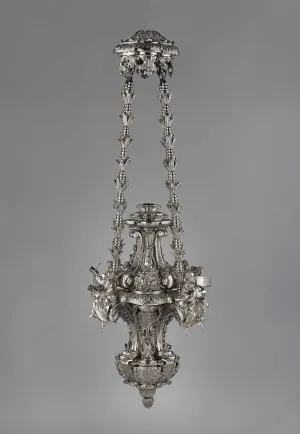
Attributed to Fabio Vendetti
Sanctuary Lamp, 1786
Silver
H. (top of hanging ring) 56 1/2 in. (143.5 cm); h. (top of silver) 52 5/8 in. (133.5 cm); w. 22 1/2 in. (57 cm); d. 22 1/2 in. (57 cm); weight: 90 lb. (40.8 kg)
Terra Sancta Museum, Jerusalem
© The Frick Collection
Inspired by Italian models, this monumental silver sanctuary lamp has no equal among surviving contemporary Spanish works. It may be the work of Fabio Vendetti, an Italian silversmith who, together with his father Antonio, was active in Spain. The lamp is decorated with the coats of arms of the Custody and of the Kingdom of Spain. The four large sculptures around the lamp represent the four Evangelists with their symbols: Matthew (with an angel), Mark (with a lion), Luke (with an ox), and John (with an eagle).

Portugal
Basin, 1673
Silver
H.: 6 11/16 in. (17 cm), diam.: 23 1/8 in. (58.7 cm)
Terra Sancta Museum, Jerusalem
© The Frick Collection
This basin was used to wash the feet of pilgrims arriving at the Holy Sepulcher. During the ceremony of Maundy Thursday, the Custos—and the Patriarch of Jerusalem today—washes the feet of pilgrims to commemorate the action of Christ before the Last Supper. This large basin was the gift of the future king Peter II of Portugal (r. 1683–1706), who had been regent since 1667.

Lisbon
Sanctuary Lamp, 1740s
Gold
27 × 10 13/16 × 9 13/16 in. (68.5 × 27.5 × 25 cm)
Terra Sancta Museum, Jerusalem
© The Frick Collection

Lisbon
Lectern Cloth from the “Palm Leaf ” Set of Pontifical Vestments of Portugal, 1728
Silk velvet, gold and silver thread
104 5/16 × 23 13/16 in., 2.18 lb. (265 × 60.5 cm, 0.99 kg)
Terra Sancta Museum, Jerusalem
© The Frick Collection
A set of fabrics was sent by King John V of Portugal (r. 1706–50) to the Custody of the Holy Land in 1728. Made of elegant velvet decorated with a pattern of pomegranates, these were from the Italian city of Genoa. The fabric is described in documents as “a drapery from Portugal, an opulent piece of material, with a silver ground to be used on the outside of the Most Holy Saint Sepulcher.” Later, in 1735, the king sent a set of pontifical vestments with a similar fabric.

Gennaro De Blasio (act. 1724–40)
Antependium, 1731
Silver and gilt bronze
38 3/4 × 95 1/4 × 11 7/16 in. (98.5 × 242 × 29 cm)
Terra Sancta Museum, Jerusalem
© The Frick Collection
This antependium is made of three parts: a central relief showing the Pentecost—the moment when the Holy Spirit appeared to the Virgin Mary and the apostles after the resurrection of Christ—and two wings with the figures of St. Bonaventure (left) and St. Louis of Anjou (right) in niches. The altar frontal is signed by Gennaro De Blasio, son of the Neapolitan silversmith Andrea De Blasio and consul of the guild of silversmiths in the city in 1740. The antependium arrived in Jerusalem on June 8, 1731.
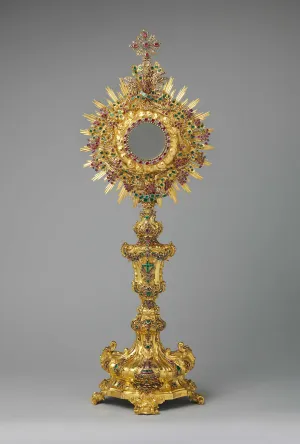
Naples
Monstrance, 1746
Gold, precious stones
27 15/16 × 10 1/4 × 7 1/16 in. (71 × 26 × 18 cm)
Terra Sancta Museum, Jerusalem
© The Frick Collection
Made of solid gold and studded with emeralds, rubies, and diamonds, this monstrance is an extraordinary survival of Neapolitan goldsmith work. As indicated from the inscription on the base, it was a gift from the Kingdom of Naples at the time of King Charles of Bourbon (r. 1734–59). It was brought to Jerusalem in January 1747.
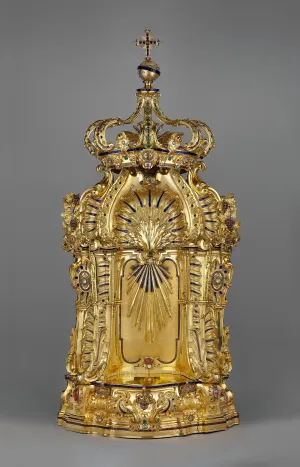
Antonio de Laurentiis
Throne of Eucharistic Exposition, 1754
Gold, gilt copper, glass, precious and semi-precious stones
68 11/16 × 32 5/16 × 15 3/8 in. (174.5 × 82 × 39 cm)
Terra Sancta Museum, Jerusalem
© The Frick Collection
Following the arrival of the Neapolitan gold monstrance in 1747, the Kingdom of Naples sent this Throne of Eucharistic Exposition to Jerusalem in October 1755. Extraordinary for its size and the value of its materials, this is the most impressive object preserved today in the Latin Treasure and one of the most important survivals of eighteenth-century European goldsmith work. The throne bears the arms of King Charles and of his wife, Queen Maria Amalia of Saxony. On the base at left, it is signed by the Neapolitan goldsmith Antonio de Laurentiis, whose name is associated primarily with objects in gold-inlaid tortoiseshell and mounted snuffboxes.
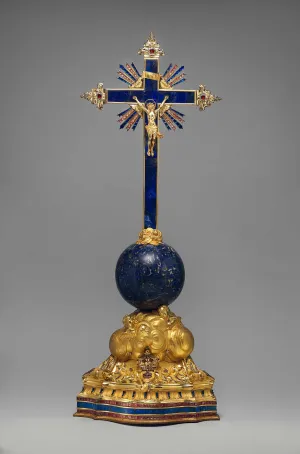
Naples
Crucifix, 1756
Gold, lapis lazuli, precious and semi-precious stones
35 7/16 × 13 7/16 × 9 1/16 in. (90 × 34.2 × 23 cm)
Terra Sancta Museum, Jerusalem
© The Frick Collection
The base of this crucifix displays a royal crown, the Jerusalem Cross, and a horse (the arms of the Commissariat of Naples). This opulent object was delivered to Jerusalem in June 1757, after the Neapolitan monstrance and Throne of Eucharistic Exposition. It was a gift from King Charles of Naples and “his most faithful subjects.” The crucifix can be placed in the niche of the Throne of Eucharistic Exposition instead of the monstrance, depending on the occasion.

Naples
Crozier, 1756
Gold, glass, precious and semi-precious stones
77 15/16 × 6 1/8 × 4 5/16 in. (198 × 15.5 × 11 cm)
Terra Sancta Museum, Jerusalem
© The Frick Collection
The Commissariat of Naples sent this glorious crozier, together with the gold and lapis lazuli crucifix, to the Holy Sepulcher in June 1757. It is meant for use by the Custos. The four statuettes represent three Franciscan saints—Francis of Assisi, Bonaventure, and Louis of Anjou—and Januarius, the patron saint of Naples. In the context of Neapolitan goldsmith work, this crozier is unparalleled by any other similar, surviving works of art.
Venice
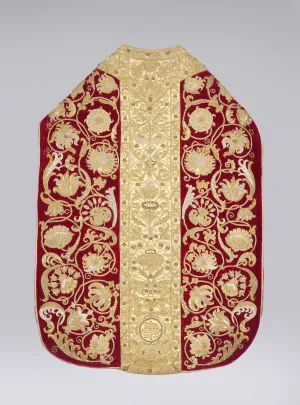
Chasuble from the Pontifical Vestment in Crimson Velvet of Venice, 1669–72
Silk velvet, gold and silver thread, semi-precious stones
48 13/16 × 34 1/16 in., 9.5 lb. (124 × 86.5 cm, 4.31 kg)
Terra Sancta Museum, Jerusalem
© The Frick Collection
Related to Miter from the Pontifical Vestment in Crimson Velvet of Venice
Venice
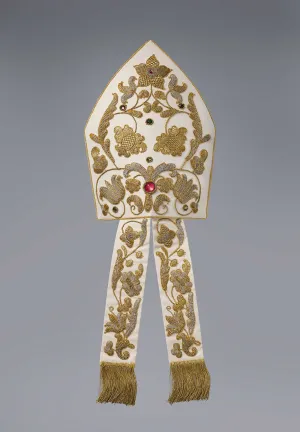
Miter from the Pontifical Vestment in Crimson Velvet of Venice, 1669–72
Silk velvet, gold and silver thread, semi-precious stones
33 7/8 × 13 9/16 in. (86 × 34.5 cm)
Terra Sancta Museum, Jerusalem
© The Frick Collection
Related to Chasuble from the Pontifical Vestment in Crimson Velvet of Venice
Al San Lorenzo Giustinian Workshop
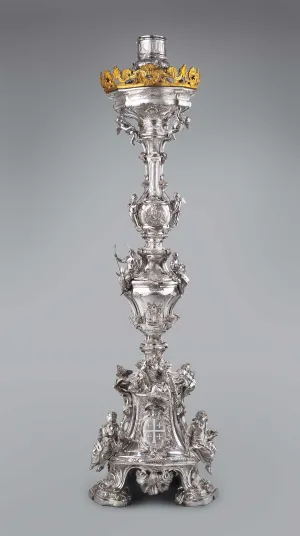
Pair of Torchères, 1762
Silver and gilt silver
Each: 96 1/16 × 27 9/16 × 24 13/16 in. (244 × 70 × 63 cm)
Terra Sancta Museum, Jerusalem
© The Frick Collection
After the Greek Orthodox clergy ransacked the Holy Sepulcher, on April 2, 1757, the Custody managed to recover a number of damaged objects and bought back others that had been stolen. They reclaimed 1,304 ounces of silver from the objects that could not be salvaged. The silver was sent to Venice, where it was used to create new liturgical objects for the Holy Sepulcher, among them, these two torchères. They were produced in one of the most prominent silversmith shops in Venice: al San Lorenzo Giustinian. Venetian workshops were identified by their shop signs (in this case an image of St. Lorenzo Giustinian). The torchères are decorated with reliefs showing scenes from the Passion of Christ and with statuettes of the four Evangelists (most prominently, St. Mark, the patron saint of Venice) and the three Theological Virtues (Hope, Faith, and Charity). They reached Jerusalem on June 23, 1765.

Genoa, probably Workshop of Domenico Piola (1628–1703)
Cope from the Red Pontifical Set of Vestments of Genoa, 1686–97
Embroidered silk
54 1/8 × 110 13/16 in., 6.94 lb. (137.5 × 281.5 cm, 3.15 kg)
Terra Sancta Museum, Jerusalem
© The Frick Collection
This cope is part of a remarkable set of vestments given by Genoa to the Custody of the Holy Land. The importance of the thirteen vestments that make up this set lies not in the opulence of its elements, which feature neither gold nor silver thread, but rather in the quality of its design and the virtuosity of the embroidery. The arms of Genoa and of the Custody are combined with interlacing scrolls with flowers and fruits. The central scene represents the patron saint of the Republic of Genoa: George defeating the dragon. The parts of the set were delivered to Jerusalem between 1687 and 1697. The set’s design has been attributed to the Genoese painter Domenico Piola and members of his workshop, including his brother-in-law, Stefano Camogli, who specialized in painting flowers, fruit, and arabesque motifs.