

France
Commissariats of the Holy Land—organizations established in many principal European cities—were responsible for assembling and shipping gifts, as well as alms (money and other precious materials), to the Custody of the Holy Land in Jerusalem. In France, in the seventeenth and eighteenth centuries, commissariats in Paris and Marseille shipped many gifts across the Mediterranean Sea to the Holy Land.
This room displays gifts created in France for the Holy Sepulcher under the consecutive reigns of Louis XIII (r. 1610–43), Louis XIV (r. 1643–1715), and Louis XV (r. 1715–74). Included are sacred vessels in precious materials—gold and silver—and rich liturgical vestments. They are often decorated with the French royal arms to denote the provenance of the gift.
A group of objects donated by Louis XIII displayed in this gallery evokes a liturgical ceremony at the Holy Sepulcher.

Claude Caignet (act. as of 1609)
Large Sanctuary Lamp, 1617–18
Gilt silver
H.: 29 3/4 (75 cm), diam.: 10 1/4 in. (26 cm)
Terra Sancta Museum, Jerusalem
© The Frick Collection
Part of Mass Setting

Attributed to Claude Caignet (act. as of 1609)
Large Processional Cross, ca. 1620
Gilt silver
107 7/8 × 20 1/4 × 6 5/16 in. (274 × 51.5 × 16 cm)
Terra Sancta Museum, Jerusalem
© The Frick Collection
Part of Mass Setting

Claude Caignet (act. as of 1609) and an anonymous Parisian goldsmith
Six Altar Candlesticks, 1620–45
Gilt silver
Candlestick Pair A: A) h. 17 5/16 in. (44 cm); base diam. 6 1/8 in. (15.5 cm); drip pans diam. 4 1/2 in. (11.5 cm) B) h. 17 1/8 in. (43.5 cm); base diam. 6 1/8 in. (15.5 cm); drip pans diam. 4 1/2 in. (11.5 cm); Candlestick Pair B: A) h. 17 5/16 in. (44 cm); base diam. 6 1/2 in. (16.5 cm); drip pans diam. 5 11/16 in. (14.5 cm) B) h. 17 5/16 in. (44 cm); base diam. 6 11/16 in. (17 cm); drip pans diam. 5 1/2 in. (14 cm); Candlestick Pair C: A) h.15 3/8 in. (39 cm); base diam. 5 5/16 in. (13.5 cm); drip pans diam. 4 1/8 in. (10.5 cm) B) h.14 3/4 in. (37.5 cm); base diam. 5 5/16 in. (13.5 cm); drip pans diam. 4 1/8 in. (10.5 cm)
Terra Sancta Museum, Jerusalem
© The Frick Collection
Part of Mass Setting

Alexandre Paynet (or Penet) (act. 1615–56)
Red Pontifical Vestments: Three Copes, 1619
Silk, gold and silver threads
Cope 1: 59 1/16 × 118 1/8 in., 14.15 lb. (150 × 300 cm, 6.42 kg); cope 2: 60 1/4 × 118 1/8 in., 16.05 lb. (153 × 300 cm, 7.28 kg); cope 3: 59 13/16 × 118 1/8 in., 13.65 lb. (152 × 300 cm, 6.19 kg)
Terra Sancta Museum, Jerusalem
© The Frick Collection
Related to An Antependium and Two Dalmatics
Part of Mass Setting
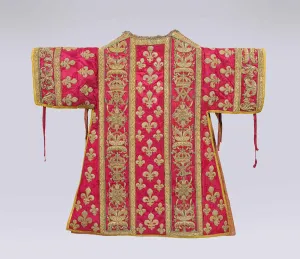
Alexandre Paynet (or Penet) (act. 1615–56)
Red Pontifical Vestments: Two Dalmatics, 1619
Silk, gold and silver threads
Dalmatic 1: 42 1/2 × 48 1/16 in., 8.73 lb. (108 × 122 cm, 3.96 kg); Dalmatic 2: 42 1/2 × 47 5/8 in., 7.8 lb. (108 × 121 cm, 3.54 kg)
Terra Sancta Museum, Jerusalem
© The Frick Collection
Related to An Antependium and Three Copes
Part of Mass Setting
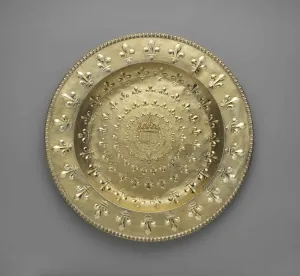
Claude Caignet (act. as of 1609)
Two Ceremonial Basins, 1620–24
Gilt silver
Diam.: 15 3/8 in. (39 cm); depth: 1 3/16 in. (3 cm)
Terra Sancta Museum, Jerusalem
© The Frick Collection
According to a longstanding tradition, a credenza laden with ceremonial dishes is placed in the choir of churches during Pontifical Mass (a solemn Mass celebrated by a high-ranking prelate, like a bishop or the Custos). The two large basins, decorated with the arms of France and Navarre and with fleurs-de-lys, were sent to Jerusalem in 1635 as a gift from Louis XIII (r. 1610–43).

Nicolas Dolin (act. 1648–84)
Crozier, 1654–55
Gilt silver, glass, semi-precious stones
80 1/8 × 6 11/16 × 4 1/8 in. (203.5 × 17 × 10.5 cm)
Terra Sancta Museum, Jerusalem
© The Frick Collection
A crozier (or pastoral staff) is used by a bishop (and by the Custos) during offices to symbolize his pastoral responsibilities. This one, created in Paris by the goldsmith Nicolas Dolin, was a gift from Louis XIV (r. 1643–1715) to the Custody of the Holy Land. It is decorated with the lilies (fleurs-de-lys) of France and two statuettes of St. Louis, King of France, and his nephew, the Franciscan Bishop St. Louis of Toulouse, both ancestors of the king.

Nicolas Dolin (act. 1648–84)
Chalice, 1661–63
Gilt silver, glass, semi-precious stone
H.: 12 3/16 in. (31 cm), base diam.: 7 1/16 (18 cm), cup diam.: 4 5/16 in. (11 cm)
Terra Santa Museum, Jerusalem
© The Frick Collection
This chalice is decorated, on its base, with the arms of France and Navarre and with a relief of St. Louis (Louis IX) holding the crown of thorns and three nails. The king had acquired some of the Passion relics and brought them to Paris. On the stem are small statuettes of Christ, St. Francis of Assisi, and St. Anthony of Padua. Along the upper part are reliefs of the Flagellation, the Crucifixion, and the Resurrection. The paten is decorated with a relief of the Assumption of the Virgin. This magnificent chalice and paten, a gift from Louis XIV, arrived in Jerusalem on May 4, 1665.
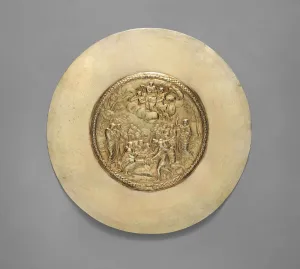
Nicolas Dolin (act. 1648–84)
Paten, 1661–63
Gilt silver, glass, semi-precious stone
Diam.: 7 5/8 in. (19.3 cm)
Terra Santa Museum, Jerusalem
© The Frick Collection
Related to Chalice
This chalice is decorated, on its base, with the arms of France and Navarre and with a relief of St. Louis (Louis IX) holding the crown of thorns and three nails. The king had acquired some of the Passion relics and brought them to Paris. On the stem are small statuettes of Christ, St. Francis of Assisi, and St. Anthony of Padua. Along the upper part are reliefs of the Flagellation, the Crucifixion, and the Resurrection. The paten is decorated with a relief of the Assumption of the Virgin. This magnificent chalice and paten, a gift from Louis XIV, arrived in Jerusalem on May 4, 1665.

Jean Hubé (act. 1636–87)
Ciborium, 1668–69
Gilt silver
Cup: 15 9/16 × 6 9/16 × 5 7/8 in. (39.5 × 16.7 × 15 cm); Lid: h. 5 1/2 in. (14 cm), diam. 5 7/8 in. (15 cm) ; Cross on lid: h. 3 5/16 in. (8.4 cm)
Terra Sancta Museum, Jerusalem
© The Frick Collection
A ciborium (or pyx) is a container for the consecrated Host. The relief scenes on this object refer to the Passion of Christ and the Eucharist and are linked to the use of the vessel. On the base are the Agony in the Garden, the Washing of the Feet, and Christ before His Judges. On the cup are the Last Supper, the Crucifixion, and the Supper at Emmaus. The domed cover depicts scenes of the Meeting of Abraham and Melchizedek, the Paschal Lamb, and the Fall of Manna. The figure of the resurrected Christ stands at the top. The ciborium is probably a gift from Charles Olier (1635–1685), marquis de Nointel, who, as French ambassador to Constantinople, visited Jerusalem in March 1674.
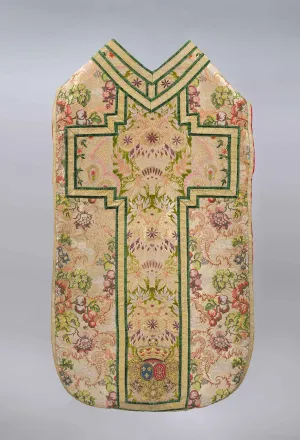
France
Set of Pontifical Vestments: Chasuble, 1741
Silk, gold and silver threads
49 3/16 × 27 3/16 in., 4.83 lb. (125 × 69 cm, 2.19 kg)
Terra Sancta Museum, Jerusalem
© The Frick Collection
This set of vestments was delivered to Jerusalem in April 1741 from the Commissariat of the Holy Land in Paris. They were a gift from the Kingdom of France, under the reign of Louis XV (r. 1715–74). The fabric used for the paraments represents the finest in French weaving from around 1735–40 and was most likely made in Lyon. While a chasuble is worn by priests during Mass, a cope is used during solemn celebrations and processions. A dalmatic, identifiable by its sleeves, is usually worn by deacons.
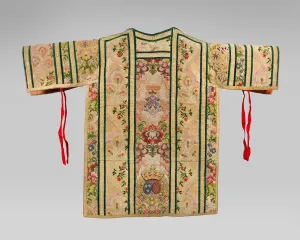
France
Set of Pontifical Vestments: Dalmatic, 1741
Silk, gold and silver threads
38 9/16 × 52 3/8 in., 6.26 lb. (98 × 133 cm, 2.84 kg)
Terra Sancta Museum, Jerusalem
© The Frick Collection
This set of vestments was delivered to Jerusalem in April 1741 from the Commissariat of the Holy Land in Paris. They were a gift from the Kingdom of France, under the reign of Louis XV (r. 1715–74). The fabric used for the paraments represents the finest in French weaving from around 1735–40 and was most likely made in Lyon. While a chasuble is worn by priests during Mass, a cope is used during solemn celebrations and processions. A dalmatic, identifiable by its sleeves, is usually worn by deacons.