

Holy Roman Empire
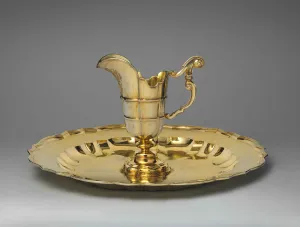
Daniel I. Schäffler (1659–1727)
Ewer and Basin, ca. 1721–25
Gilt silver
Ewer: 10 1/4 × 4 3/4 × 10 1/16 in. (26 × 12 × 25.5 cm)
Basin: Diam.: 20 7/8 in. (53 cm); depth: 2 in. (5 cm)
Terra Sancta Museum, Jerusalem
© The Frick Collection
In August 1730, a shipment reached Jerusalem from the Commissariat of the Holy Land in Vienna. This included a series of significant gifts—among them, this ewer and basin—from the emperor Charles VI to be used in the churches of the Holy Sepulcher and of the Nativity in Bethlehem. Objects of this kind are used for the washing of the hands of the Custos during Mass, usually before the consecration of the Eucharist. Goldsmiths, such as Daniel Schäffler, produced objects like these for both religious and secular purposes. Originally from Dresden, Schäffler worked in Augsburg where he specialized in the creation of ceremonial pieces and toilette services.

Michael Gotthardt Unterhuber (1657/58–1743)
Dish, 1732
Gilt silver
17 15/16 × 21 1/4 × 1 3/8 in. (45.5 × 54 × 3.5 cm)
Terra Sancta Museum, Jerusalem
© The Frick Collection
This large dish, one of a pair, is engraved with the imperial coat of arms, surrounded by the chain of the Order of the Golden Fleece. It was a gift to the Custody from Emperor Charles VI, who, in 1736, sent another pair of similar dishes. Dishes such as this have no practical purpose. They are displayed on a credenza during pontifical ceremonies. The engraved decoration around the rim is similar to decoration that was painted, around the same time, on porcelain pieces produced by the Du Paquier Manufactory in Vienna.

Vienna
Chalice, 1737
Gilt silver, enamal, semi-precious stones
12 13/16 × 7 1/16 × 4 5/16 in. (32.5 × 18 × 11 cm)
Terra Sancta Museum, Jerusalem
© The Frick Collection
This splendid chalice is decorated with enamel plaques that depict episodes from the Passion of Christ. On the base are the Flagellation, the Crowning with Thorns, and the Bearing of the Cross; and on the chalice are the Agony in the Garden, the Last Supper, and the Crucifixion. The angels in relief hold some of the instruments of the Passion (whip, crown of thorns, and spear). Under the supervision of Brother Hugo Babler, the Commissariat in Vienna sent impressive gifts to Jerusalem in the 1730s, at the time of Emperor Charles VI.
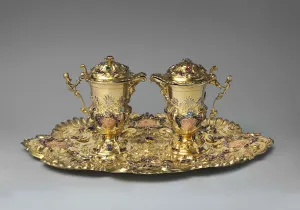
Master IK
Tray and Cruets, 1740
Gold, gilt silver, precious and semi-precious stone
Tray: 13 3/8 × 16 5/16 × 1 in. (34 × 41.5 × 2.5 cm)
Cruets: Each 6 1/8 × 3 3/8 × 5 1/2 × 2 9/16 in. (15.5 × 8.5 × 14 × 6.5 cm)
Terra Sancta Museum, Jerusalem
© The Frick Collection
Cruets are small containers for water and wine that are poured by the priest into the chalice during Mass. The decoration of this magnificent set is linked to its use. Wheat and grapes are shown surrounding four biblical scenes (relating to water and wine) in relief in pink gold: Rebecca at the Well, the Wedding Feast at Cana, the Samaritan Woman at the Well, and the Last Supper. On the bodies of the cruets are reliefs displaying the four virtues: Faith, Hope, Charity, and Meekness. A gift as luxurious as this most likely came from the emperor. Signed with the initials IK, the piece must have been made by an important Viennese goldsmith.
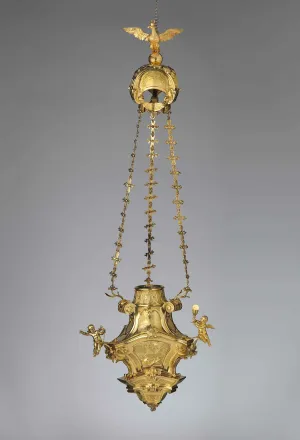
Attributed to Johann Caspar Kriedemann (act. 1734–59)
Sanctuary Lamp, 1758–59
Gold, gilt silver
34 13/16 × 12 3/16 × 11 7/16 in. (88.5 × 31 × 29 cm)
Terra Sancta Museum, Jerusalem
© The Frick Collection
On August 1, 1730, Emperor Charles VI (r. 1711–40) gifted a gold sanctuary lamp to the Holy Sepulcher. On the night of April 2 (eve of Palm Sunday), 1757, the Greek clergy at the Holy Sepulcher attacked the Franciscan friars and ransacked and smashed much of the Latin Treasure; the lamp of Charles VI was heavily damaged. This lamp may have been made in Vienna with the gold of the previous lamp. It was a gift from Empress Maria Theresa (r. 1740–80), in honor of her parents, Charles VI and Elisabeth Christine of Brunswick-Wolfenbüttel. The lamp is decorated with reliefs showing three episodes from the life of Christ: the Nativity, the Resurrection, and the Ascension. It arrived in Jerusalem on May 5, 1759.