

Altar Setting
A Throne of Eucharistic Exposition is a structure that usually includes an apse in which a monstrance can be placed to display the Holy Sacrament. This example, which arrived in Jerusalem in April 1666, was a gift from Philip IV of Spain (r. 1621–65) but was paid for from the coffers of the Kingdom of Sicily (at the time, Sicily belonged to Spain). It was made by a prominent goldsmith from Messina, Pietro Juvarra, in collaboration with his sons, Eutichio and Sebastiano. The candlesticks and decorative vases with flowers were also produced in Messina by the Juvarra workshop. Embellished with towers and lions—symbols of Castile and Leon (principal regions of Spain)—they are gifts from Philip IV’s son, Charles II (r. 1665–1700), and are used to decorate an altar during a pontifical Mass.
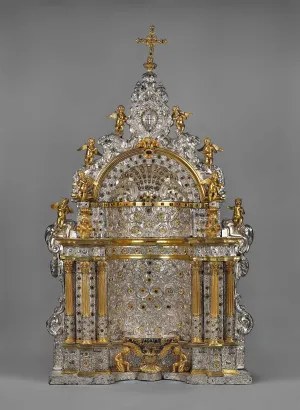
Pietro (ca. 1609–1705), Eutichio (d. 1682), and Sebastiano (d. 1701) Juvarra
Throne of Eucharistic Exposition, 1665
Silver, gilt silver, gilt copper, glass, precious and semi-precious stones
73 1/4 × 43 1/2 × 15 15/16 in. (186 × 110.5 × 40.5 cm)
Terra Sancta Museum, Jerusalem
© The Frick Collection
Part of Altar Setting

Pietro (ca. 1609–1705), Eutichio (d. 1682), and Sebastiano (d. 1701) Juvarra
Six Candlesticks, ca. 1673
Silver, gilt silver, gilt copper, glass, precious and semi-precious stones
Candlestick A: 43 5/16 × 13 9/16 × 11 13/16 in. (110 × 34.5 × 30 cm); Candlestick B: 43 11/16 × 13 × 12 3/16 in. (111 × 33 × 31 cm); Candlestick C: 43 7/8 × 13 3/16 × 12 3/16 in. (111.5 × 33.5 × 31 cm); Candlestick D: 43 5/16 × 13 3/8 × 12 3/16 in. (110 × 34 × 31 cm); Candlestick E: 42 1/8 × 12 13/16 × 12 3/16 in. (107 × 32.5 × 31 cm); Candlestick F: 40 9/16 × 13 3/16 × 12 3/16 in. (103 × 33.5 × 31 cm)
Terra Sancta Museum, Jerusalem
© The Frick Collection
Related to Four Vases
Part of Altar Setting
A Throne of Eucharistic Exposition is a structure that usually includes an apse in which a monstrance can be placed to display the Holy Sacrament. This example, which arrived in Jerusalem in April 1666, was a gift from Philip IV of Spain (r. 1621–65) but was paid for from the coffers of the Kingdom of Sicily (at the time, Sicily belonged to Spain). It was made by a prominent goldsmith from Messina, Pietro Juvarra, in collaboration with his sons, Eutichio and Sebastiano. The candlesticks and decorative vases with flowers were also produced in Messina by the Juvarra workshop. Embellished with towers and lions—symbols of Castile and Leon (principal regions of Spain)—they are gifts from Philip IV’s son, Charles II (r. 1665–1700), and are used to decorate an altar during a pontifical Mass.
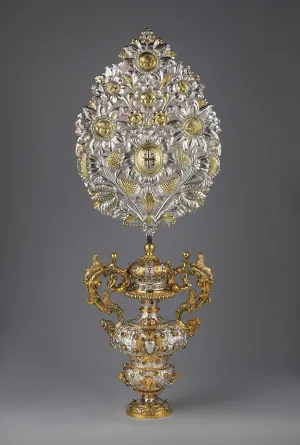
Pietro (ca. 1609–1705), Eutichio (d. 1682), and Sebastiano (d. 1701) Juvarra
Four Vases, ca. 1673
Silver, gilt silver, gilt copper, glass, precious and semi-precious stones
Vases A and B: 42 1/8 × 16 1/8 × 9 5/8 in. (107 × 41 × 24.5 cm); Vase C: 42 1/8 × 14 3/8 × 9 5/8 in. (107 × 36.5 × 24.5 cm); Vase D: 42 1/8 × 14 3/4 × 9 5/8 in. (107 × 37.5 × 24.5 cm)
Terra Sancta Museum, Jerusalem
© The Frick Collection
Related to Six Candlesticks
Part of Altar Setting
A Throne of Eucharistic Exposition is a structure that usually includes an apse in which a monstrance can be placed to display the Holy Sacrament. This example, which arrived in Jerusalem in April 1666, was a gift from Philip IV of Spain (r. 1621–65) but was paid for from the coffers of the Kingdom of Sicily (at the time, Sicily belonged to Spain). It was made by a prominent goldsmith from Messina, Pietro Juvarra, in collaboration with his sons, Eutichio and Sebastiano. The candlesticks and decorative vases with flowers were also produced in Messina by the Juvarra workshop. Embellished with towers and lions—symbols of Castile and Leon (principal regions of Spain)—they are gifts from Philip IV’s son, Charles II (r. 1665–1700), and are used to decorate an altar during a pontifical Mass.