

Kingdom of Spain
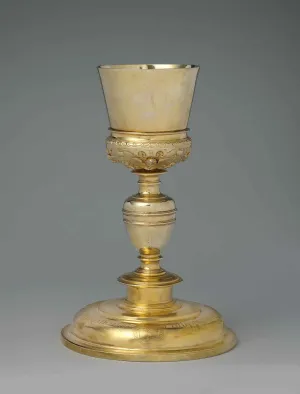
Juan Rodríguez de Babia (ca. 1525–1594)
Chalice, 1587
Gilt silver
H.: 10 1/4 in. (26 cm), base diam.: 6 3/8 in. (16.2 cm), diam.: 3 7/8 in. (9.8 cm)
Terra Sancta Museum, Jerusalem
© The Frick Collection
This chalice is one of the earliest surviving pieces in the Latin Treasure. It was a Spanish tradition for the king to present three chalices to churches or religious communities on the Feast of the Epiphany. These chalices were blessed during Mass to commemorate the gifts of the Magi to the baby Jesus. A gift to the Custody from Philip II (r. 1556–98), this chalice is inscribed with the name of Don García de Loaysa y Girón, royal chaplain and tutor of the future Philip III (r. 1598–1621).

Castile
Pair of Holy Oil Vessels, before 1640
Silver
Each: H.: 4 3/4 in. (12.1 cm), diam.: 2 3/8 in. (6 cm)
Terra Sancta Museum, Jerusalem
© The Frick Collection
Small vessels like these were meant to contain the chrism (oil blessed on Holy Thursday and used for the sacraments of baptism and confirmation) and the oil for the catechumens (used for exorcisms). Both are decorated with the royal arms of Spain and the crosses of Jerusalem.
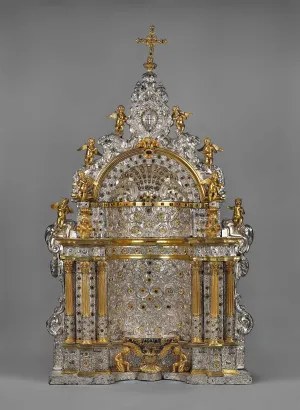
Pietro (ca. 1609–1705), Eutichio (d. 1682), and Sebastiano (d. 1701) Juvarra
Throne of Eucharistic Exposition, 1665
Silver, gilt silver, gilt copper, glass, precious and semi-precious stones
73 1/4 × 43 1/2 × 15 15/16 in. (186 × 110.5 × 40.5 cm)
Terra Sancta Museum, Jerusalem
© The Frick Collection
Part of Altar Setting

Southern Italy (Naples or Sicily) or Spain
Antependium, ca. 1675–1700
Silk, linen, gold and silver thread
39 3/8 × 90 15/16 in., 7.08 lb. (100 × 231 cm, 3.21 kg)
Terra Sancta Museum, Jerusalem
© The Frick Collection
During Mass, the front of an altar is usually decorated with an antependium (or palliotto) made of metal, wood, or fabric. This example is richly embroidered with floral and plant motifs. Although it could have been made in Spain, it was more likely created in Southern Italy, as a gift from the Spanish Crown.

Pietro (ca. 1609–1705), Eutichio (d. 1682), and Sebastiano (d. 1701) Juvarra
Six Candlesticks, ca. 1673
Silver, gilt silver, gilt copper, glass, precious and semi-precious stones
Candlestick A: 43 5/16 × 13 9/16 × 11 13/16 in. (110 × 34.5 × 30 cm); Candlestick B: 43 11/16 × 13 × 12 3/16 in. (111 × 33 × 31 cm); Candlestick C: 43 7/8 × 13 3/16 × 12 3/16 in. (111.5 × 33.5 × 31 cm); Candlestick D: 43 5/16 × 13 3/8 × 12 3/16 in. (110 × 34 × 31 cm); Candlestick E: 42 1/8 × 12 13/16 × 12 3/16 in. (107 × 32.5 × 31 cm); Candlestick F: 40 9/16 × 13 3/16 × 12 3/16 in. (103 × 33.5 × 31 cm)
Terra Sancta Museum, Jerusalem
© The Frick Collection
Related to Four Vases
Part of Altar Setting
A Throne of Eucharistic Exposition is a structure that usually includes an apse in which a monstrance can be placed to display the Holy Sacrament. This example, which arrived in Jerusalem in April 1666, was a gift from Philip IV of Spain (r. 1621–65) but was paid for from the coffers of the Kingdom of Sicily (at the time, Sicily belonged to Spain). It was made by a prominent goldsmith from Messina, Pietro Juvarra, in collaboration with his sons, Eutichio and Sebastiano. The candlesticks and decorative vases with flowers were also produced in Messina by the Juvarra workshop. Embellished with towers and lions—symbols of Castile and Leon (principal regions of Spain)—they are gifts from Philip IV’s son, Charles II (r. 1665–1700), and are used to decorate an altar during a pontifical Mass.
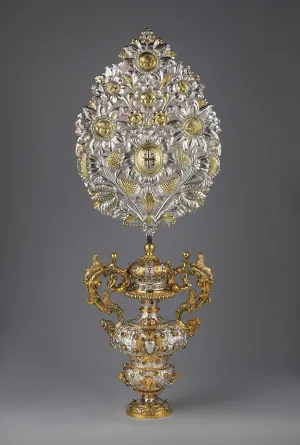
Pietro (ca. 1609–1705), Eutichio (d. 1682), and Sebastiano (d. 1701) Juvarra
Four Vases, ca. 1673
Silver, gilt silver, gilt copper, glass, precious and semi-precious stones
Vases A and B: 42 1/8 × 16 1/8 × 9 5/8 in. (107 × 41 × 24.5 cm); Vase C: 42 1/8 × 14 3/8 × 9 5/8 in. (107 × 36.5 × 24.5 cm); Vase D: 42 1/8 × 14 3/4 × 9 5/8 in. (107 × 37.5 × 24.5 cm)
Terra Sancta Museum, Jerusalem
© The Frick Collection
Related to Six Candlesticks
Part of Altar Setting
A Throne of Eucharistic Exposition is a structure that usually includes an apse in which a monstrance can be placed to display the Holy Sacrament. This example, which arrived in Jerusalem in April 1666, was a gift from Philip IV of Spain (r. 1621–65) but was paid for from the coffers of the Kingdom of Sicily (at the time, Sicily belonged to Spain). It was made by a prominent goldsmith from Messina, Pietro Juvarra, in collaboration with his sons, Eutichio and Sebastiano. The candlesticks and decorative vases with flowers were also produced in Messina by the Juvarra workshop. Embellished with towers and lions—symbols of Castile and Leon (principal regions of Spain)—they are gifts from Philip IV’s son, Charles II (r. 1665–1700), and are used to decorate an altar during a pontifical Mass.
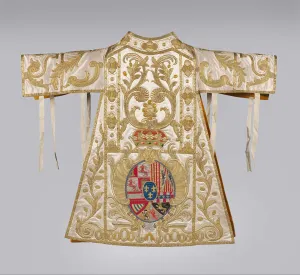
Spain
Dalmatic from the White Pontifical Vestments of Spain, 1758–60
Silk, gold and silver threads
42 1/2 × 51 3/16 in., 6.57 lb. (108 × 130 cm, 2.98 kg)
Terra Sancta Museum, Jerusalem
© The Frick Collection
A pontifical set of vestments of twenty pieces arrived in Jerusalem in June 1760. This was a gift from Ferdinand VI (r. 1746–59) and his wife, Queen Maria Barbara of Portugal. Originally, these were black vestments, with scenes from the Passion of Christ, used on Good Friday at the Holy Sepulcher. In 1885, however, the vestments were sent back to Spain, where the Sisters Adorers of Valencia painstakingly transferred the embroideries onto a new background of white satin. On one side, the vestments present scenes from the Passion of Christ, while on the other, they feature the royal arms of Spain.

Damián de Castro (1716–1793)
Chalice, 1778–80
Gold
H.: 10 5/8 in. (27 cm), base diam.: 4 15/16 (12.6 cm), cup diam.: 3 9/16 in. (9 cm)
Terra Sancta Museum, Jerusalem
© The Frick Collection
Documented as working in Madrid and Córdoba, Damián de Castro y Osorio was the principal Spanish goldsmith of the second half of the eighteenth century. The base of this chalice, which was donated by Spanish benefactors, is decorated with figures of angels holding the instruments of the Passion of Christ and, above, Christ at the Column and Our Lady of Sorrow. A third figure is missing.
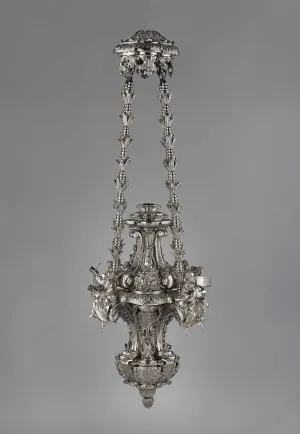
Attributed to Fabio Vendetti
Sanctuary Lamp, 1786
Silver
H. (top of hanging ring) 56 1/2 in. (143.5 cm); h. (top of silver) 52 5/8 in. (133.5 cm); w. 22 1/2 in. (57 cm); d. 22 1/2 in. (57 cm); weight: 90 lb. (40.8 kg)
Terra Sancta Museum, Jerusalem
© The Frick Collection
Inspired by Italian models, this monumental silver sanctuary lamp has no equal among surviving contemporary Spanish works. It may be the work of Fabio Vendetti, an Italian silversmith who, together with his father Antonio, was active in Spain. The lamp is decorated with the coats of arms of the Custody and of the Kingdom of Spain. The four large sculptures around the lamp represent the four Evangelists with their symbols: Matthew (with an angel), Mark (with a lion), Luke (with an ox), and John (with an eagle).