

Republic of Venice
Venice
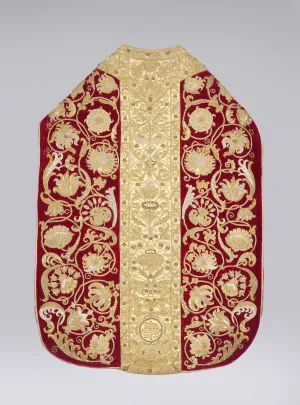
Chasuble from the Pontifical Vestment in Crimson Velvet of Venice, 1669–72
Silk velvet, gold and silver thread, semi-precious stones
48 13/16 × 34 1/16 in., 9.5 lb. (124 × 86.5 cm, 4.31 kg)
Terra Sancta Museum, Jerusalem
© The Frick Collection
Related to Miter from the Pontifical Vestment in Crimson Velvet of Venice
Venice
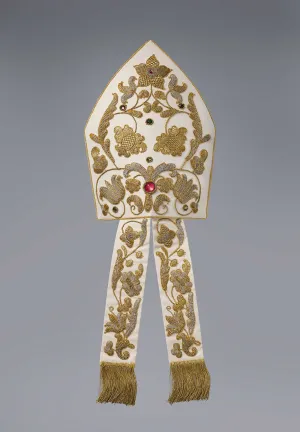
Miter from the Pontifical Vestment in Crimson Velvet of Venice, 1669–72
Silk velvet, gold and silver thread, semi-precious stones
33 7/8 × 13 9/16 in. (86 × 34.5 cm)
Terra Sancta Museum, Jerusalem
© The Frick Collection
Related to Chasuble from the Pontifical Vestment in Crimson Velvet of Venice
Al San Lorenzo Giustinian Workshop
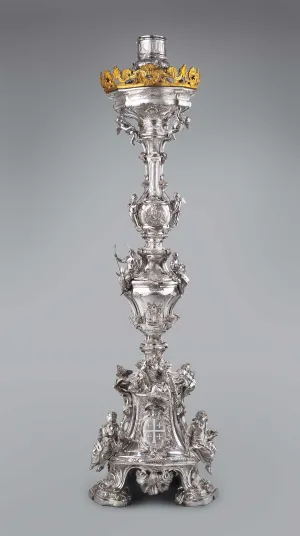
Pair of Torchères, 1762
Silver and gilt silver
Each: 96 1/16 × 27 9/16 × 24 13/16 in. (244 × 70 × 63 cm)
Terra Sancta Museum, Jerusalem
© The Frick Collection
After the Greek Orthodox clergy ransacked the Holy Sepulcher, on April 2, 1757, the Custody managed to recover a number of damaged objects and bought back others that had been stolen. They reclaimed 1,304 ounces of silver from the objects that could not be salvaged. The silver was sent to Venice, where it was used to create new liturgical objects for the Holy Sepulcher, among them, these two torchères. They were produced in one of the most prominent silversmith shops in Venice: al San Lorenzo Giustinian. Venetian workshops were identified by their shop signs (in this case an image of St. Lorenzo Giustinian). The torchères are decorated with reliefs showing scenes from the Passion of Christ and with statuettes of the four Evangelists (most prominently, St. Mark, the patron saint of Venice) and the three Theological Virtues (Hope, Faith, and Charity). They reached Jerusalem on June 23, 1765.