

Court Splendor
Court gowns—reserved for official occasions—were rigid, heavily ornamented, and deliberately antiquated, evoking the splendor of Louis XIV's seventeenth-century reign. One print shows a debutante collecting alms in the Royal Chapel wearing a lavishly embellished court gown, its pulled-back overskirt and train recalling fashions of the late seventeenth and early eighteenth centuries. Another illustrates a robe à la française (French-style dress), also known as a sack-back gown, distinguished by box pleats falling from the shoulders to the floor forming a train. Widespread across Europe, the style became increasingly associated with formal wear at court by the end of the eighteenth century. A third print likely depicts Madame du Barry, Louis XV's official mistress, accompanied by her Bengali servant, Zamor. Although Zamor's pearls and plumes rival the extravagance of his mistress's attire, his livery was imposed rather than chosen. The silver collar bearing her coat of arms underscores the stark power imbalance between them.
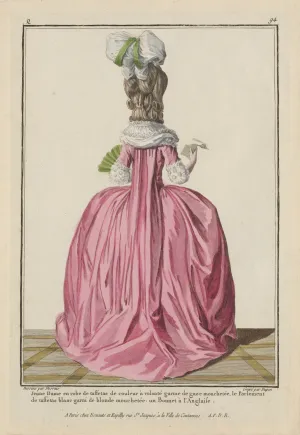
Gallerie des modes et costumes français. 16e Cahier des Costumes Français. 10e Suite d'Habillemens à la mode. Q.94
ca. 1778
Designed by Claude-Louis Desrais (French, Paris 1746–1816); engraved by Nicholas Dupin (French, act. 1776–89)
Hand-colored engraving
Approx. 11 1/2 × 17 in. (29.2 × 43.2 cm)
Frick Art Research Library; Gift of Melinda Martin Sullivan, 2016
Image Frick Digital Studio
Mode à la française
Popular across Europe, the robe à la française (French-style dress), also known as the sack-back gown, features box pleats that fall loosely from the back shoulder to the floor with a train. This example is paired with a collapsible hood inspired by the ruffled collars worn by judges in the French parlement.
Inscription
English: "Young lady in a taffeta gown of any desired color trimmed with speckled gauze, and the white taffeta parlement [drawstring hood] trimmed with speckled blonde lace; a bonnet in the English style."
French: "Jeune Dame en robe de taffetas de couleur à volonté garnie de gaze mouchetée, le Parlement de taffetas blanc garni de blonde mouchetée; un Bonnet à l'Anglaise."

Gallerie des modes et costumes français. 19e Cahier des Costumes Français. 13e Suite d'Habillemens à la mode depuis 1776. T.109
ca. 1779
Designed by Claude-Louis Desrais (French, Paris 1746–1816); Jacques Le Roy (?) (French, b. 1739)
Hand-colored engraving
Approx. 11 1/2 × 17 in. (29.2 × 43.2 cm)
Frick Art Research Library; Gift of Melinda Martin Sullivan, 2016
Image Frick Digital Studio
Mistress and Servant
This image very likely portrays Madame du Barry, Louis XV's official mistress, alongside her Bengali servant Zamor, who was trafficked to France by British slave traders. Despite the similarities of their elaborate ensembles, this plate is a reminder of the stark power imbalance between the two figures: The servant's silver collar bears the lady's coat of arms.
Inscription
English: "A lady of quality whose train is carried by a young Black [servant]: she is coiffed in a kind of pouf decorated with feathers and flowers; with an interlaced ribbon; her hair is encircled by a pearl band with a tassel. Her gown is of plain pink taffeta trimmed with gathered blonde lace adorned with garlands of flowers and interlaced with pinched ribbons. Her Black [servant] is coiffed with a Moorish-style bonnet decorated with pearls and plumes and he wears a silver collar bearing the lady's coat of arms. He is dressed in a coat and waistcoat of blue fabric richly decorated with a double silver braid over a short jacket of fire-colored fabric, similarly braided."
French: "Dame de qualité à qui un jeune negrè porte la queue: elle est coeffée d'une espèce de pouf orné de plumes et de fleurs; avec un ruban entrelassé; les cheveux sont ceints d'une barriere de perles avec un gland. Sa robe est de taffetas rose uni garnie de blonde froncée avec des guirlandes de fleurs et entrelassées de rubans pincés. Son nêgre est coeffé dun bonnet à la moresque orné de perles et de panaches avec un collier d'argent portant les armes de la Dame. Il est vêtu d'un habit et veste fond bleu orné d'un double galon d'argent très riche sur une veste courte fond couleur de feu, aussi galonnée."

Gallerie des modes et costumes français. 27e Cahier de Costumes Français. 21e Suite d'Habillemens à la mode, en 1779. CC.157
ca. 1779
Designed by Pierre-Thomas Le Clerc (French, Paris 1740–1796); engraved by Nicholas Dupin (French, act. 1776–89)
Hand-colored engraving
Approx. 11 1/2 × 17 in. (29.2 × 43.2 cm)
Frick Art Research Library; Gift of Melinda Martin Sullivan, 2016
Image Frick Digital Studio
The Debutant
At once demonstrating her piety and announcing her official entry into society, the woman shown here is collecting alms for the poor during Sunday Mass in the Royal Chapel at Versailles. This was an activity performed by wealthy debutantes in the presence of the king and queen, which is the reason for the formal court dress she wears. Her male companion likewise appears in a formal ensemble made of luxurious materials.
Inscription
English: "Young lady who collects alms: she is dressed in a court gown, of pekin silk, trimmed with gauze interlaced with ribbons and garlands of flowers. The one who accompanies her is dressed in a coat of Gros de Naples silk, embroidered all around with sequins of every color."
French: "Jeune Dame qui quête; elle est vêtue d'une robe de Cour, de Pekin, garnie de gaze entrelassée de rubans et de guirlandes de fleurs. Celui qui la conduit est vêtu d'un habit de Gros de Naples, brodé autour en pailletes de toutes coulrs."