

The Rise of Informal Daywear
In the 1770s, new styles of informal daywear emerged in France. Designed for casual settings, these garments introduced slimmer silhouettes, freer movements, and greater simplicity, and they were typically made from lightweight fabrics. In one print, a woman wears a robe à la polonaise (Polish-style dress) with built-in drawstrings that lift the train into puffy sections. Another woman wears a robe a la circassienne (Circassian-style dress), a more embellished variant of the polonaise. In another image, a woman wears a robe à l'anglaise (English-style dress) with a fitted bodice. A woman taking snuff wears a lévite gown with an open front fastened by a sash. Marie Antoinette particularly favored the lévite style for its comfort during her first pregnancy. By 1782, it had become a staple in her wardrobe. A woman wearing a tucked-up skirt, a taffeta shawl, and a fur muff for winter weather walks down the promenade to attract suitors.
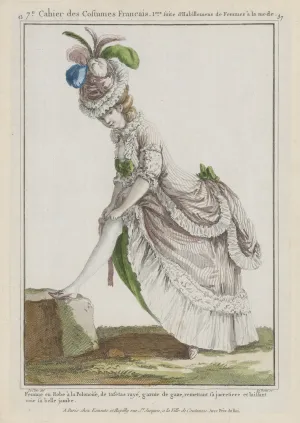
Gallerie des modes et costumes français. 7e Cahier des Costumes français. 1ere Suite d’Habillemens de Femmes à la mode. G.37
ca. 1778
Designed by Pierre-Thomas Le Clerc (French, Paris 1740–1796;) engraved by Pierre Adrien Le Beau (French, Paris, b. 1748)
Hand-colored engraving
Approx. 11 1/2 × 17 in. (29.2 × 43.2 cm)
Frick Art Research Library; Gift of Melinda Martin Sullivan, 2016
Image Frick Digital Studio
The Polonaise
One of the most popular informal daywear styles, the robe à la polonaise (Polish-style dress) is characterized by an overskirt looped up by two ribbons or cords, forming three puffy sections or swags. The style was often made with lightweight fabrics appropriate for casual settings and activities.
Inscription
English: "Woman in a robe à la polonaise, made of striped taffeta, trimmed with gauze, putting on her garter and revealing her beautiful leg."
French: "Femme en Robe à la Polonaise, de taffetas rayé garnie de gaze, remettant sa jarretière et laissant voir sa belle jambe."

Gallerie des modes et costumes français. 13e Cahier des Costumes Français. 7e Suite d'Habillemens à la mode. N.73
ca. 1778
Designed by Pierre-Thomas Le Clerc (French, Paris 1740–1796); engraved by Nicholas Dupin (French, act. 1776–89)
Hand-colored engraving
Approx. 11 1/2 × 17 in. (29.2 × 43.2 cm)
Frick Art Research Library; Gift of Melinda Martin Sullivan, 2016
Image Frick Digital Studio
The Circassienne
A variation of the robe à la polonaise, the robe à la circassienne (Circassian-style dress) had no direct link to traditional garments from Circassia, a historical region in Eastern Europe. Rather, it reflected the French fascination with the imagery of Circassian women, celebrated beauties in the harems of the Ottoman Empire.
Inscription
English: "This robe à la circassienne of a new style, is made of sulfur-colored gauze, the trim is made of soft lilac gauze; the large flounce and the band that run through the trimming are made of the same gauze as the dress, as is the fabric of the sabot sleeves; only the piped bands on the trimming are lilac, along with the lilac ribbons, even the one in the headdress."
French: "Cette Robe à la Circassienne d'un nouveau gout, est de gaze couleur de soufre, la garniture de gaze lilas tendre; le grand falbala et le bandeau qui règne dans la garniture est la même gaze que la robe, le fond des sabot aussi; il n'y a que les bandes de garnitures à tuyaux qui soient lilas, les rubans lilas, même celui de la coëffure."
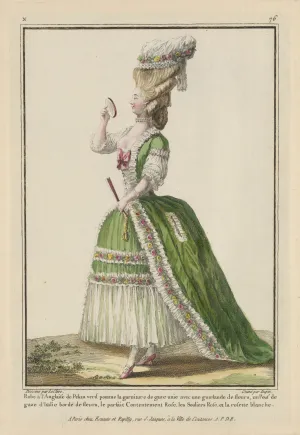
Gallerie des modes et costumes français. 13e Cahier des Costumes Français. 7e Suite d'Habillemens à la mode. N.76
ca. 1778
Designed by Pierre-Thomas Le Clerc (French, Paris 1740–1796); engraved by Nicholas Dupin (French, act. 1776–89)
Hand-colored engraving
Approx. 11 1/2 × 17 in. (29.2 × 43.2 cm)
Frick Art Research Library; Gift of Melinda Martin Sullivan, 2016
Image Frick Digital Studio
The Anglaise
This robe à l'anglaise (English-style dress), defined by the fitted back of the bodice, is made of a type of silk called pekin, alluding to the fabric's Chinese origin. The front of the overskirt is clasped together by a bow that fashion merchants called "the perfect contentment." On the side is a pocket slit, which allows the wearer to reach the separate tie-on pouch under the skirt (instead of the sewn-in pockets in menswear).
Inscription
English: "Robe à l'anglaise of apple-green pekin silk trimmed with plain gauze and a garland of flowers, a pouf of Italian gauze edged with flowers, the pink parfait contentement [bow], pink shoes, and the white rosette."
French: "Robe à l'Anglaise de Pekin verd pomme la garniture de gaze unie avec une guirlande de fleurs, un Pouf de gaze d'Italie bordé de fleurs, le parfait Contentement Rose, les Souliers Rose, et la rosette blanche."

Gallerie des modes et costumes français. 28e Cahier de Costumes Français. 22e Suite d'Habillemens à la mode, en 1780. DD.163
ca. 1780
Designed by Pierre-Thomas Le Clerc (French, Paris 1740–1796); engraved by Nicholas Dupin (French, act. 1776–89)
Hand-colored engraving
Approx. 11 1/2 × 17 in. (29.2 × 43.2 cm)
Frick Art Research Library; Gift of Melinda Martin Sullivan, 2016
Image Frick Digital Studio
The Lévite
A lightweight gown tied at the waist with a sash, the lévite was inspired by Ottoman kaftans and by the costumes of actresses playing Jewish priestesses in eighteenth-century performances of Jean Racine's biblical play Athalie. The lévite was favored by Marie Antoinette during her pregnancy, and the style at one point made up a significant portion of her wardrobe.
Inscription
English: "Lévite-style gown decorated with tassels, epaulettes and cords: the matching skirt is edged with a band of a different color, blonde lace around the lévite and along both edges of the skirt trimming. The hat is made of white gauze, and adorned with a black gauze pouf, encircled with black lace and a colored ribbon."
French: "Habit en Lévite enrichi de glands, d'epauletes et cordonets: la juppe parielle bordée d'une bande de différente couleur, une blonde autour du Lévite et aux deux bords de la garniture du juppon. Le chapeau de gaze blanche, et garni en pouf de gaze noire, ceint de dentelle noire et d'un ruban de couleur."

Gallerie des modes et costumes français. 47e Cahier de Costumes Français. 42e Suite d'Habillemens à la mode, en 1785. CCC.295
ca. 1785
Designed by François Louis Joseph Watteau (French, Valenciennes 1758–1823); engraved by Nicholas Dupin (French, act. 1776–89)
Hand-colored engraving
Approx. 11 1/2 × 17 in. (29.2 × 43.2 cm)
Frick Art Research Library; Gift of Melinda Martin Sullivan, 2016
Image Frick Digital Studio
The Nymph
The 1784 play The Marriage of Figaro by Pierre-Augustin Caron de Beaumarchais became a popular source of fashion inspiration. The woman here wears a wide-brimmed hat inspired by the costume of the pageboy character, Cherubino. The caption goes beyond the description of the garments to emphasize the public nature of fashionable dress, intended to impress spectators and attract suitors.
Inscription
English: "The slender-waisted nymph under the appearance of going out alone in winter in a public promenade, casts her eyes about to find someone who might give her some new pleasure and prevent boredom from taking hold of her: she is wearing a hat called à la Chérubin and a morning dress with a white muff of Siberian sheep hair."
French: "La Nymphe à la taille légère sous l'apparence de sortir seule pour s'hyverner dans une promenade publique, jette les yeux de part et d'autre pour trouver quelqu'un qui puisse lui donner quelque nouvel agrément et empêcher l'ennui de s'emparer d'elle: elle est en chapeau à la Chérubin et en robe du matin avec un manchon blanc de poil de mouton de Sibérie."