

Checklist

Gallerie des modes et costumes français. 6e Cahier de Modes Françaises pour les Coeffures, despuis 1776. F.31
ca. 1778
Designer unknown
Hand-colored engraving
Approx. 11 1/2 × 17 in. (29.2 × 43.2 cm)
Frick Art Research Library; Gift of Melinda Martin Sullivan, 2016
Image Frick Digital Studio
Pouf of the Day
A pouf is a towering coiffure composed variously of wire, gauze, pomatum (a styling ointment), and often false hair mixed with the wearer's own hair. Poufs could be inspired by contemporary events, such as when the French frigate La Junon captured the British Navy's Fox in 1778 (top left image), and at times they took playful names, such as the hérisson (hedgehog) style (top right image).
Inscription
English: "New hairstyle called The Frigate la Junon; Hérisson in a new style decorated with feathers, flowers, and ribbons with tassels; 'Knight's Cross' bun topped with a bonnet with a kerchief edged with pearls; Bun tied in three parts, topped with a bonnet with a kerchief."
French: "Nouvelle Coëffure dite la Frégate la Junon; Hérisson d'un nouveau gout orné de plumes fleurs et rubans avec des glands; Chignon en Croix de Chevalier surmonté d'un Bonnet au fichu bordé de perles; Chignon noué en trois parts, surmonté d'un Bonnet au fichu."
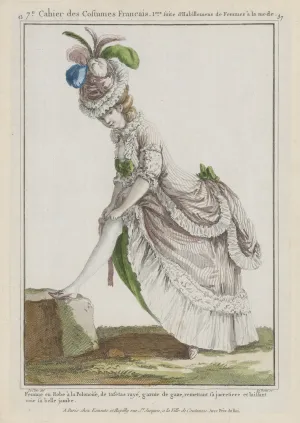
Gallerie des modes et costumes français. 7e Cahier des Costumes français. 1ere Suite d’Habillemens de Femmes à la mode. G.37
ca. 1778
Designed by Pierre-Thomas Le Clerc (French, Paris 1740–1796;) engraved by Pierre Adrien Le Beau (French, Paris, b. 1748)
Hand-colored engraving
Approx. 11 1/2 × 17 in. (29.2 × 43.2 cm)
Frick Art Research Library; Gift of Melinda Martin Sullivan, 2016
Image Frick Digital Studio
The Polonaise
One of the most popular informal daywear styles, the robe à la polonaise (Polish-style dress) is characterized by an overskirt looped up by two ribbons or cords, forming three puffy sections or swags. The style was often made with lightweight fabrics appropriate for casual settings and activities.
Inscription
English: "Woman in a robe à la polonaise, made of striped taffeta, trimmed with gauze, putting on her garter and revealing her beautiful leg."
French: "Femme en Robe à la Polonaise, de taffetas rayé garnie de gaze, remettant sa jarretière et laissant voir sa belle jambe."
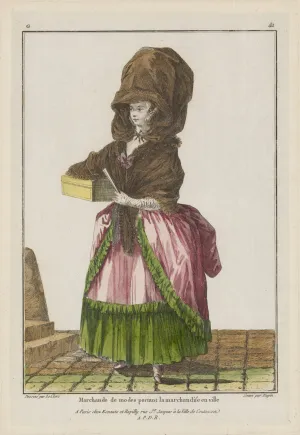
Gallerie des modes et costumes français. 7e Cahier des Costumes français. 1ere Suite d'Habillemens de Femmes à la mode. G.41
ca. 1778
Designed by Pierre-Thomas Le Clerc (French, Paris 1740–1796); engraved by Nicholas Dupin (French, act. 1776–89)
Hand-colored engraving
Approx. 11 1/2 × 17 in. (29.2 × 43.2 cm)
Frick Art Research Library; Gift of Melinda Martin Sullivan, 2016
Image Frick Digital Studio
Fashion Merchant
Fashion merchants were predominantly working-class women who often wore the costly fashions they hoped to sell. Such public exposure subjected the merchants to moral scrutiny. The merchant pictured here carries a box of her wares while wearing a taffeta hood that protects her pouf, as well as silk mittens and a bracelet, also for sale.
Inscription
English: "Fashion merchant carrying merchandise in town."
French: "Marchande de modes portant la marchandise en ville."
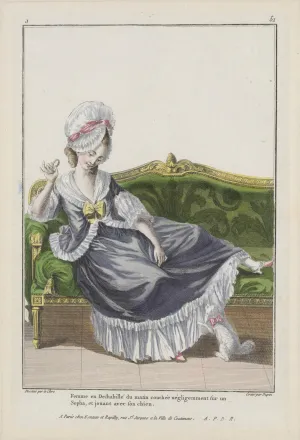
Gallerie des modes et costumes français. 9e Cahier des Costumes Français. 3e Suite d'Habillemens à la mode. J.51
ca. 1778
Designed by Pierre-Thomas Le Clerc (French, Paris 1740–1796); engraved by Nicholas Dupin (French, act. 1776–89)
Hand-colored engraving
Approx. 11 1/2 × 17 in. (29.2 × 43.2 cm)
Frick Art Research Library; Gift of Melinda Martin Sullivan, 2016
Image Frick Digital Studio
A Lady and Her Dog
The déshabillé du matin (morning negligee) is a form of undress, or informal attire, that consists of a caraco—a thigh-length jacket inspired by the garments of working-class women—and a loose gown of lightweight taffeta suitable for lounging.
Inscription
English: "Lady in a déshabillé du matin reclining casually on the sofa, and playing with her dog."
French: "Femme en Deshabillé du matin couchée négligemment sur un Sopha, et jouant avec son chien."

Gallerie des modes et costumes français. 12e Cahier des Costumes Français. 6e Suite d'Habillemens à la mode, en 1778. M.67
ca. 1778
Designed by Pierre-Thomas Le Clerc (French, Paris 1740–1796); engraved by Nicholas Dupin (French, act. 1776–89)
Hand-colored engraving
Approx. 11 1/2 × 17 in. (29.2 × 43.2 cm)
Frick Art Research Library; Gift of Melinda Martin Sullivan, 2016
Image Frick Digital Studio
At the Toilette
The hairdresser powders his client's hair with a puff, transforming the brunette into a blonde. To pass the time, the woman is reading a book, L'art d'aimer (The Art of Loving). Likely a translation of Ovid's Ars Amatoria, this book signals her sophistication and possibly hints at a romantic rendezvous.
Inscription
English: "Young lady having her hair freshly done; she is in a dressing gown and her very soft yellow gauze skirt, the hairdresser is in a slightly powdered red jacket, black breeches and gray silk stockings."
French: "Jeune Dame se faisant coëffer à neuf; elle est en peignoir et sa juppe de gaze d'un jaune très tendre, Le Coëffeur en veste rouge un peu poudrée, culotte noire et bas de soie gris."

Gallerie des modes et costumes français. 13e Cahier des Costumes Français. 7e Suite d'Habillemens à la mode. N.73
ca. 1778
Designed by Pierre-Thomas Le Clerc (French, Paris 1740–1796); engraved by Nicholas Dupin (French, act. 1776–89)
Hand-colored engraving
Approx. 11 1/2 × 17 in. (29.2 × 43.2 cm)
Frick Art Research Library; Gift of Melinda Martin Sullivan, 2016
Image Frick Digital Studio
The Circassienne
A variation of the robe à la polonaise, the robe à la circassienne (Circassian-style dress) had no direct link to traditional garments from Circassia, a historical region in Eastern Europe. Rather, it reflected the French fascination with the imagery of Circassian women, celebrated beauties in the harems of the Ottoman Empire.
Inscription
English: "This robe à la circassienne of a new style, is made of sulfur-colored gauze, the trim is made of soft lilac gauze; the large flounce and the band that run through the trimming are made of the same gauze as the dress, as is the fabric of the sabot sleeves; only the piped bands on the trimming are lilac, along with the lilac ribbons, even the one in the headdress."
French: "Cette Robe à la Circassienne d'un nouveau gout, est de gaze couleur de soufre, la garniture de gaze lilas tendre; le grand falbala et le bandeau qui règne dans la garniture est la même gaze que la robe, le fond des sabot aussi; il n'y a que les bandes de garnitures à tuyaux qui soient lilas, les rubans lilas, même celui de la coëffure."
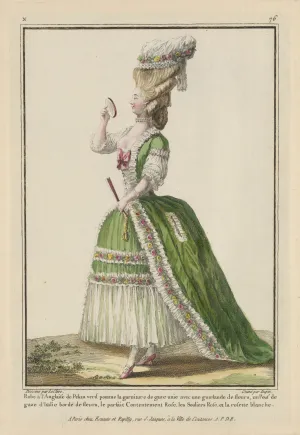
Gallerie des modes et costumes français. 13e Cahier des Costumes Français. 7e Suite d'Habillemens à la mode. N.76
ca. 1778
Designed by Pierre-Thomas Le Clerc (French, Paris 1740–1796); engraved by Nicholas Dupin (French, act. 1776–89)
Hand-colored engraving
Approx. 11 1/2 × 17 in. (29.2 × 43.2 cm)
Frick Art Research Library; Gift of Melinda Martin Sullivan, 2016
Image Frick Digital Studio
The Anglaise
This robe à l'anglaise (English-style dress), defined by the fitted back of the bodice, is made of a type of silk called pekin, alluding to the fabric's Chinese origin. The front of the overskirt is clasped together by a bow that fashion merchants called "the perfect contentment." On the side is a pocket slit, which allows the wearer to reach the separate tie-on pouch under the skirt (instead of the sewn-in pockets in menswear).
Inscription
English: "Robe à l'anglaise of apple-green pekin silk trimmed with plain gauze and a garland of flowers, a pouf of Italian gauze edged with flowers, the pink parfait contentement [bow], pink shoes, and the white rosette."
French: "Robe à l'Anglaise de Pekin verd pomme la garniture de gaze unie avec une guirlande de fleurs, un Pouf de gaze d'Italie bordé de fleurs, le parfait Contentement Rose, les Souliers Rose, et la rosette blanche."

Gallerie des modes et costumes français. 14e Cahier des Costumes Français. 8e Suite d'Habillemens à la mode. O.80
ca. 1778
Designed by Pierre-Thomas Le Clerc (French, Paris 1740–1796); engraved by Charles Emmanuel (Jean Baptiste) Patas (French, Paris 1744–1802)
Hand-colored engraving
Approx. 11 1/2 × 17 in. (29.2 × 43.2 cm)
Frick Art Research Library; Gift of Melinda Martin Sullivan, 2016
Image Frick Digital Studio
Court Splendor
The rigid formality and antiquated design of the habit or robe de cour (court dress) evoked the splendor of Louis XIV's reign in the seventeenth century, when the style first flourished. Featuring a boned bodice, exaggerated panniers (hoop-like undergarments), and luxurious materials, this example worn by Marie Antoinette (identified by her royal crest on the chair) served as a symbol of status and power.
Inscription
English: "Habit de cour of cherry satin, the head ribbon of the same fabric, the gauze visible at the righthand corner is black, the diamonds, pearls, and ribbon around the neckline are white, as are the tassels of the draped mantle, the lace in certain areas takes on a bit of the fabric color, the armchair is made with violet fabric, and the coat of arms is shown according to its proper enamels [heraldic colors], all the rest is in gold; the foot rug is multicolored."
French: "Habit de Cour de Satin Cerise, le ruban de tête de même, le coin de gaze qui se voit au côte droit est noir, les diamants, perles et ruban du tour de gorge blancs, ainsi que les glands du manteau troussé, les dentelles tirent un peu dans certaine partie sur la teinte du sond, le fond du sauteuil violet, et les armes selon leurs émaux, tout le reste or; le tapis de pied de toutes couleurs."
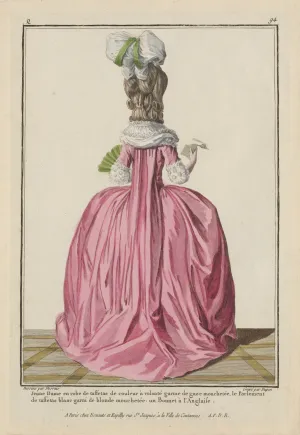
Gallerie des modes et costumes français. 16e Cahier des Costumes Français. 10e Suite d'Habillemens à la mode. Q.94
ca. 1778
Designed by Claude-Louis Desrais (French, Paris 1746–1816); engraved by Nicholas Dupin (French, act. 1776–89)
Hand-colored engraving
Approx. 11 1/2 × 17 in. (29.2 × 43.2 cm)
Frick Art Research Library; Gift of Melinda Martin Sullivan, 2016
Image Frick Digital Studio
Mode à la française
Popular across Europe, the robe à la française (French-style dress), also known as the sack-back gown, features box pleats that fall loosely from the back shoulder to the floor with a train. This example is paired with a collapsible hood inspired by the ruffled collars worn by judges in the French parlement.
Inscription
English: "Young lady in a taffeta gown of any desired color trimmed with speckled gauze, and the white taffeta parlement [drawstring hood] trimmed with speckled blonde lace; a bonnet in the English style."
French: "Jeune Dame en robe de taffetas de couleur à volonté garnie de gaze mouchetée, le Parlement de taffetas blanc garni de blonde mouchetée; un Bonnet à l'Anglaise."

Gallerie des modes et costumes français. 19e Cahier des Costumes Français. 13e Suite d'Habillemens à la mode depuis 1776. T.109
ca. 1779
Designed by Claude-Louis Desrais (French, Paris 1746–1816); Jacques Le Roy (?) (French, b. 1739)
Hand-colored engraving
Approx. 11 1/2 × 17 in. (29.2 × 43.2 cm)
Frick Art Research Library; Gift of Melinda Martin Sullivan, 2016
Image Frick Digital Studio
Mistress and Servant
This image very likely portrays Madame du Barry, Louis XV's official mistress, alongside her Bengali servant Zamor, who was trafficked to France by British slave traders. Despite the similarities of their elaborate ensembles, this plate is a reminder of the stark power imbalance between the two figures: The servant's silver collar bears the lady's coat of arms.
Inscription
English: "A lady of quality whose train is carried by a young Black [servant]: she is coiffed in a kind of pouf decorated with feathers and flowers; with an interlaced ribbon; her hair is encircled by a pearl band with a tassel. Her gown is of plain pink taffeta trimmed with gathered blonde lace adorned with garlands of flowers and interlaced with pinched ribbons. Her Black [servant] is coiffed with a Moorish-style bonnet decorated with pearls and plumes and he wears a silver collar bearing the lady's coat of arms. He is dressed in a coat and waistcoat of blue fabric richly decorated with a double silver braid over a short jacket of fire-colored fabric, similarly braided."
French: "Dame de qualité à qui un jeune negrè porte la queue: elle est coeffée d'une espèce de pouf orné de plumes et de fleurs; avec un ruban entrelassé; les cheveux sont ceints d'une barriere de perles avec un gland. Sa robe est de taffetas rose uni garnie de blonde froncée avec des guirlandes de fleurs et entrelassées de rubans pincés. Son nêgre est coeffé dun bonnet à la moresque orné de perles et de panaches avec un collier d'argent portant les armes de la Dame. Il est vêtu d'un habit et veste fond bleu orné d'un double galon d'argent très riche sur une veste courte fond couleur de feu, aussi galonnée."

Gallerie des modes et costumes français. 27e Cahier de Costumes Français. 21e Suite d'Habillemens à la mode, en 1779. CC.157
ca. 1779
Designed by Pierre-Thomas Le Clerc (French, Paris 1740–1796); engraved by Nicholas Dupin (French, act. 1776–89)
Hand-colored engraving
Approx. 11 1/2 × 17 in. (29.2 × 43.2 cm)
Frick Art Research Library; Gift of Melinda Martin Sullivan, 2016
Image Frick Digital Studio
The Debutant
At once demonstrating her piety and announcing her official entry into society, the woman shown here is collecting alms for the poor during Sunday Mass in the Royal Chapel at Versailles. This was an activity performed by wealthy debutantes in the presence of the king and queen, which is the reason for the formal court dress she wears. Her male companion likewise appears in a formal ensemble made of luxurious materials.
Inscription
English: "Young lady who collects alms: she is dressed in a court gown, of pekin silk, trimmed with gauze interlaced with ribbons and garlands of flowers. The one who accompanies her is dressed in a coat of Gros de Naples silk, embroidered all around with sequins of every color."
French: "Jeune Dame qui quête; elle est vêtue d'une robe de Cour, de Pekin, garnie de gaze entrelassée de rubans et de guirlandes de fleurs. Celui qui la conduit est vêtu d'un habit de Gros de Naples, brodé autour en pailletes de toutes coulrs."

Gallerie des modes et costumes français. 28e Cahier de Costumes Français. 22e Suite d'Habillemens à la mode, en 1780. DD.163
ca. 1780
Designed by Pierre-Thomas Le Clerc (French, Paris 1740–1796); engraved by Nicholas Dupin (French, act. 1776–89)
Hand-colored engraving
Approx. 11 1/2 × 17 in. (29.2 × 43.2 cm)
Frick Art Research Library; Gift of Melinda Martin Sullivan, 2016
Image Frick Digital Studio
The Lévite
A lightweight gown tied at the waist with a sash, the lévite was inspired by Ottoman kaftans and by the costumes of actresses playing Jewish priestesses in eighteenth-century performances of Jean Racine's biblical play Athalie. The lévite was favored by Marie Antoinette during her pregnancy, and the style at one point made up a significant portion of her wardrobe.
Inscription
English: "Lévite-style gown decorated with tassels, epaulettes and cords: the matching skirt is edged with a band of a different color, blonde lace around the lévite and along both edges of the skirt trimming. The hat is made of white gauze, and adorned with a black gauze pouf, encircled with black lace and a colored ribbon."
French: "Habit en Lévite enrichi de glands, d'epauletes et cordonets: la juppe parielle bordée d'une bande de différente couleur, une blonde autour du Lévite et aux deux bords de la garniture du juppon. Le chapeau de gaze blanche, et garni en pouf de gaze noire, ceint de dentelle noire et d'un ruban de couleur."

Gallerie des modes et costumes français. 31e Cahier de Costumes Français. 24e Suite d'Habillemens à la mode, en 1780. GG.183
ca. 1780
Designed by Pierre-Thomas Le Clerc (French, Paris 1740–1796); engraved by Nicholas Dupin (French, act. 1776–89)
Hand-colored engraving
Approx. 11 1/2 × 17 in. (29.2 × 43.2 cm)
Frick Art Research Library; Gift of Melinda Martin Sullivan, 2016
Image Frick Digital Studio
Anglomania
The double-breasted redingote was the French adaptation of the full-length English riding coat, originally designed for horseback travel in the countryside. Its popularity in the eighteenth century reflected the French admiration for the comfort and practicality of British tailoring, as well as for British culture in general.
Inscription
English: "English-style redingote with three collars and Bavarian-style trimmings."
French: "Redingote angloise à trois colets et bavaroise."
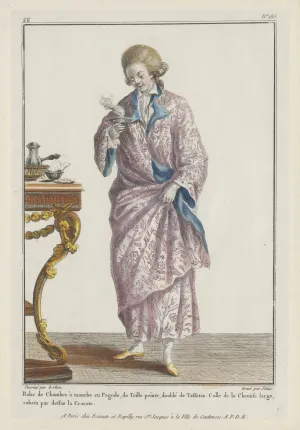
Gallerie des modes et costumes français. 31e Cahier de Costumes Français. 24e Suite d'Habillemens à la mode, en 1780. GG.185
ca. 1780
Designed by Pierre-Thomas Le Clerc (French, Paris 1740–1796); engraved by Charles Emmanuel (Jean Baptiste) Patas (French, Paris 1744–1802)
Hand-colored engraving
Approx. 11 1/2 × 17 in. (29.2 × 43.2 cm)
Frick Art Research Library; Gift of Melinda Martin Sullivan, 2016
Image Frick Digital Studio
Hot Chocolate at Home
The robe de chambre (dressing gown) likely originated in Asia, as suggested by its kimono-like silhouette, funnel-shaped sleeves, and the use of decorative fabrics with floral motifs associated with India or China. Casually gathering his robe by the waist, the man is shown enjoying hot chocolate, a delicacy in eighteenth-century France.
Inscription
English: "Robe de chambre with pagoda sleeves, made of painted toile, lined with taffeta. Wide shirt collar, folded over the cravat."
French: "Robe de Chambre à manche en Pagode, de Toille peinte, doublé de Taffetas. Colle de la Chemise large, rabatu par dessus la Cravate."

Gallerie des modes et costumes français. 32e Cahier de Costumes Français. 25e Suite d'Habillemens à la mode, en 1780. HH.190
ca. 1780
Designed by Pierre-Thomas Le Clerc (French, Paris 1740–1796); engraved by Charles Emmanuel (Jean Baptiste) Patas (French, Paris 1744–1802)
Hand-colored engraving
Approx. 11 1/2 × 17 in. (29.2 × 43.2 cm)
Frick Art Research Library; Gift of Melinda Martin Sullivan, 2016
Image Frick Digital Studio
Girls and Dolls
Children's wear of this period often mirrored adult fashions. The girl's hat, adorned with a bouquet of white plumes—an emblem of Henry IV of France—was inspired by costumes worn at Louis XVI's court balls honoring Henry IV's reign. The girl holds a fashion doll (called a pandora or poupée) dressed in a miniature version of the latest fashion sent by dressmakers to their clients as design models.
Inscription
English: "The little girl seen from the front is dressed in a taffeta frock trimmed with gauze; she has a gauze apron, her frock is made in the English style; a 'Henry IV'–style hat. The other little girl has a woolen frock turned up in the Polish style. The little boy is dressed as an ordinary sailor with rolled up sleeves."
French: "La petite Fille vue de face est vétue d'un Foureau de Tafetas garni de Gaze elle a un Tablier de Gaze son Foureau est fait à l'anglaise; Chapeau à la Henry-quatre. L'autre petite Fille a un Foureau de Burat retroussé à la polonaise. Le petit Garçon en Matelot simple et les Manches retroussées."

Gallerie des modes et costumes français. 37e Cahier des Costumes Français. 29e Suite d'Habillemens à la mode, en 1781. NN.211
ca. 1781
Designed by Pierre-Thomas Le Clerc (French, Paris 1740–1796); engraved by Nicholas Dupin (French, act. 1776–89)
Hand-colored engraving
Approx. 11 1/2 × 17 in. (29.2 × 43.2 cm)
Frick Art Research Library; Gift of Melinda Martin Sullivan, 2016
Image Frick Digital Studio
Muted Elegance
After the death of a royal, the whole nation was expected to observe the grand deuil de cour (full-court mourning)—a mandated mourning dress code—for up to a year (depending on the rank of the deceased). During that time, no colors or jewelry could be worn. This dress code had three stages. Initially, one must wear non-reflective black clothes of wool or poplin for several months (as shown here). This was to be followed by clothes of black silk or satin. The final stage was one of half-mourning wherein black and white garments were allowed.
Inscription
English: "Dress fitted for grand deuil de cour and tied headdress. Following the etiquette the dress is made of raz de Saint-Maur fabric trimmed with gauze drapery ornamented with ribbons over ruffled crepe fabric."
French: "Grand deuil de Cour ajusté et la Coëfe nouée Selon l'etiquette la robbe est de Raz de S. Maur garnie de Gaze en draperie nouée de rubans sur un fond de Crêpe bouilloné."

Gallerie des modes et costumes français. 37e Cahier des Costumes Français. 29e Suite d'Habillemens à la mode, en 1781. NN.212
ca. 1781
Designed by Pierre-Thomas Le Clerc (French, Paris 1740–1796); engraved by Etienne Claude Voysard (French, Paris 1746–1812)
Hand-colored engraving
Approx. 11 1/2 × 17 in. (29.2 × 43.2 cm)
Frick Art Research Library; Gift of Melinda Martin Sullivan, 2016
Image Frick Digital Studio
Man in Black
Guidelines for appropriate mourning attire for members of society at various removes from the royal family were continually updated in journals and almanacs, making mourning a major sartorial event. Men were required to wear black ensembles made of wool during the first stage of full court mourning (as shown here), in addition to pleureuses (literally, mourners)—bands of white linen or cambric—around their sleeve cuffs, as well as strips of black crepe fabric around their hats and swords.
Inscription
English: "Grand deuïl de cour, large pleureuse and tie, woolen stockings, black sword and buckles, crepe fabric on the hat and the sword."
French: "Grand Deuïl de Cour, grand pleureuse et cravate, bas de laine, épéc et boucles noires, crêpe au Chapeau et à l'épée."
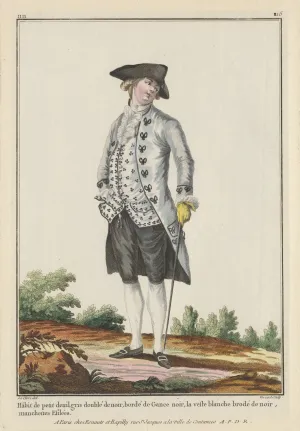
Gallerie des modes et costumes français. 37e Cahier des Costumes Français. 29e Suite d'Habillemens à la mode, en 1781. NN.215
ca. 1781
Designed by Pierre-Thomas Le Clerc (French, Paris 1740–1796); engraved by Etienne Claude Voysard (French, Paris 1746–1812)
Hand-colored engraving
Approx. 11 1/2 × 17 in. (29.2 × 43.2 cm)
Frick Art Research Library; Gift of Melinda Martin Sullivan, 2016
Image Frick Digital Studio
Mourning in Style
Compared to the black attire of full mourning, half-mourning dress was more embellished, incorporating white and gray textiles and decoration. Even though prolonged periods of court mourning significantly undermined the production and sale of colored textiles and jewelry, dressmakers and merchants found ways to innovate, especially during half mourning, when restrictions were relaxed and greater variety was allowed.
Inscription
English: "Petit deuil garment, made of gray fabric lined with black fabric, edged with black cord, the white waistcoat is embroidered with black decorations, frayed cuffs."
French: "Hâbit de petit deuil, gris doublé de noir, bordé de Gance noir, la veste blanche brodé de noir, manchettes Efilées."
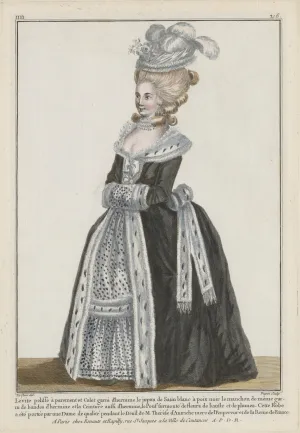
Gallerie des modes et costumes français. 37e Cahier des Costumes Français. 29e Suite d'Habillemens à la mode, en 1781. NN.216
ca. 1781
Designed by Pierre-Thomas Le Clerc (French, Paris 1740–1796); engraved by Nicholas Dupin (French, act. 1776–89)
Hand-colored engraving
Approx. 11 1/2 × 17 in. (29.2 × 43.2 cm)
Frick Art Research Library; Gift of Melinda Martin Sullivan, 2016
Image Frick Digital Studio
A Vision in Emine
The death of Empress Maria Theresa on November 29, 1780, was followed by six months of court mourning. Working within the confines of mourning etiquette, dressmakers created black and white clothes with fashionable cuts and luxurious trimmings for the half-mourning stage in the cold months, such as this lévite-style coat decked out in ermine fur.
Inscription
English: "Lévite-style pelisse with ornaments and collar trimmed with ermine; petticoat of white satin with black dots; muff of the same satin trimmed with bands of ermine and the belt is also made of ermine. The pouf is topped with cambric flowers and feathers. This gown was worn by a lady of quality during the mourning for Maria Theresa of Austria, mother of the [Austrian] Emperor and the Queen of France."
French: "Lévite pelisse à parement et Colet garni d'hermine le jupon de Satin blanc à poix noir le manchon de même garni de bandes d'hermine et la Ceinture aussi d'hermine, le Pouf surmounté de fleurs de batiste et de plumes. Cette Robe a été portée par une Dame de qualité pendant le Deuïl de M. Thérèse d'Autriche mere de l'Empereur et de la Reine de France."

Gallerie des modes et costumes français. 39e Cahier des Costumes Français. 10e Suite des Coeffures à la mode, en 1781. PP.223
ca. 1781
Designer unknown
Hand-colored engraving
Approx. 11 1/2 × 17 in. (29.2 × 43.2 cm)
Frick Art Research Library; Gift of Melinda Martin Sullivan, 2016
Image Frick Digital Studio
Hats Galore
Similar to eighteenth-century hairstyles, hat designs drew inspiration from a wide range of sources. Many of the hats shown here were named after the regions where the styles emerged. Around the mid-1780s, towering poufs gradually fell out of fashion, and curls were loosened and lowered, while wide-brimmed hats became the focal point of headdress.
Inscription
English: "Gallant hat with kerchief à la Mirza [in a style associated with Persia or Central Asia]; Hat in a new style known as à la St. Léger in the County of Chiny [today in Belgium]; New hat in the style called à la Longwy near Luxembourg; Hat in a style called à la Granville in the Duchy of Bar [present-day Lorraine, in eastern France]; Hat said to be à l'Augustine [in the manner of an Augustinian nun]; Hat said to be à l'Épernaise [Épernay] in the province of Champagne; Hat in the style called à la Berthelot otherwise called à la Comtoise [from the region of Franche-Comté]; Hat described as à la Jeannot des Variétés amusantes [based on the character of Janot, from the play Janot, ou Les Battus Paient l'Amende, first performed in 1779 at the Théâtre des Variétés Amusantes in Paris]; Neapolitan-style hat; the same hat seen from the front; Hat called à l'Alexandrine [potentially a reference to Alexandria in Egypt]; Hat in the style of an Amazon; Straw hat called à la Bergère [in the style of a shepherdess]; Hat in the Irish style; Hat said to be à la Colinette galante [in the style of an elegant shepherdess]; Hat called à l'Anglomane [in the English style]."
French: "Chapeau galant avec un fichu à la Mirza; Chapeau d'un nouveau gout dit à la St. Leger dans le Comte de Chini; Chapeau nouveau dit à la Longwi près de Luxembourg; Chapeau à la Granville dans le Duché de Bar; Chapeau à l'Augustine; Chapeau à l'Epernaise province de Champagne; Chapeau à la Berthelot autrement dit à la Comtoise; Chapeau à la Jeannot des Varietés amusantes; Chapeau à la Napolitaine; le même Chapeau vu de face; Chapeau à l'Alexandrine; Chapeau à l'Amazone; Chapeau de paille dit à la Bergere; Chapeau à l'Irlandaise; Chapeau à la Colinette galante; Chapeau à l'Anglomane."

Gallerie des modes et costumes français. 39e Cahier des Costumes Français. 34e Suite d'Habillemens les plus à la mode. 252
ca. 1783
Designed by Pierre-Thomas Le Clerc (French, Paris 1740–1796); engraved by Jean-François Janinet (French, Paris 1752–1814)
Hand-colored engraving
Approx. 11 1/2 × 17 in. (29.2 × 43.2 cm)
Frick Art Research Library; Gift of Melinda Martin Sullivan, 2016
Image Frick Digital Studio
The Masquerade
Particularly popular in eighteenth-century France, the masquerade, or masked ball, drew large crowds and gave rise to a specific type of garment called the domino. A full-length, hooded silk gown that covers the clothes beneath entirely, a domino preserves the anonymity of the man or woman who wears it.
Inscription
English: "Lady dressed in a very elegant large domino for going to the masquerade."
French: "Dame habillée en grand Domino très élégant pour aller au Bal masqué."

Gallerie des modes et costumes français. 43e Cahier de Costumes Français. 38e Suite d'Habillemens à la mode, en 1784. ZZ.276
ca. 1784
Designed by François Louis Joseph Watteau (French, Valenciennes 1758–1823); engraved by Nicholas Dupin (French, act. 1776–89)
Hand-colored engraving
Approx. 11 1/2 × 17 in. (29.2 × 43.2 cm)
Frick Art Research Library; Gift of Melinda Martin Sullivan, 2016
Image Frick Digital Studio
Perfect Love
The voluminous skirt of the seated lady is scrunched up in the back—the reality of wearing glamorous gowns in the eighteenth century. While savoring her "perfect love," a type of sweet liquor, she shows off her luscious curls. Her hairstyle was inspired by Louise Contat, a trendsetting actress who rose to fame playing the lead role in the play The Marriage of Figaro in 1784.
Inscription
English: "A voluptuous beauty, consuming parfait amour in turn with ices, while waiting for pleasures more worthy of her; her hair is made up in the style called à la Contat, and her dress is in the English style."
French: "La Beauté voluptueuse, prenant alternativement du parfait amour et des glaces, en attendant des plaisirs plus dignes d'elle; sa coëffure est à la Contat, et sa robe à l'Angloise."

Gallerie des modes et costumes français. 41e Cahier de Costumes Français. 36e Suite d'Habillemens à la mode, en 1784. XX.262
ca. 1784
Designed by Pierre-Thomas Le Clerc (French, Paris 1740–1796); engraved by Nicholas Dupin (French, act. 1776–89)
Hand-colored engraving
Approx. 11 1/2 × 17 in. (29.2 × 43.2 cm)
Frick Art Research Library; Gift of Melinda Martin Sullivan, 2016
Image Frick Digital Studio
The Queen's Chemise
Chemise à la Reine (the queen's chemise) is a type of informal dress popularized by Marie Antoinette. The one-piece white muslin gown, worn in the summer for comfort and ease of movement, originated from the lightweight garments worn by European women and free women of color in the French Caribbean colonies, designed to withstand the tropical climate.
Inscription
English: "Chemise à la Reine seen from behind. This woman has a kerchief-mantle on her shoulders, she is wearing a flat hat topped with a feather, her hair is half made up with two ponytails, the belt is made of black velvet."
French: "Chemise à la Reine vue par derriere. Cette femme a sur les épaules un fichu-mantelet, elle est coëffé d'un chapeau plat surmonté d'une plume, les cheveux en négligé et deux catogans, la cinture est de velour noir."

Gallerie des modes et costumes français. 47e Cahier de Costumes Français. 42e Suite d'Habillemens à la mode, en 1785. CCC.295
ca. 1785
Designed by François Louis Joseph Watteau (French, Valenciennes 1758–1823); engraved by Nicholas Dupin (French, act. 1776–89)
Hand-colored engraving
Approx. 11 1/2 × 17 in. (29.2 × 43.2 cm)
Frick Art Research Library; Gift of Melinda Martin Sullivan, 2016
Image Frick Digital Studio
The Nymph
The 1784 play The Marriage of Figaro by Pierre-Augustin Caron de Beaumarchais became a popular source of fashion inspiration. The woman here wears a wide-brimmed hat inspired by the costume of the pageboy character, Cherubino. The caption goes beyond the description of the garments to emphasize the public nature of fashionable dress, intended to impress spectators and attract suitors.
Inscription
English: "The slender-waisted nymph under the appearance of going out alone in winter in a public promenade, casts her eyes about to find someone who might give her some new pleasure and prevent boredom from taking hold of her: she is wearing a hat called à la Chérubin and a morning dress with a white muff of Siberian sheep hair."
French: "La Nymphe à la taille légère sous l'apparence de sortir seule pour s'hyverner dans une promenade publique, jette les yeux de part et d'autre pour trouver quelqu'un qui puisse lui donner quelque nouvel agrément et empêcher l'ennui de s'emparer d'elle: elle est en chapeau à la Chérubin et en robe du matin avec un manchon blanc de poil de mouton de Sibérie."