

The Fashion Industry
In addition to documenting contemporary ensembles, Gallerie des modes illustrates the people and practices that shaped the fashion industry. For example, a hairdresser carefully powders his client's hair, transforming the brunette into the then more desirable blonde; a fashion merchant is pictured walking in town while modeling the costly garments and accessories she hopes to sell, including openwork silk mittens and an oversized brown taffeta hood protecting her coiffure, as well as a box of trimmings for gowns and headwear. Another print shows children playing with what may be a fashion doll—known as a pandora or poupée—dressed in a miniature version of the latest style. Such dolls were sent by boutiques to clients as design models and fabric samples. Fashion plates such as those in Gallerie des modes provided a more efficient way to disseminate fashion trends and paved the way for the advent of fashion magazines in the 1780s.
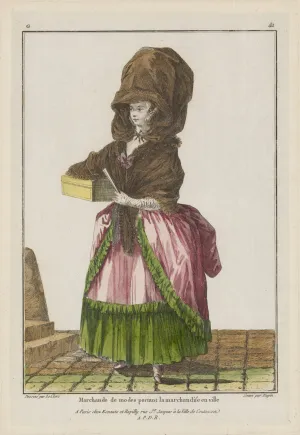
Gallerie des modes et costumes français. 7e Cahier des Costumes français. 1ere Suite d'Habillemens de Femmes à la mode. G.41
ca. 1778
Designed by Pierre-Thomas Le Clerc (French, Paris 1740–1796); engraved by Nicholas Dupin (French, act. 1776–89)
Hand-colored engraving
Approx. 11 1/2 × 17 in. (29.2 × 43.2 cm)
Frick Art Research Library; Gift of Melinda Martin Sullivan, 2016
Image Frick Digital Studio
Fashion Merchant
Fashion merchants were predominantly working-class women who often wore the costly fashions they hoped to sell. Such public exposure subjected the merchants to moral scrutiny. The merchant pictured here carries a box of her wares while wearing a taffeta hood that protects her pouf, as well as silk mittens and a bracelet, also for sale.
Inscription
English: "Fashion merchant carrying merchandise in town."
French: "Marchande de modes portant la marchandise en ville."

Gallerie des modes et costumes français. 12e Cahier des Costumes Français. 6e Suite d'Habillemens à la mode, en 1778. M.67
ca. 1778
Designed by Pierre-Thomas Le Clerc (French, Paris 1740–1796); engraved by Nicholas Dupin (French, act. 1776–89)
Hand-colored engraving
Approx. 11 1/2 × 17 in. (29.2 × 43.2 cm)
Frick Art Research Library; Gift of Melinda Martin Sullivan, 2016
Image Frick Digital Studio
At the Toilette
The hairdresser powders his client's hair with a puff, transforming the brunette into a blonde. To pass the time, the woman is reading a book, L'art d'aimer (The Art of Loving). Likely a translation of Ovid's Ars Amatoria, this book signals her sophistication and possibly hints at a romantic rendezvous.
Inscription
English: "Young lady having her hair freshly done; she is in a dressing gown and her very soft yellow gauze skirt, the hairdresser is in a slightly powdered red jacket, black breeches and gray silk stockings."
French: "Jeune Dame se faisant coëffer à neuf; elle est en peignoir et sa juppe de gaze d'un jaune très tendre, Le Coëffeur en veste rouge un peu poudrée, culotte noire et bas de soie gris."

Gallerie des modes et costumes français. 32e Cahier de Costumes Français. 25e Suite d'Habillemens à la mode, en 1780. HH.190
ca. 1780
Designed by Pierre-Thomas Le Clerc (French, Paris 1740–1796); engraved by Charles Emmanuel (Jean Baptiste) Patas (French, Paris 1744–1802)
Hand-colored engraving
Approx. 11 1/2 × 17 in. (29.2 × 43.2 cm)
Frick Art Research Library; Gift of Melinda Martin Sullivan, 2016
Image Frick Digital Studio
Girls and Dolls
Children's wear of this period often mirrored adult fashions. The girl's hat, adorned with a bouquet of white plumes—an emblem of Henry IV of France—was inspired by costumes worn at Louis XVI's court balls honoring Henry IV's reign. The girl holds a fashion doll (called a pandora or poupée) dressed in a miniature version of the latest fashion sent by dressmakers to their clients as design models.
Inscription
English: "The little girl seen from the front is dressed in a taffeta frock trimmed with gauze; she has a gauze apron, her frock is made in the English style; a 'Henry IV'–style hat. The other little girl has a woolen frock turned up in the Polish style. The little boy is dressed as an ordinary sailor with rolled up sleeves."
French: "La petite Fille vue de face est vétue d'un Foureau de Tafetas garni de Gaze elle a un Tablier de Gaze son Foureau est fait à l'anglaise; Chapeau à la Henry-quatre. L'autre petite Fille a un Foureau de Burat retroussé à la polonaise. Le petit Garçon en Matelot simple et les Manches retroussées."