

Mourning in Style
Mourning was a significant sartorial event in eighteenth-century France. After the death of a royal, the whole nation was expected to observe the grand deuil de cour (full court mourning), a mandated dress code that could last for more than a year, depending on the rank of the deceased. During this time, wearing colors or jewelry was strictly prohibited. Full mourning unfolded in three stages. Initially, mourners were required to wear plain, non-reflective black garments made of wool or poplin for several months. This was followed by a second stage of black silk or satin attire. In the final stage, known as petit deuil (half-mourning), black-and-white garments and embellishments were permitted. Although mourning clothes were supposed to be solemn and unadorned, such garments were clearly influenced by fashionable styles of the day.

Gallerie des modes et costumes français. 37e Cahier des Costumes Français. 29e Suite d'Habillemens à la mode, en 1781. NN.211
ca. 1781
Designed by Pierre-Thomas Le Clerc (French, Paris 1740–1796); engraved by Nicholas Dupin (French, act. 1776–89)
Hand-colored engraving
Approx. 11 1/2 × 17 in. (29.2 × 43.2 cm)
Frick Art Research Library; Gift of Melinda Martin Sullivan, 2016
Image Frick Digital Studio
Muted Elegance
After the death of a royal, the whole nation was expected to observe the grand deuil de cour (full-court mourning)—a mandated mourning dress code—for up to a year (depending on the rank of the deceased). During that time, no colors or jewelry could be worn. This dress code had three stages. Initially, one must wear non-reflective black clothes of wool or poplin for several months (as shown here). This was to be followed by clothes of black silk or satin. The final stage was one of half-mourning wherein black and white garments were allowed.
Inscription
English: "Dress fitted for grand deuil de cour and tied headdress. Following the etiquette the dress is made of raz de Saint-Maur fabric trimmed with gauze drapery ornamented with ribbons over ruffled crepe fabric."
French: "Grand deuil de Cour ajusté et la Coëfe nouée Selon l'etiquette la robbe est de Raz de S. Maur garnie de Gaze en draperie nouée de rubans sur un fond de Crêpe bouilloné."

Gallerie des modes et costumes français. 37e Cahier des Costumes Français. 29e Suite d'Habillemens à la mode, en 1781. NN.212
ca. 1781
Designed by Pierre-Thomas Le Clerc (French, Paris 1740–1796); engraved by Etienne Claude Voysard (French, Paris 1746–1812)
Hand-colored engraving
Approx. 11 1/2 × 17 in. (29.2 × 43.2 cm)
Frick Art Research Library; Gift of Melinda Martin Sullivan, 2016
Image Frick Digital Studio
Man in Black
Guidelines for appropriate mourning attire for members of society at various removes from the royal family were continually updated in journals and almanacs, making mourning a major sartorial event. Men were required to wear black ensembles made of wool during the first stage of full court mourning (as shown here), in addition to pleureuses (literally, mourners)—bands of white linen or cambric—around their sleeve cuffs, as well as strips of black crepe fabric around their hats and swords.
Inscription
English: "Grand deuïl de cour, large pleureuse and tie, woolen stockings, black sword and buckles, crepe fabric on the hat and the sword."
French: "Grand Deuïl de Cour, grand pleureuse et cravate, bas de laine, épéc et boucles noires, crêpe au Chapeau et à l'épée."
Gallerie des modes et costumes français. 37e Cahier des Costumes Français. 29e Suite d'Habillemens à la mode, en 1781. NN.215
ca. 1781
Designed by Pierre-Thomas Le Clerc (French, Paris 1740–1796); engraved by Etienne Claude Voysard (French, Paris 1746–1812)
Hand-colored engraving
Approx. 11 1/2 × 17 in. (29.2 × 43.2 cm)
Frick Art Research Library; Gift of Melinda Martin Sullivan, 2016
Image Frick Digital Studio
Mourning in Style
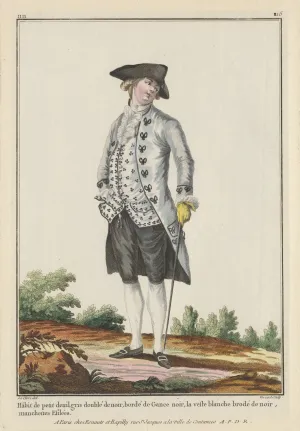
Compared to the black attire of full mourning, half-mourning dress was more embellished, incorporating white and gray textiles and decoration. Even though prolonged periods of court mourning significantly undermined the production and sale of colored textiles and jewelry, dressmakers and merchants found ways to innovate, especially during half mourning, when restrictions were relaxed and greater variety was allowed.
Inscription
English: "Petit deuil garment, made of gray fabric lined with black fabric, edged with black cord, the white waistcoat is embroidered with black decorations, frayed cuffs."
French: "Hâbit de petit deuil, gris doublé de noir, bordé de Gance noir, la veste blanche brodé de noir, manchettes Efilées."
Gallerie des modes et costumes français. 37e Cahier des Costumes Français. 29e Suite d'Habillemens à la mode, en 1781. NN.216
ca. 1781
Designed by Pierre-Thomas Le Clerc (French, Paris 1740–1796); engraved by Nicholas Dupin (French, act. 1776–89)
Hand-colored engraving
Approx. 11 1/2 × 17 in. (29.2 × 43.2 cm)
Frick Art Research Library; Gift of Melinda Martin Sullivan, 2016
Image Frick Digital Studio
A Vision in Emine
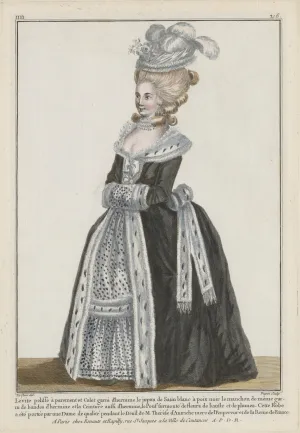
The death of Empress Maria Theresa on November 29, 1780, was followed by six months of court mourning. Working within the confines of mourning etiquette, dressmakers created black and white clothes with fashionable cuts and luxurious trimmings for the half-mourning stage in the cold months, such as this lévite-style coat decked out in ermine fur.
Inscription
English: "Lévite-style pelisse with ornaments and collar trimmed with ermine; petticoat of white satin with black dots; muff of the same satin trimmed with bands of ermine and the belt is also made of ermine. The pouf is topped with cambric flowers and feathers. This gown was worn by a lady of quality during the mourning for Maria Theresa of Austria, mother of the [Austrian] Emperor and the Queen of France."
French: "Lévite pelisse à parement et Colet garni d'hermine le jupon de Satin blanc à poix noir le manchon de même garni de bandes d'hermine et la Ceinture aussi d'hermine, le Pouf surmounté de fleurs de batiste et de plumes. Cette Robe a été portée par une Dame de qualité pendant le Deuïl de M. Thérèse d'Autriche mere de l'Empereur et de la Reine de France."