

Fashion and Culture
Gallerie des modes offers not only invaluable insights into diverse styles of the time but also a vivid window onto French culture and daily life. In one print, a woman dressed in a morning negligee teases her dog with a gimblette (a ring-shaped biscuit). The sensual composition and suggestive pose of the woman recall Rococo depictions of women in their boudoirs. Another lady is shown eating ice cream and sipping "perfect love," a type of sweet liquor, and a man wearing a pink robe de chambre (dressing gown) is shown enjoying hot chocolate, a delicacy at the time. A woman enveloped in a full-length hooded cloak known as a domino makes her way to a masquerade while a man strolls outdoors in an English-style redingote, a riding coat that speaks to the French fascination with all things British at the time.
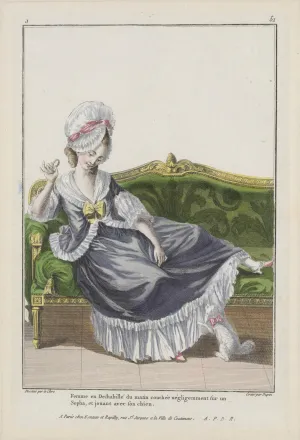
Gallerie des modes et costumes français. 9e Cahier des Costumes Français. 3e Suite d'Habillemens à la mode. J.51
ca. 1778
Designed by Pierre-Thomas Le Clerc (French, Paris 1740–1796); engraved by Nicholas Dupin (French, act. 1776–89)
Hand-colored engraving
Approx. 11 1/2 × 17 in. (29.2 × 43.2 cm)
Frick Art Research Library; Gift of Melinda Martin Sullivan, 2016
Image Frick Digital Studio
A Lady and Her Dog
The déshabillé du matin (morning negligee) is a form of undress, or informal attire, that consists of a caraco—a thigh-length jacket inspired by the garments of working-class women—and a loose gown of lightweight taffeta suitable for lounging.
Inscription
English: "Lady in a déshabillé du matin reclining casually on the sofa, and playing with her dog."
French: "Femme en Deshabillé du matin couchée négligemment sur un Sopha, et jouant avec son chien."

Gallerie des modes et costumes français. 31e Cahier de Costumes Français. 24e Suite d'Habillemens à la mode, en 1780. GG.183
ca. 1780
Designed by Pierre-Thomas Le Clerc (French, Paris 1740–1796); engraved by Nicholas Dupin (French, act. 1776–89)
Hand-colored engraving
Approx. 11 1/2 × 17 in. (29.2 × 43.2 cm)
Frick Art Research Library; Gift of Melinda Martin Sullivan, 2016
Image Frick Digital Studio
Anglomania
The double-breasted redingote was the French adaptation of the full-length English riding coat, originally designed for horseback travel in the countryside. Its popularity in the eighteenth century reflected the French admiration for the comfort and practicality of British tailoring, as well as for British culture in general.
Inscription
English: "English-style redingote with three collars and Bavarian-style trimmings."
French: "Redingote angloise à trois colets et bavaroise."
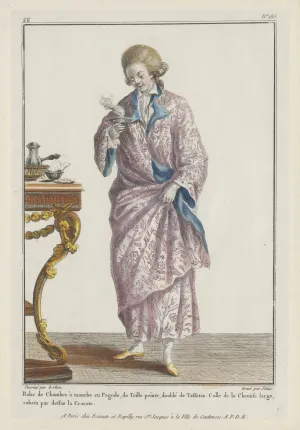
Gallerie des modes et costumes français. 31e Cahier de Costumes Français. 24e Suite d'Habillemens à la mode, en 1780. GG.185
ca. 1780
Designed by Pierre-Thomas Le Clerc (French, Paris 1740–1796); engraved by Charles Emmanuel (Jean Baptiste) Patas (French, Paris 1744–1802)
Hand-colored engraving
Approx. 11 1/2 × 17 in. (29.2 × 43.2 cm)
Frick Art Research Library; Gift of Melinda Martin Sullivan, 2016
Image Frick Digital Studio
Hot Chocolate at Home
The robe de chambre (dressing gown) likely originated in Asia, as suggested by its kimono-like silhouette, funnel-shaped sleeves, and the use of decorative fabrics with floral motifs associated with India or China. Casually gathering his robe by the waist, the man is shown enjoying hot chocolate, a delicacy in eighteenth-century France.
Inscription
English: "Robe de chambre with pagoda sleeves, made of painted toile, lined with taffeta. Wide shirt collar, folded over the cravat."
French: "Robe de Chambre à manche en Pagode, de Toille peinte, doublé de Taffetas. Colle de la Chemise large, rabatu par dessus la Cravate."

Gallerie des modes et costumes français. 39e Cahier des Costumes Français. 34e Suite d'Habillemens les plus à la mode. 252
ca. 1783
Designed by Pierre-Thomas Le Clerc (French, Paris 1740–1796); engraved by Jean-François Janinet (French, Paris 1752–1814)
Hand-colored engraving
Approx. 11 1/2 × 17 in. (29.2 × 43.2 cm)
Frick Art Research Library; Gift of Melinda Martin Sullivan, 2016
Image Frick Digital Studio
The Masquerade
Particularly popular in eighteenth-century France, the masquerade, or masked ball, drew large crowds and gave rise to a specific type of garment called the domino. A full-length, hooded silk gown that covers the clothes beneath entirely, a domino preserves the anonymity of the man or woman who wears it.
Inscription
English: "Lady dressed in a very elegant large domino for going to the masquerade."
French: "Dame habillée en grand Domino très élégant pour aller au Bal masqué."

Gallerie des modes et costumes français. 43e Cahier de Costumes Français. 38e Suite d'Habillemens à la mode, en 1784. ZZ.276
ca. 1784
Designed by François Louis Joseph Watteau (French, Valenciennes 1758–1823); engraved by Nicholas Dupin (French, act. 1776–89)
Hand-colored engraving
Approx. 11 1/2 × 17 in. (29.2 × 43.2 cm)
Frick Art Research Library; Gift of Melinda Martin Sullivan, 2016
Image Frick Digital Studio
Perfect Love
The voluminous skirt of the seated lady is scrunched up in the back—the reality of wearing glamorous gowns in the eighteenth century. While savoring her "perfect love," a type of sweet liquor, she shows off her luscious curls. Her hairstyle was inspired by Louise Contat, a trendsetting actress who rose to fame playing the lead role in the play The Marriage of Figaro in 1784.
Inscription
English: "A voluptuous beauty, consuming parfait amour in turn with ices, while waiting for pleasures more worthy of her; her hair is made up in the style called à la Contat, and her dress is in the English style."
French: "La Beauté voluptueuse, prenant alternativement du parfait amour et des glaces, en attendant des plaisirs plus dignes d'elle; sa coëffure est à la Contat, et sa robe à l'Angloise."